📖 Read more: Digital Currency: The End of Cash
📦 A Revolution That's Here to Stay
In 2013, Jeff Bezos showed a video on “60 Minutes” of an Amazon drone delivering a package. Most people laughed. “Science fiction,” they said. “Legally impossible,” others added. Ten years later, nobody's laughing anymore.
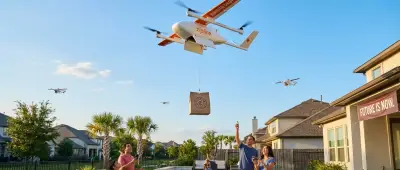
Today, Amazon Prime Air, Wing (an Alphabet/Google subsidiary), Zipline, and dozens of other companies are making thousands of autonomous deliveries every day. And this is only the beginning.
🏢 The Players Changing the Game
⚔️ Drone vs Human: The Hard Comparison
Why are companies investing billions to replace human couriers? The cost difference is stark:
Drone Delivery
- Cost: $0.25-0.50 per delivery
- Speed: 10-30 minutes
- Availability: 24/7/365
- Address errors: 0.01%
- Package theft: Near zero
- CO₂ emissions: 97% lower
- Traffic accidents: 0
- Breaks/time off: Not needed
Human Delivery
- Cost: $5-15 per delivery
- Speed: 30-120 minutes
- Availability: Business hours
- Address errors: 2-5%
- Package theft: 1.7M/year in the US
- CO₂ emissions: Baseline
- Traffic accidents: Thousands/year
- Breaks/time off: Mandatory
"Industry analysts predict widespread drone delivery adoption within five years, not decades."
🔧 How Autonomous Delivery Works
Today's delivery drones pack more computing power than a laptop from five years ago. Here's what happens from the moment you hit "Buy":
1. Order Processing (0-30 seconds)
AI analyzes the order, confirms availability, calculates weight, and selects the optimal drone and route.
📖 Read more: EHang: The First Flying Taxi Already Flies in China
2. Automated Loading (30-90 seconds)
Robotic arms place the package onto the drone. Zero human contact. The system verifies weight, center of gravity, and cargo security.
3. Takeoff & Navigation
The drone takes off vertically (VTOL), ascends to an “air corridor” (typically 150-400 feet), and flies autonomously using:
- GPS for general positioning
- LiDAR and cameras for obstacle avoidance
- AI for dynamic route recalculation
- V2V communication with other drones
4. Approach & Delivery
The drone identifies the exact drop-off location (yard, balcony, landing pad). It lowers the package on a tether or lands at a safe spot. Cameras confirm delivery. The customer receives a photo of their package in place.
5. Return & Recharge
The drone returns to the hub, lands at a charging station, and is ready for its next mission. Batteries are automatically swapped in 2 minutes.
The Role of Artificial Intelligence
AI doesn't just pilot the drone — it manages the entire fleet. It predicts demand by area, optimizes routes for hundreds of drones simultaneously, flags maintenance issues before anything breaks, and learns from every flight to get better. Learn more in our AI category.
📅 The Revolution Timeline
🇬🇷 What Does This Mean for Greece?
Greece's geography creates perfect conditions for drone delivery:
- Islands: 6,000+ islands, many with limited access. Drones can transport medicine, samples, and emergency supplies in minutes instead of hours or days.
- Mountainous regions: Villages with poor road access — ideal for aerial delivery.
- Tourism: Deliveries to hotels, villas, and yachts — a premium service with high profit margins.
- Great weather: 300+ sunny days per year = fewer weather-related disruptions.
Pilot programs for medical supply transport are already underway in the Dodecanese and Cyclades islands. The first commercial deliveries are expected by 2027.
📖 Read more: Electric Planes: Zero-Emission Flights
⚠️ The Human Cost: What Happens to Couriers?
A Hard Truth
Globally, millions of people work as delivery drivers — from FedEx couriers to Wolt gig workers. Automation directly threatens these jobs. The displacement will be swift and painful for many workers.
Proponents argue that:
- New jobs will be created (drone technicians, operators, programmers)
- Workers can be retrained
- The delivery market is growing — there's room for everyone
Critics counter that:
- New positions require skills that current workers don't have
- Retraining is expensive and time-consuming
- Companies will keep the profits, not share them
Government response will determine whether this transition creates new opportunities or mass unemployment.
🛡️ Safety & Regulations
Drones fly over our heads. What if something falls? What if they get hacked? Regulatory authorities worldwide are working overtime:
- FAA (USA): Mandatory Remote ID — every drone broadcasts its identity
- EASA (EU): Risk-based drone categorization, mandatory insurance
- Air corridors: Designated routes for drones, away from airports and crowds
- Fault tolerance: Drones must be able to land safely even if something fails
- Cybersecurity: Encrypted communications, hijacking protection
🔮 The Future: What Comes Next?
Drones are just the beginning. Consider:
- Autonomous ground robots: Starship Technologies already has small robots delivering on college campuses
- Underground networks: Magway in London is designing tubes for autonomous package transport
- Self-driving vehicles: Nuro, Waymo, and others are testing autonomous delivery cars
- All of the above combined: A package could start by drone, transfer to an autonomous vehicle, and be delivered by a ground robot — without a single human touching it
Just as electric hydrofoils are transforming sea transport and electric vehicles are reshaping the roads, drones are poised to conquer the skies. The future of delivery won't ring your doorbell — it'll land on your balcony.