📖 Read more: Glass Data Storage: 10,000 Years (Microsoft)
What Is DNA Data Storage?
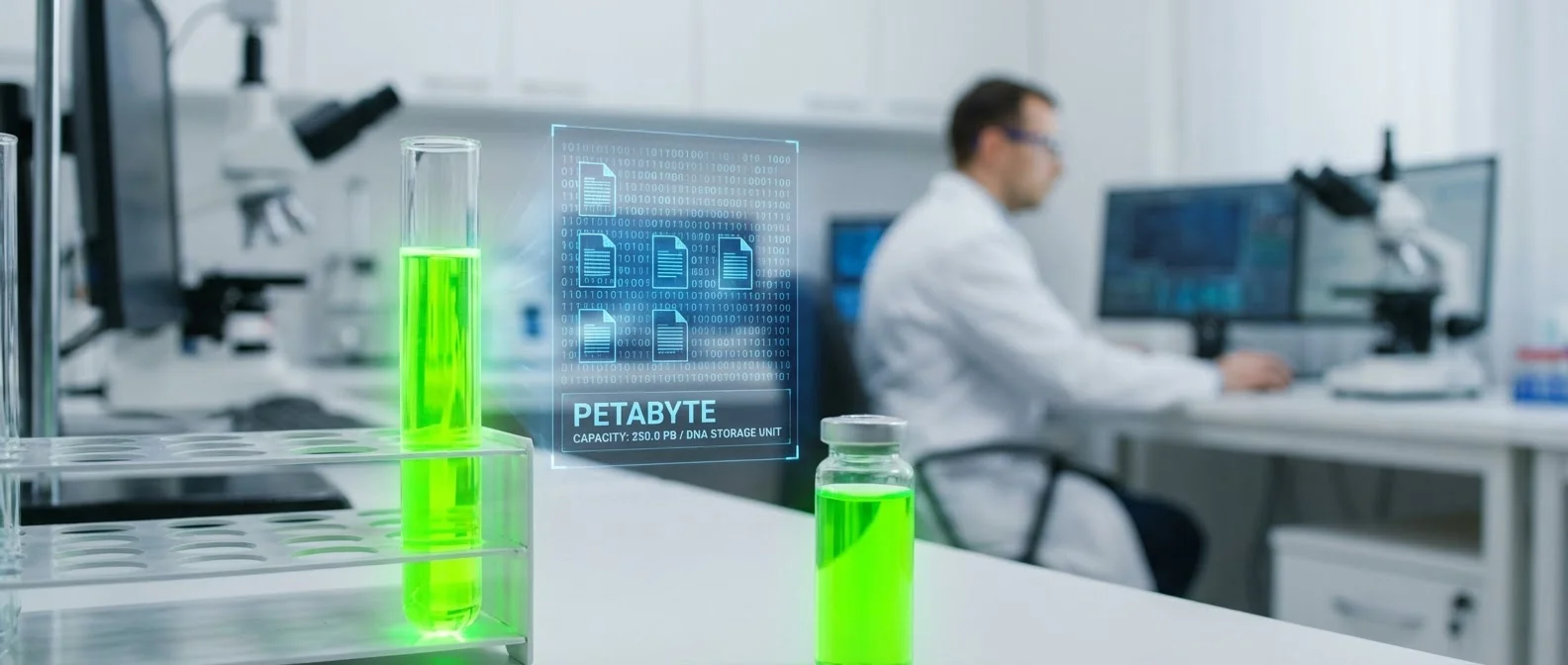
DNA digital data storage is the process of encoding and decoding binary data into synthetic strands of deoxyribonucleic acid. Instead of magnetic disks or flash memory, information is stored in the four bases of DNA: Adenine (A), Thymine (T), Guanine (G), and Cytosine (C).
The idea is elegantly simple: instead of 0s and 1s, we use four “letters” (A, T, G, C). Binary data is first converted to a ternary (base 3) system, and each digit is mapped to a nucleotide. Specialized algorithms avoid base repeats (homopolymers) that cause errors during sequencing.
🧬 Why DNA?
A single gram of DNA can theoretically store 215 petabytes of data — meaning all the world's data could fit in a small room. By comparison, a 1TB hard drive weighs about 100 grams. DNA is millions of times more dense in storage capacity. Better yet, it needs no power to maintain — just cool, dark conditions.
History of a Radical Idea
“DNA could store all the world's data in a single room.”
How It Works: From Bits to Bases
The encoding process follows these steps:
1. Binary data conversion: Original data (0s and 1s) is converted to a ternary system (0, 1, 2). Each “trit” is mapped to a nucleotide (A, T, G, or C), depending on the previous nucleotide in the sequence — to avoid homopolymers.
2. DNA synthesis: Machines “print” nucleotides into short oligonucleotides (200-300 bases). Data is divided into segments with overlapping sequences for redundancy and error correction (e.g., Reed-Solomon codes).
3. Storage: The DNA molecules are stored in lyophilized (freeze-dried) form at room temperature, or encapsulated in silica glass spheres for long-term preservation without any energy input.
4. Reading: Decoding is performed via DNA sequencing — the same technology used for genome mapping. Error correction algorithms reassemble the original file.
DNA of Things: Biological Memory in Objects
In 2019, researchers from Israel and Switzerland (Yaniv Erlich, Robert Grass) introduced the concept of "DNA of Things" (DoT). Rather than Internet of Things, objects carry their own information embedded in DNA within the material itself.
As proof of concept, they 3D-printed a Stanford Bunny (a plastic rabbit) containing its own design files (blueprint) encoded in DNA within the plastic. By cutting a small piece from the ear, they were able to amplify and decode the data — and print a new copy. Objects that reproduce themselves, like biological organisms.
The Lunar Library
That same year (2019), the Arch Mission Foundation placed the “Lunar Library” aboard Israel's Beresheet lunar lander. The library contained 20 books and 10,000 images encoded in DNA, along with files on nickel discs. Although the lander crashed on the Moon in April 2019, the DNA most likely survived — the density and durability of DNA means the information could remain readable for billions of years.
The Challenge: Cost and Speed
Despite its impressive capabilities, DNA storage faces two major obstacles:
Cost: In 2017, synthesizing 2MB of data cost $7,000 and reading it cost $2,000. By comparison, a 1TB hard drive costs $30-50. However, DNA synthesis costs are dropping exponentially — following a curve similar to Moore's Law.
Speed: Writing reaches 1 Mbps (2021, CATALOG) — thousands of times slower than an SSD. Reading via sequencing takes hours or days. This makes DNA ideal only for “cold storage” — archival storage of data that doesn't require frequent access.
💡 Random Access
Until recently, reading DNA meant decoding all stored data. In 2018, Microsoft and the University of Washington demonstrated random access — the ability to retrieve specific files without decoding the entire dataset. Without this breakthrough, DNA storage would remain trapped in the lab.
Future Applications
Archival storage: Governments, libraries, and enterprises can archive cultural, legal, and scientific data in DNA for centuries with zero energy maintenance cost.
Cryptography & steganography: “DNA of Things” enables hidden information in objects — contact lenses containing encrypted messages, or 3D-printed objects carrying secret data.
Space missions: The Lunar Library demonstrates that DNA can preserve information in extraterrestrial environments — ideal for colonies on the Moon or Mars.
Medicine: Writing medical records directly into patient cells via CRISPR — in the future, every cell could carry a complete medical history.
Microsoft & Writing to DNA
Microsoft leads the commercial race for DNA storage. In partnership with the University of Washington, the company has achieved multiple milestones: 200 MB storage (2018), a fully automated write-read system (2019), and random access. The goal: a commercial “DNA drive” system to replace tape drives in data centers within the decade.
According to estimates, if the cost of DNA synthesis continues its exponential decline (as it has for the past 20 years), the technology will become economically competitive for long-term storage by 2030-2035.
"All the data humanity has ever produced throughout its entire history would fit in a few grams of DNA."
The Davos Bitcoin Challenge
To prove the technology works, Nick Goldman of the European Bioinformatics Institute presented a challenge at the World Economic Forum (2015): test tubes of DNA containing the private key to a Bitcoin. Three years later, Belgian PhD student Sander Wuyts decoded the DNA and claimed the Bitcoin — proving that data can be reliably stored in and retrieved from DNA.
What Lies Ahead?
DNA storage remains experimental, but the core technology works. Data centers worldwide consume 1-2% of the planet's energy, a percentage rapidly growing due to AI. A DNA-based cold storage system could eliminate this energy footprint for data that doesn't require frequent access (estimated at over 60% of data center data being “cold”).
Nature has been storing information in DNA for 3.8 billion years. Now we're learning to do the same — with digital data. That droplet on your fingertip? It could hold more data than Google's largest server farm.