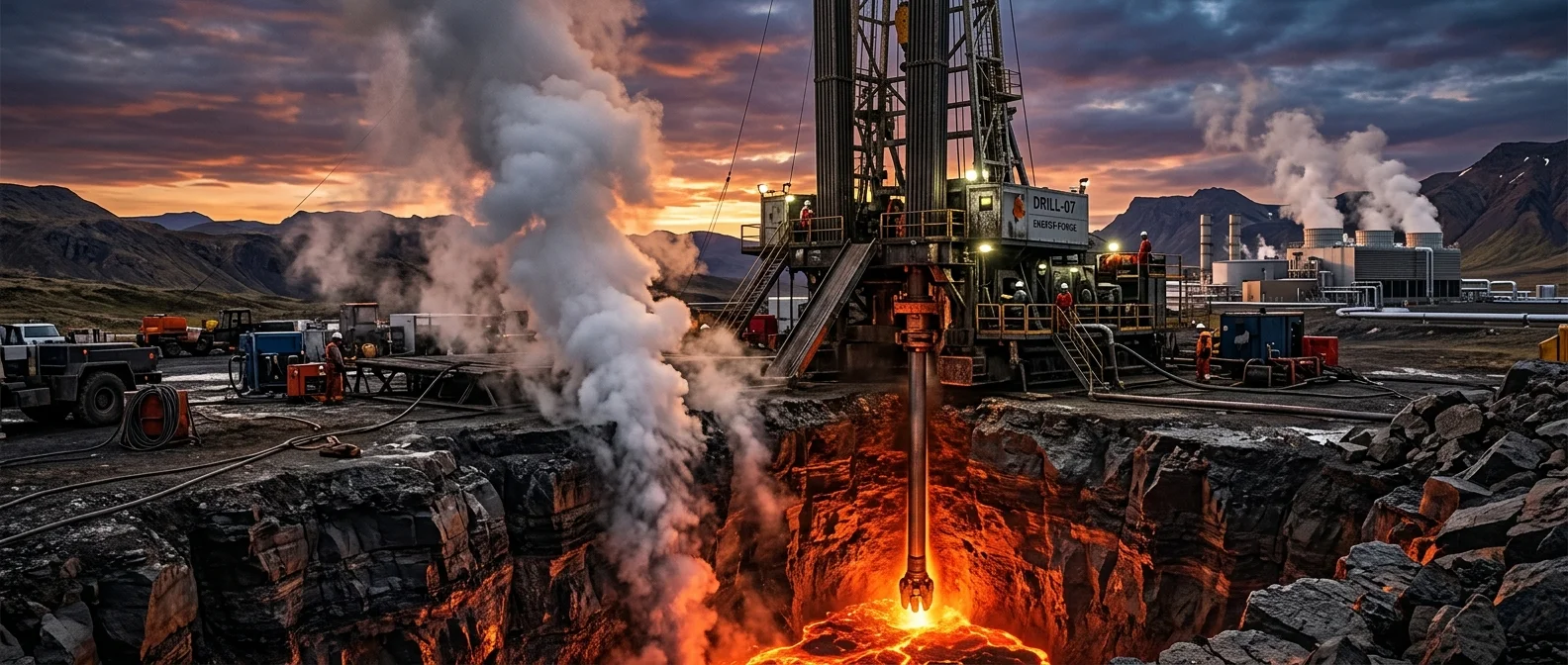
Beneath our feet lies an almost inexhaustible energy source. Earth's core maintains temperatures rivaling the surface of the Sun, and we're only now learning how to harness that power. Deep geothermal energy has moved from laboratory to commercial deployment in just the past five years.
📖 Read more: Artificial Photosynthesis: Fuel from Sunlight
What Is Deep Geothermal Energy
Conventional geothermal energy taps into naturally occurring hydrothermal systems — locations where hot water or steam exists close to the surface. But these sites are geographically limited. Iceland, Kenya, and parts of the western United States represent the classic examples, covering a tiny fraction of the planet.
Deep geothermal drilling reaches hot rock anywhere on Earth. Using advanced drilling techniques, we can now reach depths of 5 to 20 kilometers, where rock is extremely hot regardless of location. Down there, at temperatures exceeding 375°C, water no longer behaves as a liquid or a gas — it becomes a supercritical fluid, a state that carries enormous amounts of thermal energy. A single supercritical well can produce several times the power output of a conventional geothermal well.
Enhanced Geothermal Systems (EGS)
The key innovation making deep geothermal feasible is called Enhanced Geothermal Systems (EGS). In many areas, underground rock is scorching hot but lacks sufficient natural permeability or fluids. EGS solves this problem by creating engineered reservoirs deep underground.
The process works like this: water is injected at depth under carefully controlled conditions to create new fractures and reopen existing ones in the rock. This increased permeability allows fluid to circulate through the hot formation, absorb heat, and get pumped back to the surface, where thermal energy is converted into electricity. It's essentially creating a heat exchanger inside the Earth itself.
The FORGE Project: The U.S. Department of Energy (DOE) funds the largest EGS demonstration at Milford, Utah — the Frontier Observatory for Research in Geothermal Energy. Researchers have already demonstrated significant drilling innovations and successful rock stimulation, paving the way for commercial-scale deployment.
Results are already compelling. At Desert Peak, Nevada, Ormat Technologies used EGS stimulation to add 1.7 MW of electrical capacity to an existing geothermal plant. At The Geysers in Northern California — the world's largest geothermal field — two abandoned wells were refurbished and stimulated, adding 5.8 MW to the grid. These demonstrations prove EGS works in real-world conditions.
Fervo Energy: The Pioneer
If one company symbolizes the new era of geothermal energy, it's Fervo Energy. The company applies proven oil and gas technologies — horizontal drilling and distributed fiber optic sensing — to geothermal energy production, dramatically expanding where geothermal can work economically.
In February 2026, Fervo announced it had drilled the hottest well in its history at a new giga-scale geothermal project site. The company is developing Cape Station, one of the world's first commercial-scale EGS projects, while already partnering with major technology companies to supply 24/7 clean power for data centers.
"Geothermal is no longer a niche, geographically limited energy source. When temperature is the sole constraint, geothermal becomes a much more scalable resource."
— Fervo EnergyQuaise Energy: Millimeter Wave Drilling
While Fervo relies on proven mechanical techniques, Quaise Energy takes an entirely different approach. The company is developing drilling technology using millimeter waves — electromagnetic radiation produced by specialized devices called gyrotrons that were originally developed for fusion research.
The concept is revolutionary: instead of mechanically cutting through rock — a process that becomes slow and expensive at extreme depths — millimeter waves melt and vaporize rock directly. This could enable drilling to depths of 20+ kilometers, reaching temperatures of 500°C and beyond, where a single well could generate ten times the energy of a conventional geothermal installation.
Why it matters: If Quaise's technology succeeds, virtually every point on Earth could become a geothermal power station. The company's vision is to retrofit existing coal and gas power plants by replacing fossil fuel boilers with deep geothermal heat, reusing all existing turbines and grid infrastructure.
📖 Read more: Nuclear Fusion: Unlimited Energy by 2040
Economics and Costs
The biggest barrier to deep geothermal remains drilling costs. Wellbore construction — particularly casing and cementing — represents 30 to 40 percent of total well costs, according to the DOE. Conventional drill bits wear out rapidly in extremely hard, hot crystalline rock, driving expenses even higher.
Costs are dropping fast. Applying technologies from the shale oil industry — horizontal drilling, hydraulic fracturing, fiber optic sensors — has brought dramatic reductions. Fervo Energy claims geothermal is already cost-competitive with other forms of 24/7 clean energy, and with further innovation and policy support, costs will continue declining through this decade.
The DOE has committed $171.5 million in funding for next-generation geothermal field tests and resource exploration, with anticipated grants of $4 to $25 million per project. Meanwhile, the “Wells of Opportunity” initiative explores converting millions of abandoned oil and gas wells across America for geothermal energy production — potentially unlocking vast resources at a fraction of the cost of new drilling.
The Global Picture
Iceland remains the gold standard: nearly 90% of its heating and 25% of its electricity comes from geothermal sources. Kenya generates almost 50% of its electricity from geothermal plants. But these success stories rely on naturally occurring hydrothermal systems that most countries simply don't have.
The real transformation will come when EGS enables geothermal development anywhere. Germany, France, and Switzerland are already investing in deep geothermal pilot programs. Japan, with enormous geothermal reserves beneath its volcanic rock, is considered one of the largest potential producers if drilling challenges can be overcome.
"Enhanced geothermal systems hold the potential to power American homes and businesses nationwide and represent the next frontier for geothermal energy deployment."
— U.S. Department of EnergyGeothermal for Data Centers and AI
An emerging market that could dramatically accelerate deep geothermal is data centers. With the explosive growth of AI, demand for reliable, low-carbon electricity running around the clock is skyrocketing. Solar and wind are intermittent — geothermal is not. It produces power 24 hours a day, 365 days a year, with zero combustion emissions and a tiny surface footprint.
Fervo Energy is already targeting this market, and major technology companies including Google and Microsoft are evaluating geothermal as a solution for their climate commitments. A single geothermal project can supply uninterrupted power to a data center without emissions and without dependence on weather conditions — making it perhaps the ideal energy source for the AI era.
What Lies Ahead
Deep geothermal energy is ready for widespread deployment. Drilling technologies are advancing rapidly, costs are falling, policy support is growing, and new markets — particularly data centers — are creating enormous demand for firm, clean power. Companies like Fervo and Quaise could make geothermal the foundation of clean electricity worldwide.
No sun required. No wind required. No uranium required. Just the heat that already exists beneath every person's feet on the planet. And now, at last, we're learning how to use it.