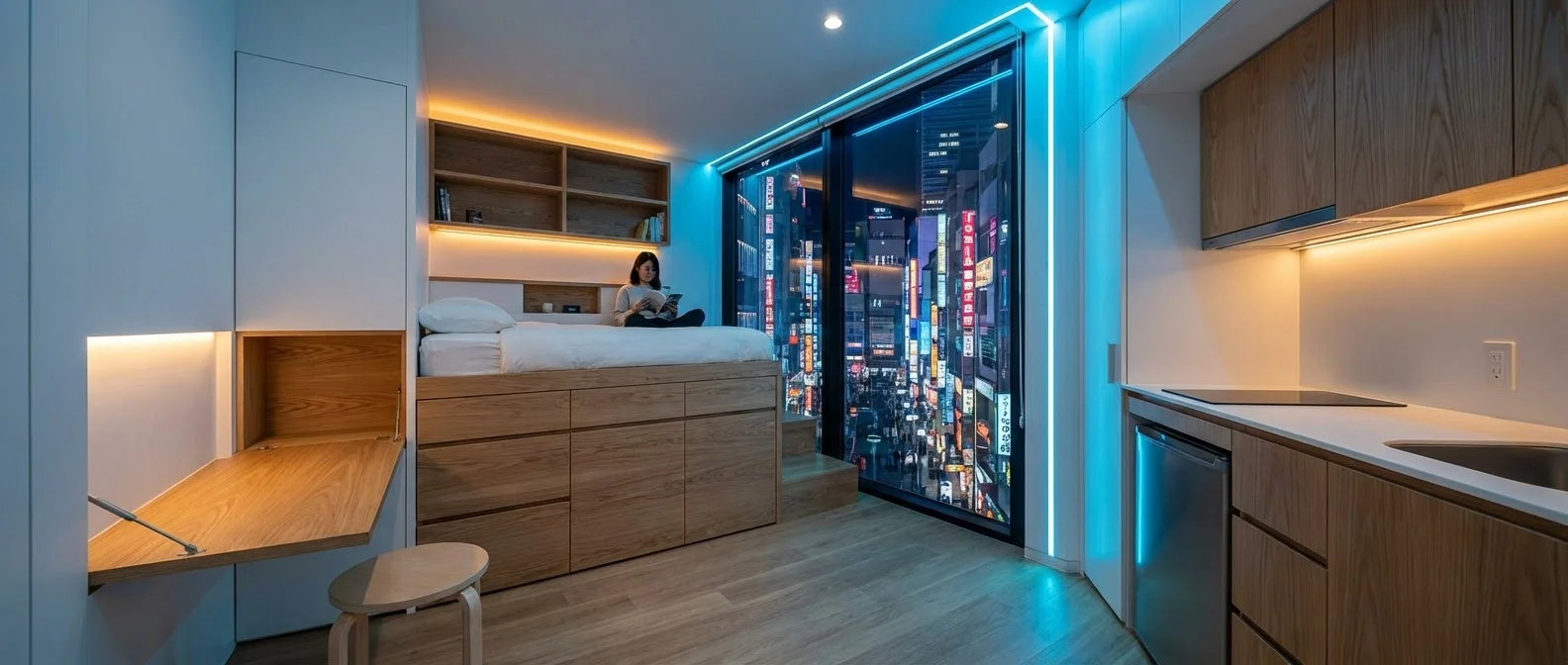
Imagine a home of 9 square meters — smaller than a parking space — with a bed, bathroom, kitchen, desk, and integrated technology. Sounds claustrophobic? For millions of residents in Tokyo, Hong Kong, and New York, this is already reality. And technology is making these tiny homes smarter than ever.
📖 Read more: city-2090
The Origin: Capsule Hotels in Japan
In February 1979, architect Kisho Kurokawa designed the world's first capsule hotel — the Capsule Inn Osaka in the Umeda district. Each capsule: a single bed, TV, air conditioning, electronic console. Cost: ¥2,000-4,000 per night (€16-32). The clientele: salarymen who missed the last train or were too drunk to get home.
Kurokawa had bigger plans. He had designed the Nakagin Capsule Tower (1972) in Tokyo — a building of 140 capsules, 10 sqm each, part of the Metabolism movement in Japanese architecture. The idea: replaceable capsules like cells. The building was finally demolished in April 2022, but its philosophy lives on.
Today's Reality
📖 Read more: Home Robots: They Clean, Cook, Do Everything
Technology That Makes the Difference
What transforms a “box” into livable space is technology:
🤖 Robotic Furniture
Ori Living (MIT Media Lab spin-off) builds robotic units: one button transforms the sleeping area into an office or living room. Murphy beds, folding tables, drawers integrated into walls.
📱 Smart Home IoT
Voice control for lighting, temperature, curtains. Humidity and air quality sensors — critical in 9 sqm where odors get trapped easily. Automatic climate adjustment.
🖨️ 3D Printing
Companies like ICON and Mighty Buildings print small homes in 24-48 hours, drastically reducing construction costs. Ideal for modular capsule housing.
🪟 Sliding Walls
Walls on ceiling rails (Gary Chang design): one room becomes 24. Folding stairs, hidden storage, collapsible doors — every centimeter counts.
📖 Read more: smart-home-2050
Size Comparison
| Type | Size | Where? |
|---|---|---|
| Capsule Hotel | ~2 sqm | Japan, worldwide |
| Nano-unit | < 18 sqm | Hong Kong, Toronto |
| Micro-apartment | 14-32 sqm | New York, London, San Francisco |
| Co-living unit | 9-17 sqm + shared areas | The Collective, Common, Ollie |
| Studio (classic) | 25-45 sqm | Worldwide |
| Average US apartment | ~80 sqm | United States |
The Co-Living Model
The big shift isn't just about size — it's about philosophy. The co-living model says: “your room is small, but the city is your living room.” Instead of a large home, you share:
- Kitchen — shared, professional-grade, 30-70 residents per floor
- Laundry — “disco-launderette” (The Collective) or communal spaces
- Gym, spa, cinema — built into the building
- Co-working — offices in the same building, no commute needed
- Garden/rooftop — outdoor spaces for relaxation
Companies like Starcity (San Francisco) convert old parking garages and offices into co-living: $1,400-$2,400/month, furnished room, wifi, cleaning, shared kitchen. The Guardian called it “a student dorm for adults.”
The Criticism: How Small Is Too Small?
"I have studied children in crowded apartments and low-income housing, and they can become withdrawn, with difficulty studying and concentrating."
The Key Problems
- Mental health — cramped conditions, isolation, inability for self-expression
- Privacy — especially in co-living with multiple residents
- Odors — in 9 sqm there isn't enough ventilation
- Working from home — impossible in a nano-unit without a desk
- Social pressure — “why do you live in a box?” stigma
- Health & safety — fire safety, natural lighting, minimum standards
The UK sets a minimum standard of 37 sqm for new homes — but this doesn't apply to office conversions (permitted development rights since 2013), a loophole exploited by developers. In Seattle, local residents successfully pushed for a ban on new micro-apartments, arguing they “harm the character of the neighborhood.”
📖 Read more: 6G Internet: 10,000x Faster Than 5G
Global Impact: Where Micro Living Thrives
- Housing crisis — London, New York, San Francisco, Hong Kong: rents have skyrocketed, Airbnb effect amplifying the squeeze
- Student housing — thousands of students without affordable homes, nano-units as a solution
- Tourism — capsule hotels in city centers and tourist hotspots, lower cost alternative
- Regulation gap — most cities lack a legal framework for co-living and micro-apartments
- Climate advantage — warm-climate cities benefit: outdoor living — balconies, rooftops, plazas offset the tightness
Timeline
Would You Live in 9 sqm?
The answer depends on where and why. A capsule apartment in Tokyo with robotic furniture, 5G, communal spa, and co-working is not the same as a 4 sqm nano-apartment in Rome without a window. Technology, design, and shared spaces can make even 9 sqm livable — if not ideal.