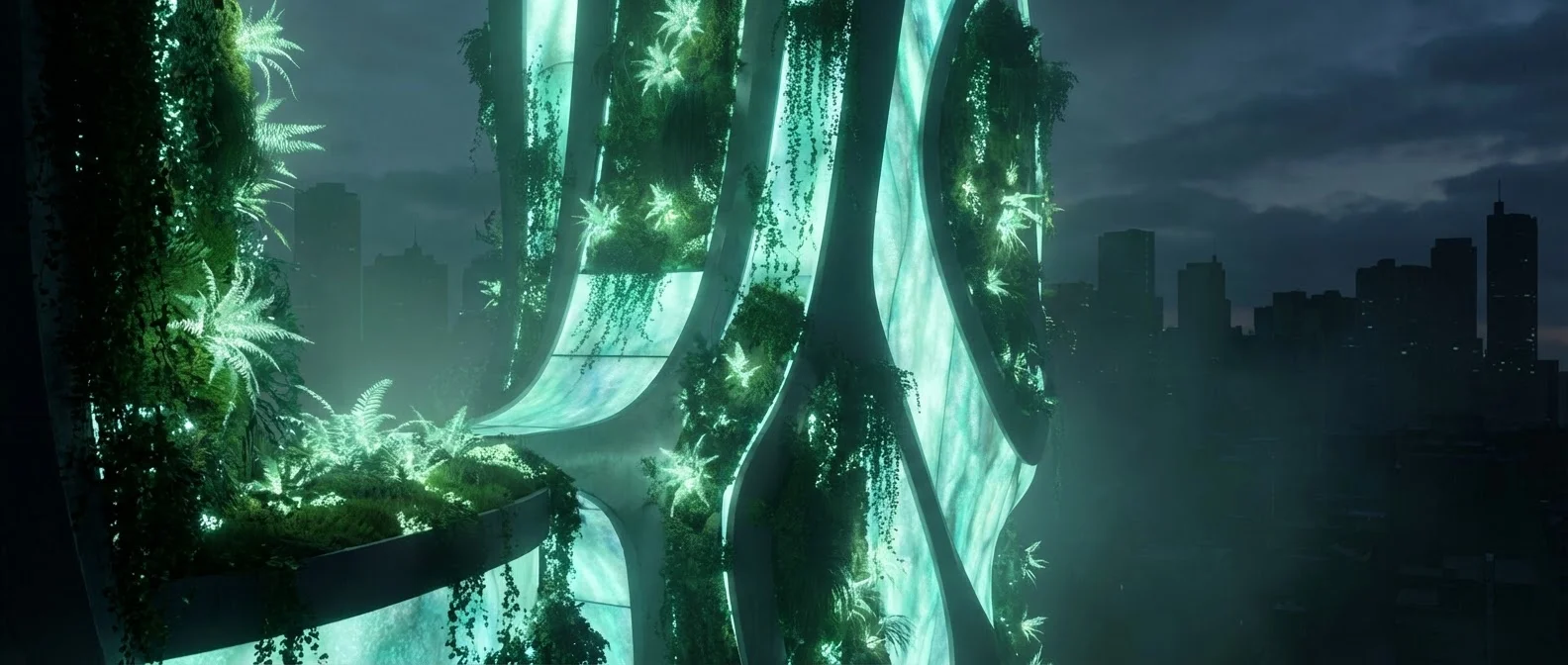
Imagine buildings that glow softly in the dark without consuming electricity — walls emitting green or blue light, facades illuminating streets without a single lamp. This emerging reality springs from bioluminescence — the ability of living organisms to produce light through chemical reactions.
📖 Read more: Bio-Architecture: Living Buildings from Biological Materials
What Is Bioluminescence
Bioluminescence is the production of light by living organisms through a chemical reaction. At its core are two substances: luciferin, a light-emitting pigment molecule, and luciferase, the enzyme that catalyzes its reaction with oxygen. The result is light without heat — cold light, with efficiency that far surpasses any electric lamp.
Nature perfected this phenomenon over hundreds of millions of years. Bioluminescence evolved independently at least 94 times, starting from octocorals 540 million years ago. Today, more than 700 animal genera include light-producing species — from fireflies and jellyfish to fungi and bacteria. In the deep ocean, approximately 76% of major deep-sea animal taxa are bioluminescent.
🧬 The Chemistry of Light
Luciferin + O₂ → (luciferase) → Oxyluciferin + Light. The reaction sometimes requires cofactors such as calcium (Ca²⁺) or magnesium (Mg²⁺) and ATP. Coelenterazine, a form of luciferin, appears in 9 different animal phyla, demonstrating its deep evolutionary origin.
From Aristotle to the Nobel Prize
The history of bioluminescence begins in antiquity. Aristotle and Pliny the Elder noted light emitted from dead fish, flesh, and damp wood. Centuries later, Robert Boyle proved that oxygen is necessary for bioluminescence in wood, fish, and glowworms.
In the late 19th century, French pharmacologist Raphaël Dubois made the foundational discovery: he named luciferin and luciferase, proving that bioluminescence involves the oxidation of a specific molecule by an enzyme. E. Newton Harvey published the 1920 monograph “The Nature of Animal Light,” laying the foundations of modern research.
The major breakthrough came in 1961, when Japanese chemist Osamu Shimomura isolated aequorin and the green fluorescent protein (GFP) from the jellyfish Aequorea victoria. This discovery transformed biology, as GFP is now used as a marker across the entire field of genetic engineering. In 2008, Shimomura, Martin Chalfie, and Roger Tsien won the Nobel Prize in Chemistry for this work.
"While sailing in these latitudes on one very dark night, the sea presented a wonderful and most beautiful spectacle. Every part of the surface glowed with a pale light."
Bioluminescence in Architecture: How Buildings Will Glow
Applying bioluminescence to buildings goes beyond aesthetics — it could slash energy consumption. Buildings account for 37% of global energy consumption and over 50% of electricity demand. Lighting constitutes a significant portion of this consumption. A building that produces part of its lighting biologically could drastically reduce its energy footprint.
Three main approaches exist:
Philips Bio-light: The First Home Application
In 2011, Philips presented the Bio-light system as part of their pioneering “Microbial Home” project. The system used bioluminescent bacteria in glass containers for ambient home lighting. The prototype demonstrated that major lighting manufacturers are taking bioluminescence seriously. The “living” nature of the light — changing intensity based on microbial nutrition — creates lighting that pulses and dims with the rhythms of living cells.
🏗️ Real-World Application: Glowee in France
Glowee was founded in Paris with the goal of replacing nighttime storefront lighting with bioluminescent solutions. It uses the bacterium Aliivibrio fischeri, the same bacterium that lives in symbiosis with the Hawaiian bobtail squid (Euprymna scolopes). The biggest challenge: bacterial cultures last only a few days before needing renewal.
📖 Read more: pangeos-terayacht
Nature as Mentor: The Templates
Bioluminescent architecture takes cues from nature's most efficient light producers:
Fireflies (Photinus pyralis) produce light with approximately 98% efficiency — virtually no heat waste. This makes them the most efficient “light bulb” in nature. Bioluminescent mushrooms (Mycena chlorophos, Armillaria) produce steady green light from their mycelium, likely to attract nocturnal insects for spore dispersal. Dinoflagellates in warm shallow waters create the spectacular “phosphorescent waves” that illuminate entire coastlines.
Of particular interest are pyrosomes (Pyrosoma), colonial tunicates where each zooid lights up in response to its neighbors' light — a biological “self-regulating lighting network” that could inspire decentralized building illumination systems.
Challenges and Obstacles
Bioluminescent architecture faces serious technical obstacles:
Light intensity: Biological light remains significantly weaker than electric lighting. Genetically modified mustard plants glow for only one hour when touched, requiring a sensitive camera to see the glow. Even the latest glowing petunias emit light visible only in semi-darkness.
Duration: Glowee's bacterial systems maintained function for a maximum of 3 days. The self-luminous plants of 2020 delivered more stable light but at low intensity. The challenge of luciferin regeneration remains central.
Scaling: Transitioning from a glowing potted plant to the facade of a multi-story building requires entirely different technologies — bioreactors, feeding systems, controlled temperature and humidity conditions.
Regulatory frameworks: The use of genetically modified organisms in public spaces is subject to strict regulations, particularly in Europe. Outdoor placement of bioluminescent plants or bacteria raises environmental safety questions.
The Road to Bioluminescent Cities
The most significant recent advance is the discovery that bioluminescence can be permanently “installed” in plant organisms. Using genes from the fungus Neonothopanus nambi — which converts caffeic acid into luciferin, a substance already naturally produced by every plant — means that glowing plants need no external “fuel” supply. This breakthrough eliminates the fuel problem. A permanently glowing plant, strategically placed in interiors, along sidewalks, or in parks, could provide ambient lighting without any electrical connection.
🏙️ Nighttime Park Lighting
Bioluminescent plants along pathways in urban parks could provide ambient lighting without electrical networks — reducing light pollution and energy costs simultaneously.
🏢 Architectural Facades
Bioreactors embedded in glass facade panels could create dynamic luminous patterns that change with the nutrition and life cycle of the microorganisms.
🚇 Underground Spaces
Tunnels, underground parking, and metro stations would be ideal locations: dark, relatively stable in temperature, and with low brightness requirements.
📖 Read more: Underground Cities: Life Below the Surface
🌊 Coastal Architecture
Coastal structures could utilize marine bioluminescent bacteria, leveraging their natural environment for self-sustaining illumination.
Ethical Dimensions
Using living organisms as “lamps” raises ethical questions. Can we instrumentalize life for aesthetic purposes? Bacteria, as single-celled organisms, don't pose the same ethical concerns as multicellular organisms. However, genetically modifying plants for lighting opens a broader discussion: if we can make a plant glow, what else can — or should — we do?
GMO regulation in the European Union remains strict. The “Firefly Petunia” was first commercially released in the USA, where regulatory approaches are more flexible. In Europe, even using glowing plants in enclosed indoor spaces may require special permits.
🔬 The 2008 Nobel Prize in Chemistry
Osamu Shimomura, Martin Chalfie, and Roger Y. Tsien were awarded for the discovery and development of the green fluorescent protein (GFP). GFP, originally isolated from the jellyfish Aequorea victoria, is now used as a biological marker in thousands of laboratories worldwide — from cancer research to neuroscience.
Bioluminescent Future: Timeline
Bioluminescent buildings will emerge in stages:
2025-2030: Commercial availability of indoor glowing plants (already begun with Firefly Petunia). Improvement of Glowee-type bacterial systems to >7 days duration. Pilot bioluminescent installation projects in museums, hotels, and public gardens.
2030-2040: Development of building-scale bioreactors. Genetically modified plants with 10-50x intensity compared to current ones. Integration of bioluminescent panels in architectural facades. First LEED-certified building with bioluminescent elements.
2040+: Bioluminescent urban parks and sidewalks. Self-sustaining glowing plants on streets. Buildings that “breathe light” — architecture as a living organism.
Global Impact
Mediterranean regions, with their rich biodiversity, warm coastal waters, and technological capabilities, offer ideal conditions for bioluminescent experiments. Warm marine lagoons already host populations of bioluminescent dinoflagellates. Traditional urban lighting combined with tourism potential makes coastal communities natural allies for bioluminescent technology.
Imagine bioluminescent pathways through historic old towns, or glowing plants along pedestrian streets on islands free from light pollution. Bioluminescence won't replace electric lighting but will add a living layer to our built environment — walls that breathe light like deep-sea creatures.
"Engineered bioluminescence could perhaps one day be used to reduce the need for street lighting, or for decorative purposes if it becomes possible to produce light that is both bright enough and can be sustained for long periods at a workable price."