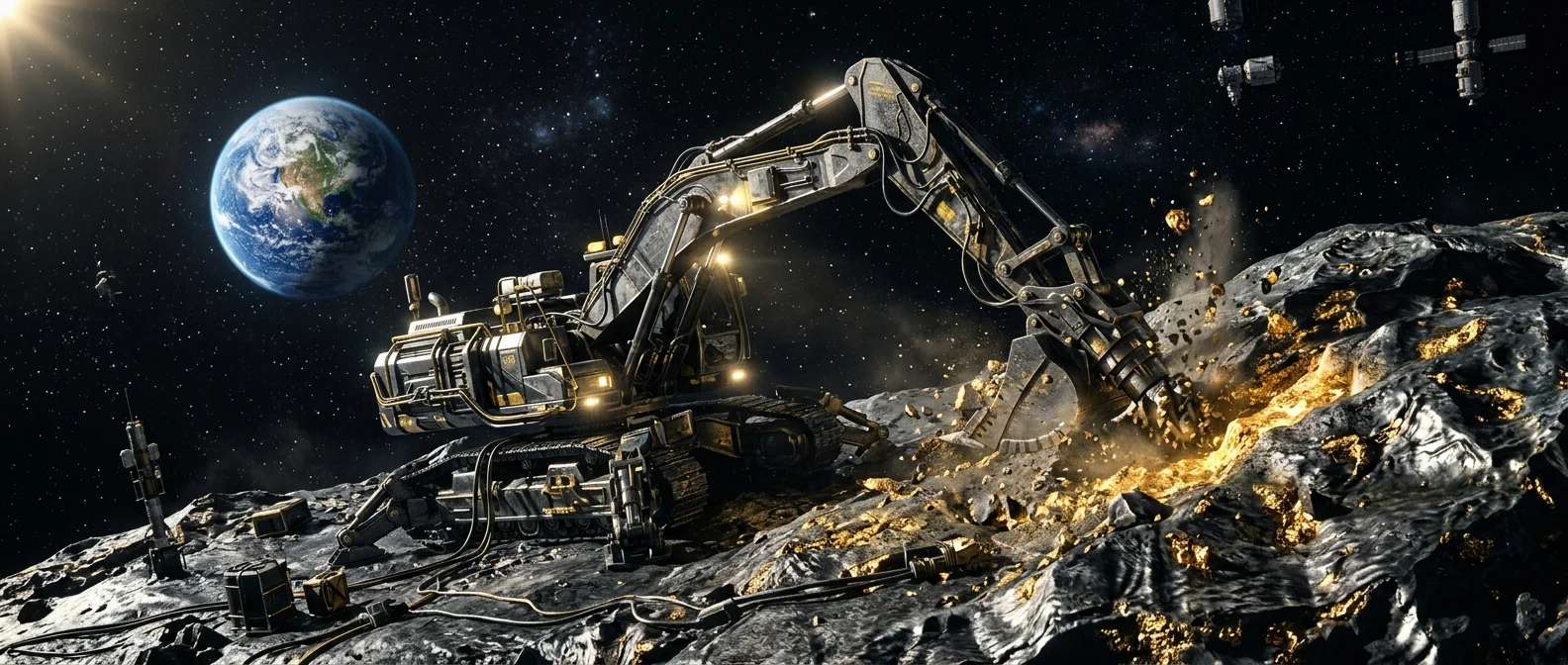
A few hundred million kilometers from Earth, asteroids worth trillions of dollars are waiting. Platinum, gold, rare earth elements — materials critical for batteries, electronics, and hydrogen fuel cells. Space mining is no longer science fiction. It's a race between startups, government agencies, and billionaires.
📖 Read more: Data Centers in Space: AI in Orbit 2028
Why Asteroids?
Earth's natural reserves are running out. Electric vehicles need lithium, cobalt, and nickel. Electronics need rare earth elements — neodymium, dysprosium. Green energy needs platinum and palladium. Mining these materials on Earth leaves behind toxic waste, destroyed forests, and displaced communities.
Between Mars and Jupiter, the Asteroid Belt hosts over 1,000,000 known bodies. Roughly 300,000 of them — according to AstroForge estimates — are metal-rich and potentially accessible. Asteroid 16 Psyche, according to NASA, is composed primarily of iron-nickel. If estimates about its rare metal content prove accurate, the theoretical value of a single asteroid would exceed the entire global economy.
NASA Psyche: The First Mission to a Metal Asteroid
The Psyche mission launched on October 13, 2023, aboard a SpaceX Falcon Heavy. It's traveling 3.6 billion kilometers on a journey of nearly 6 years. It will reach the asteroid in July 2029. This isn't a typical rocky asteroid — scientists believe it's part of the core of a planetesimal, a building block of an early planet. The spacecraft will orbit it for two years, mapping its surface, composition, and magnetic field.
Why does this matter? Because Earth's core — where precious metals originate — is inaccessible at a depth of 2,900+ kilometers. Psyche 16 gives us access to a planetary core without digging.
"Psyche 16 offers a unique window into something we can never see: the core of a planetary body."
— Lindy Elkins-Tanton, Principal Investigator, Psyche MissionAstroForge: The First Private Mining Operation
If NASA studies, AstroForge acts. The American startup, based in Huntington Beach, California, launched the first commercial asteroid mission on February 26, 2025: the Odin spacecraft. Its target: asteroid 2022 OB5, where it will gather high-resolution data on the body's composition. Their second mission, DeepSpace-2 (2026), aims to become the first private landing on a body outside a planet's gravity well.
AstroForge focuses on Platinum Group Metals (PGMs): platinum, palladium, rhodium, iridium, osmium, ruthenium. Current platinum price: ~$30,000/kg. Rhodium: ~$140,000/kg. Terrestrial PGM mining operates on margins of ~7%. In space, AstroForge projects ~85% — with no toxic waste, no destroyed ecosystems.
Key figure: According to Morgan Stanley, the space economy is expected to surpass $1 trillion by 2040. Asteroid mining is projected to be a significant component of that forecast.
Technical Challenges
The idea sounds simple. Execution is not. The core obstacles:
Delta-v and energy cost: Reaching an asteroid in the Belt requires massive velocity changes (delta-v). Electric propulsion systems (ion thrusters) reduce costs, but their power output needs to increase dramatically.
Near-zero gravity: Even a large asteroid (200+ km in diameter) has gravity that's a tiny fraction of Earth's. Traditional landing doesn't work — magnetic or grappling devices are required.
In-orbit processing: Shipping raw ore back to Earth isn't cost-effective. In-Situ Resource Utilization (ISRU) — processing materials where they're found — is the only viable path. This means autonomous factories in zero gravity, solar or nuclear heating, and robotic components.
Launch costs: There's reason for optimism, though. Since 2010, the cost of sending payload to orbit has dropped by 99%. SpaceX's Starship promises ~$100/kg to low Earth orbit — a price point that makes asteroid missions economically viable.
The Legal Framework
Who “owns” an asteroid? The Outer Space Treaty of 1967 prohibits nations from claiming sovereignty over celestial bodies. But it doesn't explicitly address private entities.
In 2015, the US passed the SPACE Act, explicitly recognizing the right of American companies to extract and own resources from asteroids. In 2017, Luxembourg followed with similar legislation, positioning itself as Europe's hub for space mining. The EU and UN have yet to establish a unified framework — a gap that creates both opportunities and risks.
Lessons from Failure
Asteroid mining isn't a new idea. Planetary Resources (founded 2012, backed by Larry Page and James Cameron) promised platinum extraction before 2025. It went bankrupt in 2018. Deep Space Industries (founded 2013) was acquired by Bradford Space in 2019 without completing a single mission.
What went wrong? Premature technology and overly optimistic timelines. Neither company had access to cheap launch infrastructure — SpaceX's Starship didn't exist yet — or autonomous processing technology capable of handling the conditions. AstroForge has a timing advantage: it was designed from the start for a world of cheap launches.
Economic Implications
The economics are staggering. AstroForge claims a single asteroid could supply Earth with platinum for 200 years. What happens to prices then? Abundance drives prices down. South Africa, Russia, and Zimbabwe, which depend on PGM mining, would be hit hard. China, which controls ~60% of global rare earth production, loses geopolitical leverage.
But falling prices could democratize technology: cheaper hydrogen fuel cells (which use platinum), cheaper electronics (rare earths), faster EV adoption (cobalt, nickel). The very suppression of commodity prices could accelerate technologies currently held back by expensive materials.
What Comes Next
The decade from 2025 to 2035 will determine whether asteroid mining becomes reality or remains a promise. The critical milestones:
- 2026: AstroForge's DeepSpace-2 — first private landing on an asteroid.
- July 2029: Psyche arrives at its namesake asteroid. First detailed mapping of a metallic body.
- ~2030: First commercial sample return from an asteroid — if the technology matures.
- 2040: Space economy surpasses $1 trillion (Morgan Stanley estimate).
Nobody knows if it will work. But for the first time in history, technology, cost, and demand are converging. The trillions aren't underground. They're in space. And some people have already gone to get them.