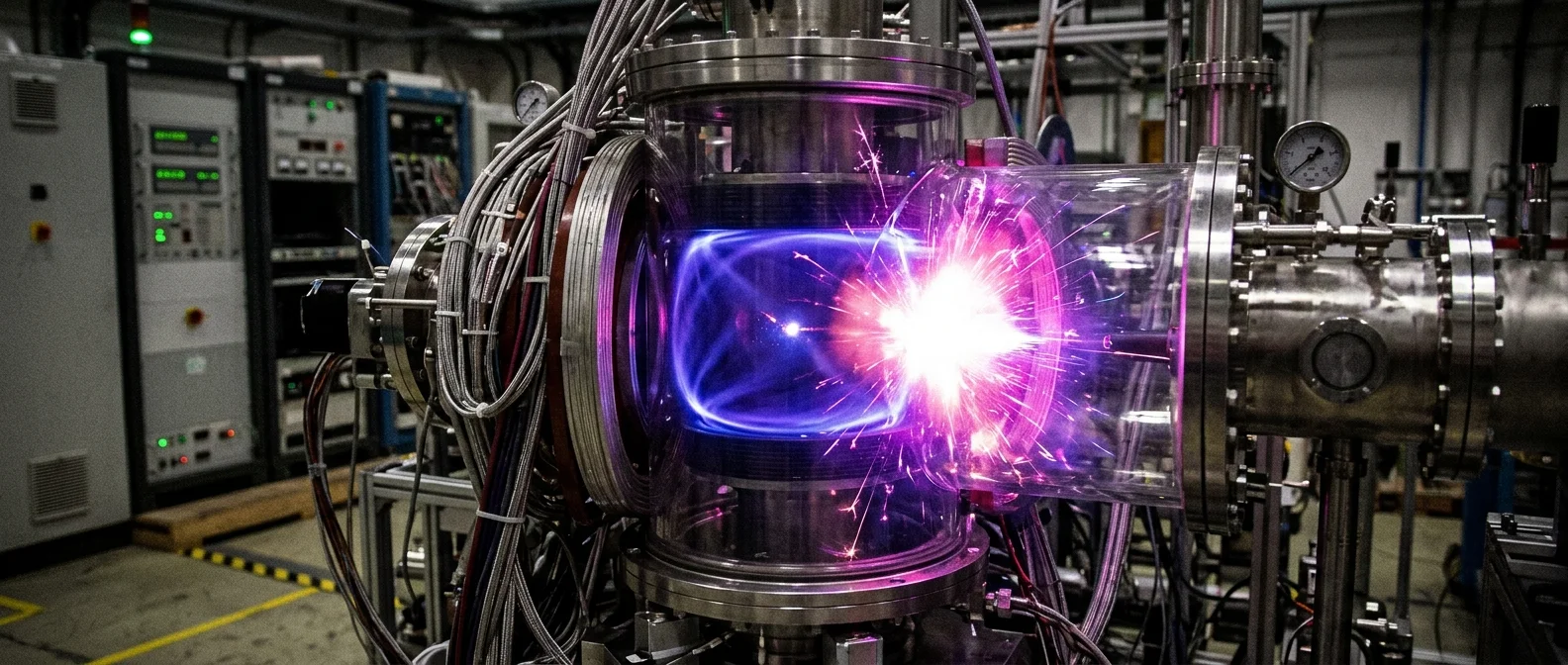
One gram of antimatter annihilating with one gram of matter releases energy equivalent to roughly 43 kilotons of TNT — three times the Hiroshima bomb. A kilogram would yield tens of megatons. And yet, in CERN's entire history, total antimatter production couldn't warm a cup of coffee.
📖 Read more: Asteroid Mining: Trillions in Space
⚛️ What Is Antimatter
In 1928, British physicist Paul Dirac wrote an equation combining quantum theory and special relativity. The equation — which earned him the 1933 Nobel Prize in Physics — had a problem: beyond the expected solution with positive energy, it also had a second solution with negative energy. Dirac interpreted this to mean that for every particle of matter, there exists a corresponding antiparticle — identical in every way, but with opposite charge.
The electron gets the positron (positive charge). The proton gets the antiproton (negative charge). And if a positron orbits an antiproton, you have antihydrogen — the simplest anti-atom.
Here's the critical rule. When matter and antimatter come into contact, they annihilate. They vanish. And their entire mass converts to energy, following E=mc². No other phenomenon in the universe converts mass to energy with absolute 100% efficiency.
💥 E=mc²: The Math Behind the Destruction
Let's do the math. Einstein's equation says energy equals mass times the speed of light squared. The speed of light is 300,000 km/s — squared, that gives 9 × 10¹⁶.
📖 Read more: Cryonics: Will We Wake Up in the Future?
One gram of antimatter annihilating with one gram of matter — a total of 2 grams fully converted to energy: 1.8 × 10¹⁴ Joules. That's 43 kilotons of TNT. For comparison, nuclear fusion (hydrogen bomb) converts only 0.7% of mass to energy. Fission (atomic bomb) converts 0.1%. Matter-antimatter annihilation? 100%.
A kilogram would equal 43 megatons of TNT — nearly matching the largest bomb ever detonated, the Soviet Tsar Bomba (50 megatons). Just one kilogram.
🔬 How It's Made at CERN
Antimatter isn't mined. It's manufactured particle by particle at CERN — in Geneva — using a one-of-a-kind facility: the Antiproton Decelerator (AD). The process: a proton beam from the Proton Synchrotron strikes a metal block. The collisions create antiprotons among many other particles. Only a small fraction have the right energy to be captured.
Antiprotons enter the AD ring, where magnets keep them in orbit and electric fields slow them down. A “cooling” technique reduces energy spread. Since 2018, the ELENA ring (Extra Low ENergy Antiproton) — with a circumference of just 30 meters — slows them further, reducing energy by a factor of 50 (from 5.3 MeV to 0.1 MeV). Thanks to ELENA, the number of trapped antiprotons increased 10 to 100 times.
In 1995, CERN created the first antihydrogen atoms in history. The anti-atoms were extremely energetic — travelling at near light speed and annihilating after just 40 billionths of a second. It took 16 years to learn how to hold onto them.
📖 Read more: Deep Geothermal: Energy from Earth's Core
In June 2011, the ALPHA experiment (Antihydrogen Laser PHysics Apparatus) announced it had trapped antihydrogen for over 16 minutes (1,000 seconds) — enough time to start studying its properties. Today, five experiments operate at the AD: AEgIS, ALPHA, ASACUSA, BASE, and GBAR.
🚀 Antimatter and Space Propulsion
Theoretically, antimatter would be the perfect spacecraft fuel. Energy per gram is billions of times greater than chemical propellants (hydrogen/oxygen) and thousands of times greater than nuclear. An antimatter-powered spacecraft could reach Mars in weeks instead of months.
NASA has studied antimatter propulsion concepts. But in practice? Currently impossible. Decades of global antimatter production amounts to nanograms. Getting to Mars would require grams.
📖 Read more: Digital Passport ID: One Chip for Everything
💰 Why It Costs Trillions
Antimatter isn't “mined” — it's built particle by particle in accelerators. The energy required to produce it is many times greater than what it yields — a massive energy loss. Estimates put the cost at roughly $62.5 trillion per gram, making antimatter the most expensive material in existence.
The only practical application today? Medicine. Positrons are used in PET scanning (Positron Emission Tomography) — an imaging technique that detects cancer, neurological disorders, and cardiac problems. Every time you get a PET scan, positrons annihilate inside your body to create an image.
Antimatter won't fuel spaceships tomorrow. But each breakthrough at CERN — every extra second of trapping time, every refined experiment — edges us toward answering why we exist. Because if matter and antimatter were created in equal amounts at the Big Bang, there should be nothing. And yet, here we are.