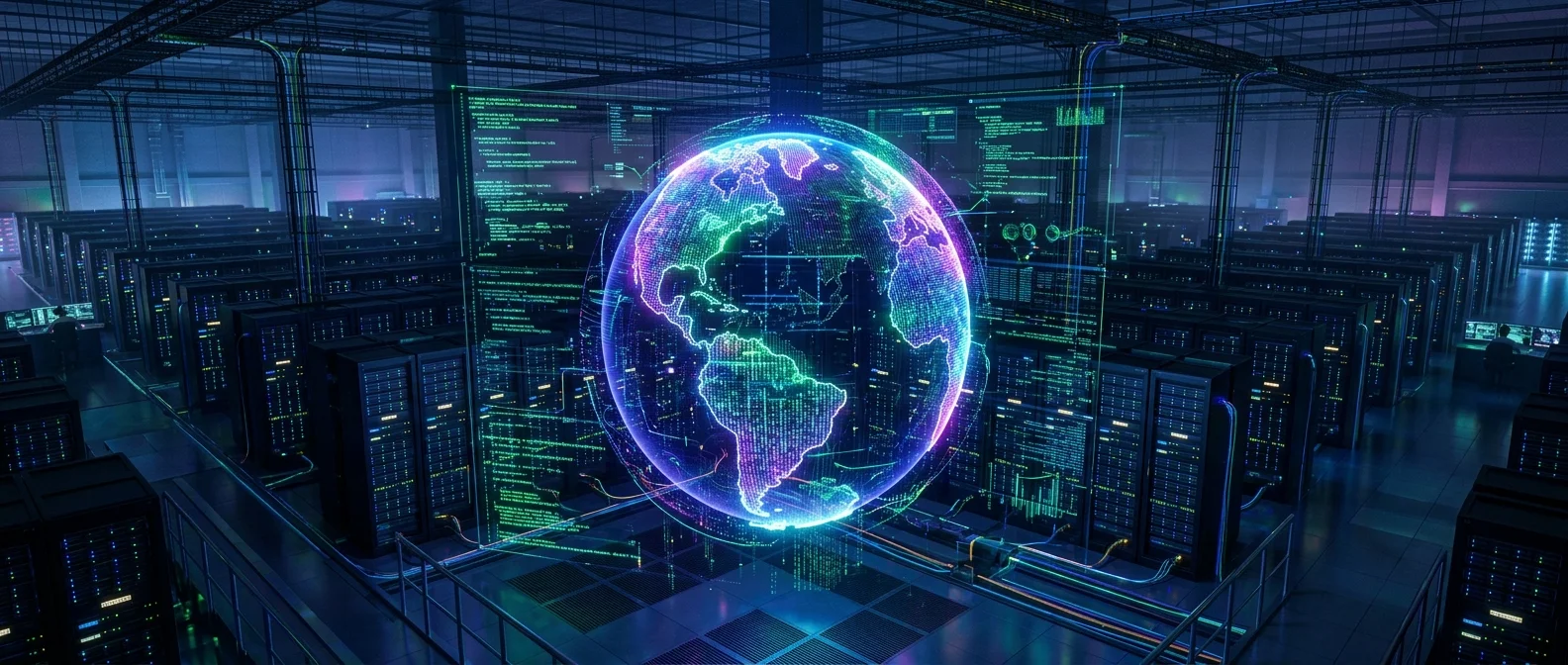
What Are Digital Twins?
Digital twins are virtual representations of physical products, processes, and facilities that enterprises use to design, simulate, and operate their physical counterparts. The concept isn't new — NASA pioneered the idea during the Apollo 13 mission, using Earth-based simulators connected in real time to the spacecraft.
What has changed dramatically is the scale and accuracy. Today, thanks to open data standards like OpenUSD, generative AI, and accelerated computing, digital twins incorporate physically accurate materials, lighting, rendering, and behavior — supporting advanced planning, simulation, and operational use cases.
NVIDIA Omniverse: The Platform That Builds Worlds
NVIDIA Omniverse is a collection of libraries and microservices for developing physical AI applications — industrial digital twins and robotics simulation. The platform leverages NVIDIA's deep expertise in accelerated computing and AI, providing pre-built functionality to developers.
The numbers tell the story. BMW uses factory digital twins for planning new facilities, with expected efficiency gains of up to 30%. Foxconn builds digital twins of installations to optimize layouts, while at its new state-of-the-art facility in Houston, Texas, engineers assemble and validate every mechanical, electrical, and plumbing system virtually before construction begins.
🏭 Impressive stat: Wistron, one of the world's largest IT product suppliers, uses digital twins to accelerate airflow simulations — converting a process that took 15 hours into just 3.6 seconds. That's a 15,000× speedup.
From Factories to Smart Cities
Digital twin applications extend far beyond manufacturing. NVIDIA Earth-2 is a climate digital twin cloud platform designed to enhance simulation and visualization of weather and climate on a global scale. Using AI surrogates, it creates interactive, high-resolution simulations — from global atmospheric conditions to local weather events.
In smart cities, digital twins enable real-time traffic simulations, urban design optimization, and enhanced public services. Linker Vision is deploying end-to-end AI solutions for cities like Kaohsiung, while India is investing $134 billion in new manufacturing facilities that will use digital twins from day one.
Google SIMA: AI Agent in Virtual Worlds
Google DeepMind took an entirely different approach with SIMA (Scalable Instructable Multiworld Agent). Rather than building digital twins, it created an AI agent that can understand and act across a variety of virtual environments — video games.
In partnership with 8 game studios, DeepMind trained SIMA on 9 different games, including No Man's Sky and Teardown. The agent was evaluated across more than 600 basic skills — navigation, object interaction, menu use. It doesn't need access to a game's source code: it requires only the on-screen images and simple natural-language instructions.
— Google DeepMind, SIMA Technical Report
Autonomous Systems and Robotics
Digital twins serve as the birthplace of physical AI systems. Self-driving cars, warehouse robots, and industrial drones need enormous volumes of sensor data for proper training. Digital twins provide a safe sandbox for generating synthetic data.
Amazon Robotics uses warehouse digital twins for simulation and design optimization. Pegatron, with AI-enabled digital twins, catches 60% more defects with 30% fewer variations than human inspectors, achieving 99.8% accuracy in PCB defect detection.
The Technology Convergence
What makes this era unique is the convergence of technologies powering digital twins. OpenUSD provides data interoperability — like “HTML for 3D data.” Generative AI enables natural-language interaction with industrial data. NVIDIA RTX delivers physically accurate sensor simulation in real time.
NVIDIA CEO Jensen Huang declared at 3DEXPERIENCE World in February 2026: "Everything will be represented in a virtual twin." The company announced a strategic partnership with Dassault Systèmes, combining Virtual Twin technologies with NVIDIA AI infrastructure to transform industries.
Where We Stand and Where We're Going
In early 2026, digital twin technology is already an integral part of critical industries — automotive, aerospace, energy, telecommunications, healthcare. Digital surgery lets surgeons practice on virtual brains. Climate modeling is changing how we forecast extreme weather events.
Next up: digital twins of entire cities, 6G networks, and the planet's climate. This is no longer science fiction — it's the new reality of engineering, where every physical object, before being built, will first exist digitally.