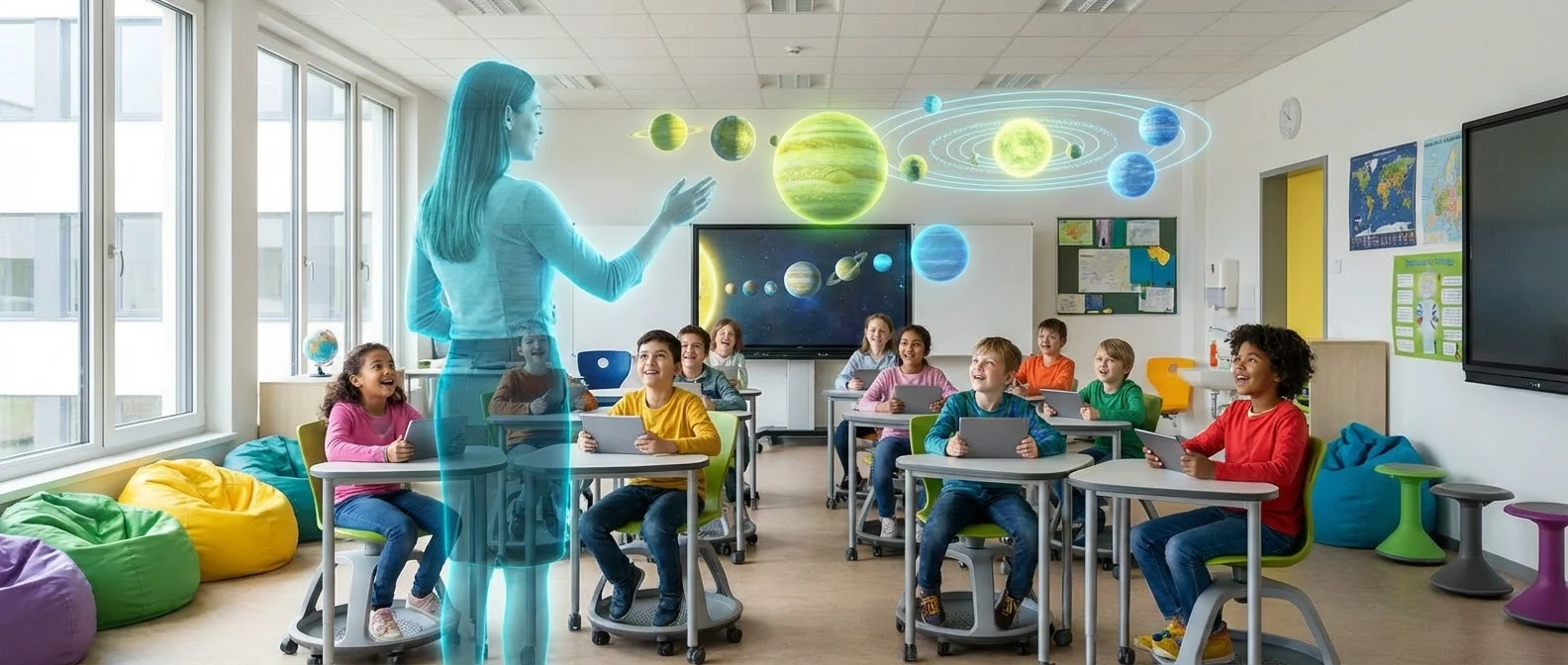
Every invention in education history — from Aristotle's one-on-one tutoring of Alexander the Great to the modern classroom — has faced the same constraint: one teacher, many students. AI is about to break that constraint forever.
📖 Read more: AI World Simulation: Digital Universes
The 2-Sigma Problem
In 1984, psychologist Benjamin Bloom discovered a stark disparity: students who receive one-on-one tutoring perform 2 standard deviations (2-sigma) better than those in traditional classrooms. In practice, this means the average tutored student outperforms 98% of classroom students. Bloom called this the “2-Sigma Problem” — because society simply cannot provide one teacher per student.
Until now. Artificial intelligence is paving the way for personalized education at massive scale — what researchers call AI Tutoring. Here's how.
The History: From PLATO to ChatGPT
The idea of teaching machines started earlier than you'd think. In 1924, Sidney Pressey at Ohio State University created a mechanical “teaching machine” resembling a typewriter. By the 1960s, PLATO (Programmed Logic for Automatic Teaching Operations) at the University of Illinois offered a complete educational terminal with displays, animations, and touch controls.
The real breakthrough came in the 1970s when Jaime Carbonell proposed Intelligent Tutoring Systems (ITS) — computers that don't just deliver content, but teach. In the 1980s, the LISP Tutor at Carnegie Mellon University proved that ITS can genuinely improve student performance, reducing time required while boosting test scores.
Today, with Large Language Models (ChatGPT, Claude, Gemini), the technology has transformed. AI tutors no longer follow fixed curricula — they “converse” with the student, identify gaps, and adapt in real time.
The 3 Paradigms of AI Education
Researchers categorize AI educational systems into three paradigms, with increasing learner agency:
📖 Read more: Ammonia Ships: Zero Emissions in Shipping 2035
How an AI Tutoring System Works
Modern intelligent tutoring systems consist of four core components:
🧠 Domain Model
The “knowledge model” — contains the rules, concepts, and problem-solving strategies of the subject. It serves as the “expert.”
👤 Student Model
Tracks the student's knowledge, gaps, and progress. Updated at every step — real-time knowledge tracing.
📚 Tutor Model
Decides the teaching strategy: when to give a hint, when to offer feedback, when to present a new challenge. Contains hundreds of rules.
🖥️ User Interface
Integrates interpretation knowledge (understanding the learner), domain knowledge (content), and communication knowledge (intent).
The Results: Do They Outperform Humans?
The research data tells a clear story. A meta-analysis of 50 studies (Kulik & Fletcher, 2015) found that ITS significantly outperform traditional methods: median effect size of 0.66 — nearly double that of traditional computer-assisted instruction (0.31) and better than human tutoring (~0.40). In practical terms, this means improvement from the 50th to the 75th percentile.
VanLehn's Surprising Discovery
In his comprehensive review (2011), Kurt VanLehn reached a stunning conclusion: there is no statistically significant difference between expert human tutors and step-based ITS. Machines, in other words, already match the best teachers.
Particularly striking were the Cognitive Tutor results in American high school math: students outperformed traditionally-taught peers on standardized tests — especially students in special education, non-native English speakers, and low-income backgrounds.
The Emotional Dimension
A human teacher senses when a student is bored, anxious, or excited. Can AI do the same? Increasingly, yes. Affective Tutoring Systems (ATS) recognize emotions through facial expressions, eye movements, and vocal tone.
📖 Read more: Anti-Aging: Will We Live to 150?
GazeTutor, for example, tracks students' eye movements, detects if they're bored or distracted, and re-engages their attention. Research shows that students learn best with mild challenge (frustration) — as long as it doesn't become overwhelming.
Risks and Concerns
AI education is no silver bullet. Serious concerns remain:
Over-Reliance and Shallow Learning
When students have access to hints, they often request them immediately without trying — effectively “bottoming out” the help system. This leads to surface-level learning: students find the right answer without understanding why. Research links AI over-reliance with reduced critical thinking, creativity, and academic self-confidence.
Digital divide: Students in rural or low-income areas may lack access to the hardware or subscriptions needed — potentially widening educational inequalities rather than reducing them.
Algorithmic bias: AI systems are trained on data that may perpetuate social inequalities. Critics argue that data processing and surveillance reinforce neoliberal approaches rather than addressing inequities.
Privacy: Student data — academic, behavioral, even emotional — is highly sensitive information. UNESCO issued updated guidelines in 2024 for generative AI in education, emphasizing ethical use, teacher training, and data protection.
The Classroom of 2040
What will education look like in 15 years? Researchers envision: every student will have an AI Tutor that deeply knows them — their strengths, gaps, preferred learning style, even their emotional state. Virtual reality will create immersive learning environments — “walking” through ancient Athens, “manipulating” molecular structures, “piloting” a spacecraft.
The human teacher's role won't disappear — it will transform. The teacher of 2040 will be a mentor, guide, and motivator. AI agents will handle the “mechanical” teaching — explanation, practice, assessment — leaving the human to do what they do best: inspire.
"Personalized education, once a privilege of kings, may soon become the right of every child on the planet."