📖 Read more: AI Protein Design: The Food Revolution
🧬 The Problem That Haunted Biology for 50 Years
Proteins underpin every biological process in every living thing. Made from long chains of amino acids, each has a unique, complex three-dimensional structure. But figuring out just one of these could take years of work and hundreds of thousands of euros in research costs.
This was known as the “protein folding problem” — a challenge that plagued biology since the 1970s. The reason? The number of possible three-dimensional arrangements of a protein exceeds the number of atoms in the universe. No experiment, no computer could test every possibility.
🏆 AlphaFold: A Nobel Prize for an AI
In November 2020, Google DeepMind's AlphaFold was recognized as solving the protein folding problem at the CASP14 competition. The system predicted protein structures at atomic accuracy — three times more precise than any other system — in minutes instead of months.
The AlphaFold Protein Structure Database, in partnership with EMBL-EBI, contains over 200 million protein structures — nearly every catalogued protein known to science. In October 2024, Demis Hassabis and John Jumper were awarded the Nobel Prize in Chemistry for this groundbreaking work.
Today, over 30% of papers citing AlphaFold relate to studying diseases — from malaria and antibiotic resistance to cancer, heart disease, and plastic pollution through plastic-eating enzymes.
⚗️ GNoME: 2.2 Million New Materials in Months
Discovering new inorganic crystalline materials — from computer chips to batteries and solar panels — was traditionally a slow, expensive trial-and-error process. In November 2023, Google DeepMind unveiled GNoME (Graph Networks for Materials Exploration), a deep learning tool designed to search for stable materials at unprecedented scale.
The scale is massive: GNoME discovered 2.2 million new crystals, of which 380,000 are considered the most stable and candidates for experimental synthesis. This is equivalent to roughly 800 years' worth of accumulated knowledge in just months.
📖 Read more: GPAI: How Close Are We to General AI?
Among the discoveries: 52,000 new layered compounds similar to graphene (previously only about 1,000 were known), which could revolutionize electronics with next-generation superconductors. Also, 528 lithium-ion conductors — 25 times more than any previous study — that could dramatically improve rechargeable batteries.
GNoME's reliability was confirmed: 736 of the new materials were independently created in laboratories worldwide, proving the predictions match reality. The stability prediction accuracy improved from 50% to 80%.
🔢 FunSearch: Mathematical Breakthroughs with LLMs
Can an AI solve math problems that have tormented mathematicians for decades? In December 2023, Google DeepMind published the FunSearch system in Nature, becoming the first large language model to make a genuine mathematical discovery.
FunSearch tackled the famed cap set problem — an open challenge in combinatorial mathematics that Terence Tao, perhaps the world's most renowned mathematician, has called his “favorite open question.” Working with Professor Jordan Ellenberg, FunSearch found the largest cap sets discovered in the past 20 years.
Beyond pure mathematics, FunSearch also solved practical problems: it discovered more efficient algorithms for the bin packing problem (optimally fitting items into containers), with applications in data centers and logistics optimization. What sets it apart: unlike neural network “black boxes,” FunSearch produces readable code that explains how it reached its solutions.
🤖 Autonomous Labs: Robots That Synthesize Materials
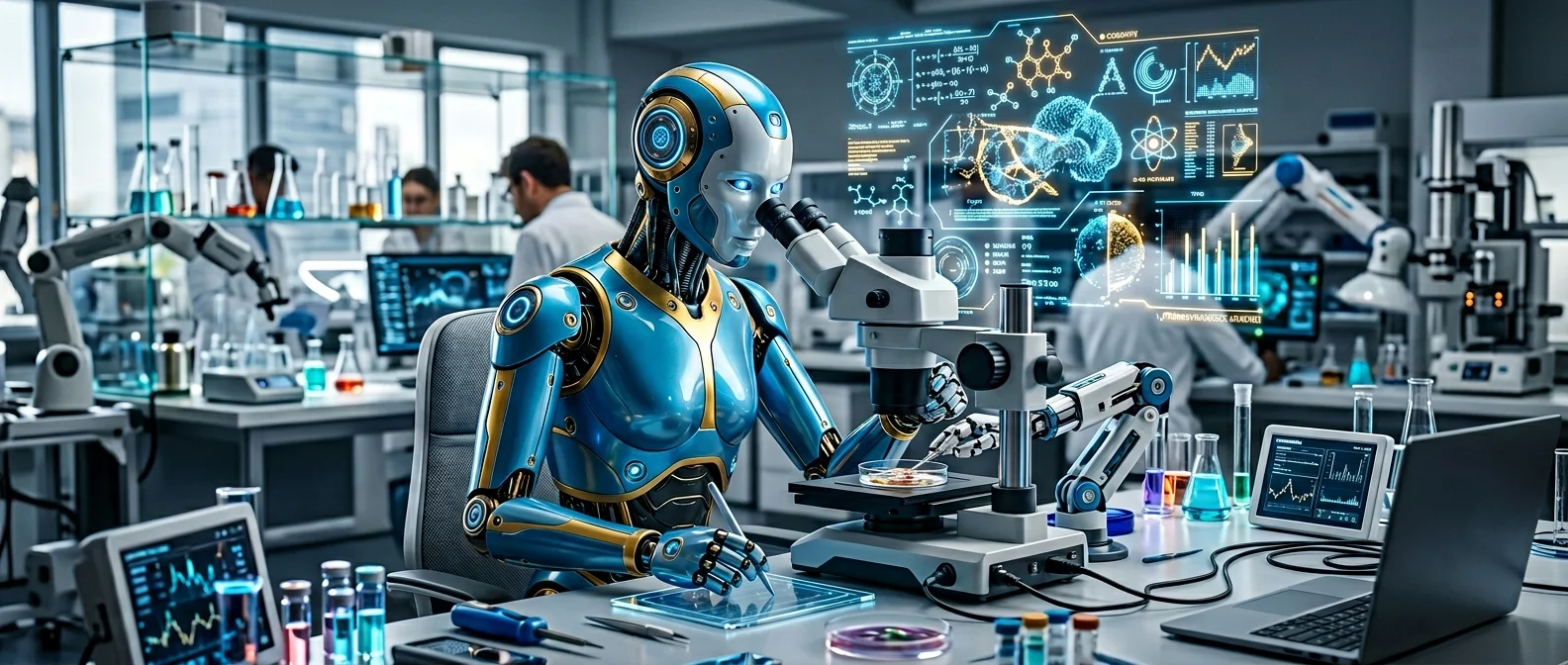
Discovering new materials is only half the equation — someone has to actually make them. At the Lawrence Berkeley National Laboratory, the A-Lab (Autonomous Lab) is a fully autonomous robotic facility where AI designs crystal “recipes” and robots execute them without human intervention.
📖 Read more: AGI: Humanity's Last Invention
Using data from the Materials Project and stability predictions from GNoME, A-Lab successfully synthesized over 41 new materials. The publication in Nature proves that automated materials synthesis isn't a future scenario — it's already happening, opening new possibilities for AI-guided materials creation.
🔮 The Future: Science Without Human Limits
AlphaFold, GNoME, and FunSearch represent a shift in how science gets done. Until now, science operated on human intuition, experimentation, and luck. Today, AI can explore possibility spaces that are impossible for the human mind to navigate.
AlphaFold has saved hundreds of millions of research years according to DeepMind, while over one million users are in low and middle-income countries — democratizing access to tools that once required millions in equipment. GNoME promises cheaper batteries, more efficient solar panels, and new superconductors. FunSearch opens a new human-AI relationship in mathematics, where researchers pose the problem and the machine explores solutions.
The question is no longer “can AI do science?” — but “what are AI laboratories discovering right now that we don't yet know about?”