📖 Read more: AI Journalism: Robots Writing the News
💊 Traditional Drug Discovery: Slow, Expensive, Uncertain
The journey from identifying a therapeutic target to getting a drug approved is one of science's slowest, most expensive, and most uncertain processes. Each drug goes through stages of target identification, molecule discovery, preclinical trials, and three phases of clinical testing. In the end, only 10% make it to patients.
❌ Traditional Method
- 10-15 years of development
- ~€2.3 billion per drug
- 90% failure in clinical trials
- Thousands of manual experiments
✅ AI-Driven Method
- 18 months to clinical trials
- Fraction of the cost
- Millions of molecules in hours
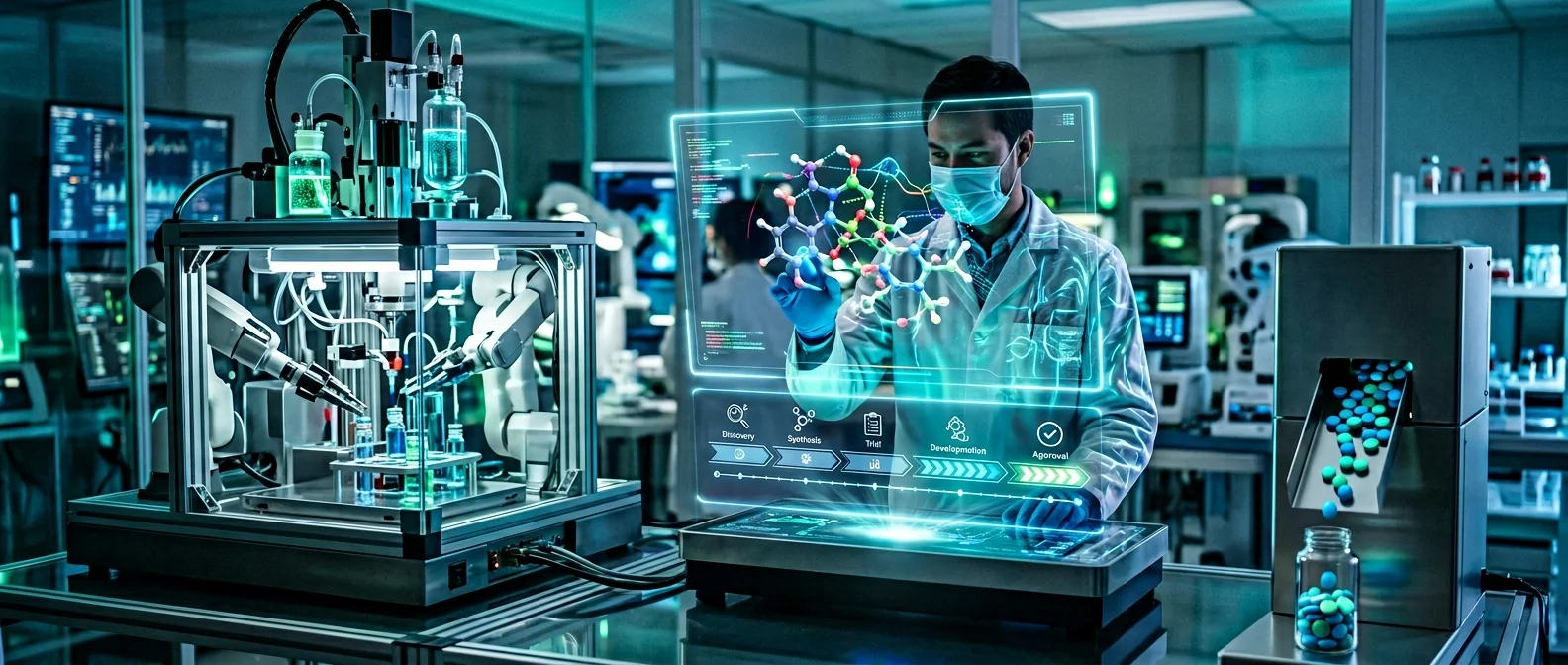
- Robotic laboratories
🧪 Insilico Medicine: 40+ AI Drug Programs
Insilico Medicine is one of the global pioneers in AI-driven drug discovery. Its Pharma.AI platform comprises three core modules: PandaOmics for target identification, Chemistry42 for molecule design, and inClinico for predicting clinical trial success.
The results are impressive: 40+ programs at various development stages, 12 IND approvals (Investigational New Drug), and partnerships with 10 of the world's 20 largest pharmaceutical companies. The most advanced program — a TNIK inhibitor for fibrotic diseases of the lung and kidney — is already in Phase II clinical trials, while other programs target breast cancer (KAT6), BRCA-mutant cancer (USP1), mesothelioma (TEAD), and inflammatory bowel disease (PHD).
The company has published in Nature Biotechnology and Cell Trends in Pharmacological Sciences, confirming that AI-designed drugs aren't theoretical — they're already entering clinical trials in patients.
🔬 Recursion: 50 Petabytes of Biological Data
Recursion approaches the problem from a different angle: instead of designing molecules from scratch, it uses robots and computer vision to photograph millions of cell experiments per week and train AI on the results.
The company has amassed over 50 petabytes of data — spanning phenomics, transcriptomics, proteomics, ADME, and de-identified patient data. It's one of the largest biological datasets in the world. To process it all, Recursion partnered with NVIDIA to build BioHive-2, biopharma's most powerful supercomputer.
Its most advanced drug, REC-4881, showed positive results in Phase 1b/2 for familial adenomatous polyposis (FAP), while REC-3565 — a selective MALT1 inhibitor for B-cell lymphomas — recently entered Phase 1 with its first patient dosed. The company focuses primarily on aggressive cancers and rare diseases — areas where current therapies are inadequate.
🧬 Isomorphic Labs: AlphaFold's Legacy
Demis Hassabis — the man behind AlphaFold and 2024 Nobel Chemistry laureate — founded Isomorphic Labs with a clear mission: to turn AlphaFold's discoveries into actual drugs. The company has developed the Drug Design Engine, a platform that goes beyond protein structure prediction into predictive and generative drug molecule design.
Isomorphic Labs has already secured deals with pharmaceutical giants: a research collaboration with Johnson & Johnson, as well as earlier agreements with Eli Lilly and Novartis. The approach is clear: AI doesn't replace chemists — it equips them with tools that let them accomplish in weeks what previously took years.
📊 Where We Stand Today
The AI drug discovery landscape is evolving rapidly. Each company brings a different approach to the same problem:
- Insilico Medicine: End-to-end generative AI — from target to clinical trial
- Recursion: Data-first approach — millions of experiments per week with robots
- Isomorphic Labs: Physics-based AI — building on AlphaFold for drug design
The common thread? All combine machine learning with wet laboratories. This isn't just about computational predictions — the molecules AI designs are synthesized and tested in physical labs, in a continuous feedback loop.
🔮 Therapies That Seemed Impossible
The real promise of AI drug discovery isn't just speed — it's the ability to find solutions for diseases that previously had no treatment. Certain protein targets were considered “undruggable” for decades because their structure was unknown. With AlphaFold revealing these structures and generative models designing molecules that “lock” onto them, the possibilities are remarkable.
We're not yet at the point where AI replaces humans in research. But the question has changed: it's no longer “can AI make drugs?” but "how many AI-designed drugs will get approved in the coming years?" With over 12 programs already in clinical trials and giants like Eli Lilly, Novartis, and J&J investing in AI, the answer may surprise us.