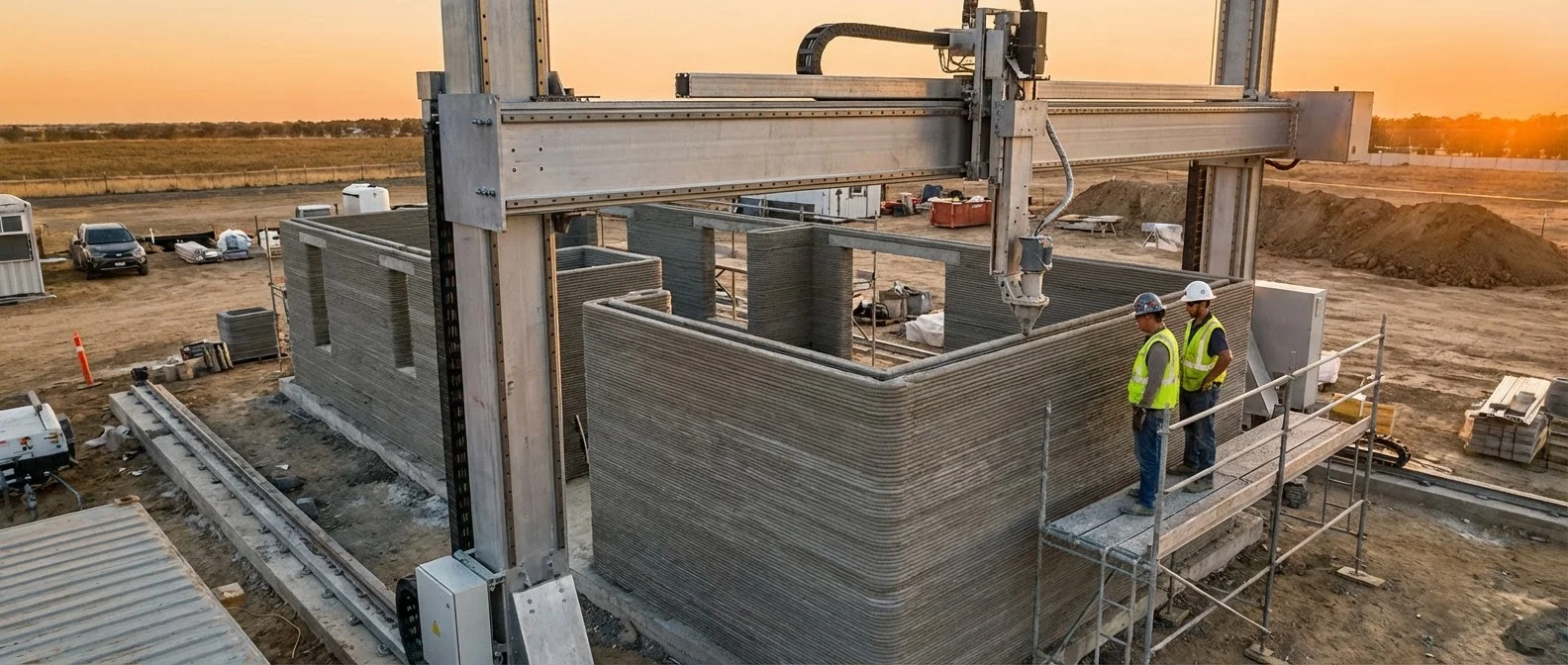
Imagine watching a house being “built” before your eyes, layer by layer, in less than 24 hours. No scaffolding, no dozens of workers, no months of waiting. 3D-printed housing is no longer science fiction — it's a technology already constructing entire neighborhoods across three continents.
📖 Read more: Capsule Apartments: Living in 9 sqm
The Technology Behind 3D-Printed Houses
Construction 3D printing (3DCP) uses robotic systems that extrude specialized concrete mixes or other materials in successive layers, creating walls and structures directly on the construction site. The two main methods involve gantry systems and multi-axis robotic arms.
Printing materials include specially formulated concrete mixes, polymers, foams, and even clay blended with natural fibers. Each material is evaluated based on four critical properties: pumpability, printability, buildability, and open time.
The Pioneers of 3D Construction
🏗️ ICON (USA)
The Austin, Texas-based company is developing the Titan system, a next-generation printer for multi-story buildings. In partnership with Lennar, it built Wolf Ranch in Texas — the largest community of 3D-printed homes in the US. In 2022, NASA awarded ICON a $57.2 million contract for constructing structures on the Moon.
🏠 COBOD (Denmark)
COBOD International created the first 3D-printed building in Europe, the Building on Demand (BOD) in Copenhagen. The company develops gantry-type printers and organized the first international conferences on 3D construction printing.
🏺 WASP (Italy)
WASP, in collaboration with architect Mario Cucinella, completed Tecla — the first 3D-printed house made from clay, local soil, and plant fibers. Printed in 200 hours with zero carbon footprint, it demonstrated that sustainable construction is achievable.
📖 Read more: 6G Internet: 10,000x Faster Than 5G
🇪🇸 EVOCONS (Spain)
In 2025, EVOCONS inaugurated in Gran Canaria the world's first building constructed using 3D printing, robotics, and artificial intelligence, with automated finishing and full regulatory certification.
How the Process Works
Building a 3D-printed house follows three main stages. First, digital design: a 3D model is “sliced” into thin horizontal layers and converted into printer instructions. Then, printing: a robotic arm or gantry system deposits material layer by layer, building walls, window recesses, and conduit channels. Finally, completion: installation of the roof, electrical, plumbing, and interior finishes.
Did You Know?
Chinese company WinSun claimed in 2014 to have printed 10 houses in a single day, at a cost of just $5,000 each. Although the claims were disputed, the event generated enormous interest in the industry and led to dozens of new companies worldwide.
📖 Read more: AGI: Humanity's Last Invention
The Advantages
Applications Across Sectors
🏘️ Social Housing
In France, the Viliaprint program inaugurated 5 rental social housing units in Reims (2022), built with a hybrid 3D concrete printing method. The UN estimates that 3 billion people will need affordable housing by 2030.
🌍 Remote Areas
The ability to use local materials (soil, clay, recycled materials) makes the technology ideal for hard-to-reach areas. After natural disasters, a printer can erect shelters within hours.
🪖 Military Applications
The US Army through ERDC is developing portable 3D concrete printers. US Marines constructed 3D-printed barracks and the first 3D-printed bridge in the Americas.
🌙 Space Construction
ICON is designing lunar structures for NASA's Artemis program using lunar regolith. ESA is exploring 3D-printed lunar bases that would require only 10% of materials to be transported from Earth.
📖 Read more: city-2090
The Challenges
The technology still hits three major roadblocks. Printing only the building envelope doesn't resolve time-consuming elements like reinforcement, utilities, and interior finishes. Regulatory recognition is still limited — few countries have established standards for 3D-printed buildings. Earthquake resistance, thermal insulation, and long-term durability still need to be proven at scale.
The second generation of printers arriving in 2024-2025 combines printing with robotic cutting, placement, and inspection functions, moving toward fully automated construction sites.
Robot Drone Swarm Printers
In 2022, researchers demonstrated swarms of autonomous drones capable of 3D printing cement structures in flight, opening the door to construction in inaccessible locations and even disaster zones — without human presence.
The Future of 3D Housing
The evolution has been exponential. From the first lab experiments in the 1990s, we've reached entire housing communities, bridges, military installations, and even plans for lunar bases. The technology is maturing at a rapid pace.
Within the next decade, 3D printing is expected to become a mainstream option for affordable housing. New multi-robot systems will further reduce construction times. And as materials become more sustainable — with recycled materials, local soil, and biological fibers — “printed” housing could become the solution to the global housing crisis.
"The housing crisis won't be solved with the same tools that created it. We need a technological revolution in construction — and 3D printing is exactly that."