📖 Read more: EV Charging in Apartment Buildings: Law & Rights
The Two “Levels” of Home Charging
In North America, home EV charging breaks down into two categories defined by SAE J1772. Level 1 uses a standard 120V household outlet (NEMA 5-15), while Level 2 requires a dedicated 240V circuit and a wall-mounted EVSE — commonly called a wallbox. In Europe, the equivalent distinction is between Mode 2 (standard Schuko outlet + portable cable) and Mode 3 (dedicated wallbox with Type 2 connector).
Charging Speed — The Biggest Difference
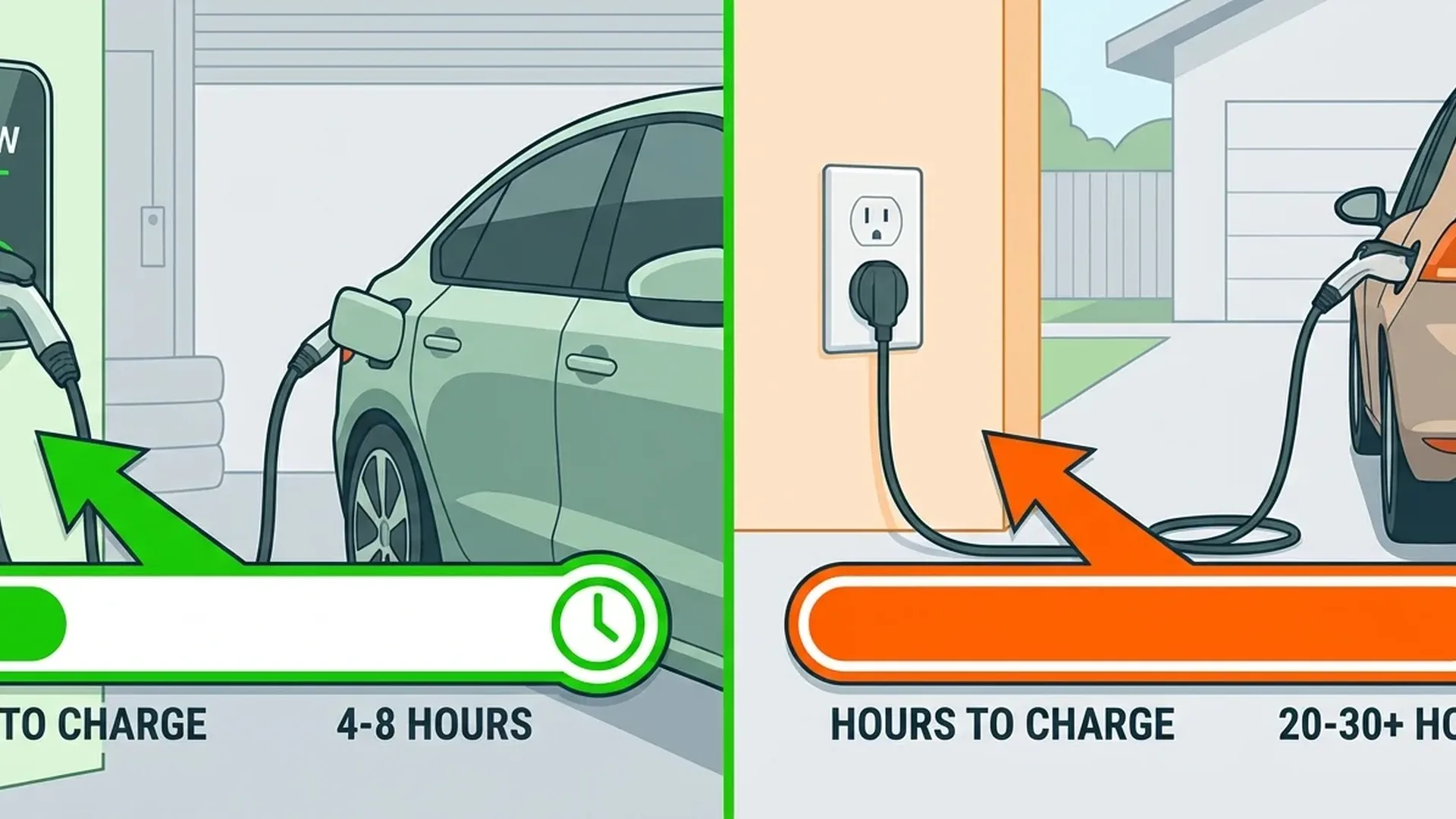
Speed is the factor that makes the biggest difference in your daily life. A standard US 120V outlet tops out at 1.4 kW (12A), while a Level 2 wallbox delivers 7.7-11.5 kW (32-48A at 240V). In Europe, a Schuko outlet provides 2.3-3.7 kW, while a three-phase wallbox reaches 22 kW. Here's what that looks like in practice:
| Method | Power | Time 10-80%* | Miles/hour added |
|---|---|---|---|
| US Outlet 120V / 12A (Level 1) | 1.4 kW | ~25 hours | 3-5 mi |
| EU Schuko 230V / 16A (Mode 2) | 3.7 kW | ~9.5 hours | 12-15 mi |
| Wallbox 240V / 32A (Level 2) | 7.7 kW | ~4.5 hours | 25-30 mi |
| Wallbox 240V / 48A (Level 2) | 11.5 kW | ~3 hours | 35-40 mi |
| EU Wallbox 3-phase (22 kW) | 22 kW | ~1.6 hours | 75+ mi |
* Estimates based on a ~50 kWh battery (e.g., Chevy Equinox EV / VW ID.4). Actual time depends on the vehicle's onboard charger capacity.
Safety — The Critical Factor
Charging an EV is nothing like charging your phone. An electric car draws current continuously for many hours at maximum load — putting extreme stress on a standard household outlet. Overheating is a real risk, especially with older wiring.
Outlet Overheating
Standard outlets were designed for intermittent use. Sustained 12-16A draws over many hours can melt contacts and damage wiring, especially in pre-1990s homes.
Aging Electrical Systems
Older homes may not have grounded outlets, adequate wire gauge, or properly sized breakers for continuous high-current loads. An electrician inspection is essential.
Built-in Wallbox Protections
GFCI/RCD protection, overcurrent monitoring, temperature sensors, and automatic shutoff on fault — all built into the unit. Most are UL-listed (US) or CE-certified (EU).
Standards & Certifications
Wallboxes are certified to SAE J1772 / IEC 61851 / UL 2594 standards. Standard outlets were never designed for continuous EV charging loads.
Important: Most EV manufacturers (Tesla, GM, Ford, VW, Hyundai, BMW) recommend Level 2 / wallbox charging as the only safe permanent home solution. Level 1 outlet charging is intended only for emergency or occasional use — like at a hotel or vacation home.
📖 Read more: First EV: 10 Things You Need to Know
Smart Features — What a Wallbox Adds
Modern wallboxes aren't just “outlets on the wall.” They pack technology that saves money and simplifies your life:
Charging
Balancing
Dynamic load balancing is perhaps the most valuable smart feature. The wallbox communicates with your electrical panel and automatically reduces charging power when you turn on the AC, oven, or water heater. Result: no tripped breakers — and you may not even need a panel upgrade.
Cost — Purchase, Installation, Operation
The outlet “costs nothing” upfront, but the full picture is more nuanced. Slower charging means greater energy losses, and the lack of scheduling means you may be charging during expensive peak hours.
Cost per Mile
With an average US electricity rate of $0.16/kWh (or ~$0.10/kWh off-peak in many states) and consumption of 3.5 mi/kWh (typical EV), the cost per mile with home charging is as low as $0.029-0.046/mile. Compare that to a gas car (28 MPG × $3.50/gal): $0.125/mile — roughly 3-4× more expensive.
Installation — What You Need
Before buying a wallbox, check a few things in your home:
A 200A panel easily supports a 48A charger. If you have a 100A panel, you may need a panel upgrade ($1,500-3,000) or a smart circuit splitter like DCC-9 ($300-400) to share circuits. Many newer wallboxes (e.g., Emporia, ChargePoint Flex) support power sharing natively.
Garage is ideal. Outdoor installation requires a NEMA 4 or IP65-rated unit. Wire run from panel to charger determines installation cost — every 10 ft adds ~$20-50. A hardwired connection is more permanent; a NEMA 14-50 plug gives flexibility to swap chargers.
Installation must be done by a licensed electrician. You'll need a dedicated circuit, appropriately sized breaker (40-60A), proper wire gauge (6 or 8 AWG), and may need a local permit. NEC 2023 requires GFCI protection for all EV charging circuits.
Tax Credits & Incentives
In the US, the federal Alternative Fuel Vehicle Refueling Property Credit (30C) provides up to $1,000 (30% of cost) for home EV charger purchase and installation through 2032. Many states and utilities offer additional rebates — California ($800+ through TECH Clean), Colorado ($500), and numerous utility-specific programs. Check the DOE Alternative Fuels Data Center (afdc.energy.gov) for incentives in your area.
📖 Read more: Polestar 4: The Premium EV Without a Rear Window
Popular Wallboxes in the US (2025-2026)
| Model | Power | Price* | Stands Out For |
|---|---|---|---|
| ChargePoint Home Flex | Up to 50A / 12 kW | $600-700 | Adjustable amperage, excellent app, UL listed |
| Tesla Wall Connector | Up to 48A / 11.5 kW | $400-475 | Tesla integration, power sharing, NACS + J1772 |
| Wallbox Pulsar Plus | Up to 48A / 11.5 kW | $500-650 | Compact design, solar integration, Bluetooth/Wi-Fi |
| Emporia EV Charger | Up to 48A / 11.5 kW | $400-500 | Budget-friendly, energy monitoring ecosystem |
| Grizzl-E Classic | Up to 40A / 9.6 kW | $400-450 | Rugged build, NEMA 4 rated, minimal maintenance |
* Approximate purchase prices without installation. Prices may vary by retailer.
Which Solution Fits Whom?
You drive <20-25 miles/day. You're never in a rush. You live in a rental without installation options. You have a plug-in hybrid with a small battery (10-15 kWh).
You drive 25-60 miles/day. You want a full charge every morning. First EV with a standard battery (50-65 kWh). 200A panel or available capacity.
You drive 60+ miles daily. Large battery (75+ kWh). Want solar pairing, multi-vehicle charging, or maximum flexibility for future EVs.
Wallbox vs Outlet — Full Comparison
Wallbox — Advantages
- 3-8× faster charging speed
- Built-in safety protections (GFCI/RCD)
- Scheduled charging — off-peak savings
- Solar panel integration
- Dynamic load balancing
- App, energy tracking, notifications
- Increases home resale value
- UL / IEC certified for EV charging
Outlet — Drawbacks
- Very slow (20-25+ hours for full charge)
- Overheating risk with sustained load
- No smart features or scheduling
- Higher energy losses at low power
- No load balancing capability
- Inadequate for large batteries
- Not recommended by manufacturers
- Not certified for EV charging use
The Bottom Line
A standard outlet technically works — but it was never designed for sustained high-current charging over many hours. If you plan to use an EV as your daily driver, a wallbox isn't a luxury — it's a necessity.
With Level 2 chargers starting at $300-500, a federal tax credit of up to $1,000, and potentially hundreds in state/utility rebates, the investment pays for itself surprisingly fast. Think of it this way: you pay once and charge safely, quickly, and cheaply for the next 10+ years.
The only scenario where an outlet makes sense as a permanent solution is if you have a plug-in hybrid with a small battery (10-15 kWh) or drive very few miles daily. For everyone else: wallbox, no second thoughts.