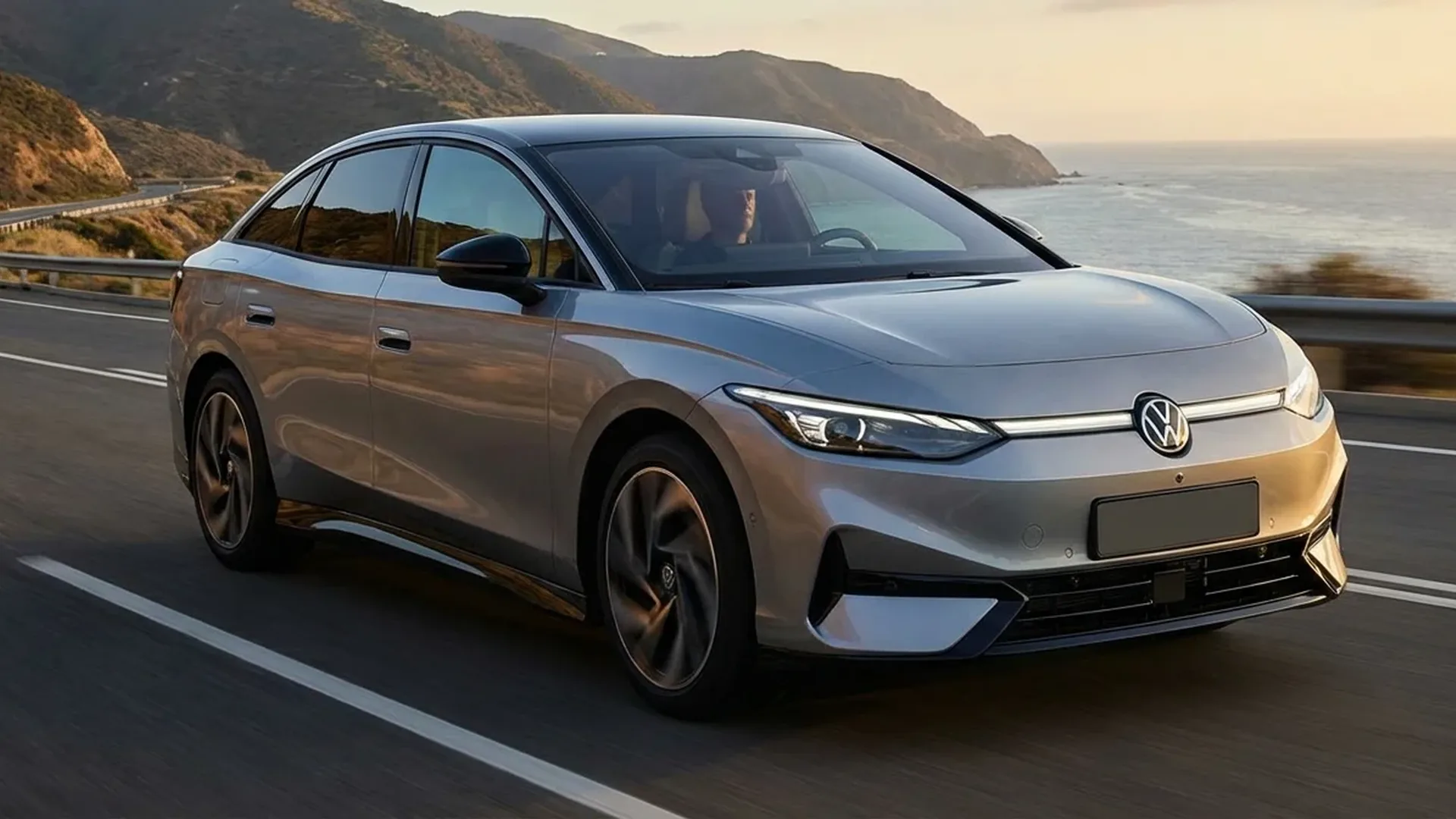
The ID.7 is essentially the electric evolution of the legendary Passat — a nameplate that sold over 30 million units worldwide. VW leveraged decades of experience building business sedans to create something tailored specifically for long-distance travel and corporate fleet use.
Versions and Specifications
What Sets the ID.7 Apart?
The ID.7 Pro S delivers one of the longest ranges in the sedan category: 700km WLTP. Built on VW Group's MEB platform, it runs the latest APP550 electric motor (permanent magnet, 282hp, 545Nm) driving the rear wheels. The aerodynamic shape is remarkable: a drag coefficient of just Cd 0.23 — among the lowest in its class, meaning less energy wasted on air resistance and more kilometers per kWh.
📖 Read more: Mazda 6e: The Electric Sedan Coming to Greece
In real-world testing, Top Gear described the ID.7 as “remarkably quiet” and an “excellent comfortable cruiser” — a car that “chews through the miles” effortlessly. The suspension (with optional adaptive dampers) handles both rough roads and motorway speeds nicely. It is not sporty — but it does not pretend to be, either.
Charging and Real-World Range
DC charging peaks at 200kW — in practice that means 10% to 80% in roughly 26 minutes, adding over 200km of range during a single coffee stop. AC charging comes standard at 11kW, enough for a full overnight charge at home. Energy efficiency sits around 14-16 kWh/100km on the motorway — an impressive figure for a sedan nearly five metres long.
In practice, the 700km WLTP range drops to around 500-550km in mixed driving at moderate temperatures — still an excellent number. Even driven exclusively on the motorway at 130km/h, you get roughly 400km: enough for an Athens-to-Thessaloniki trip without stopping. Very few EVs at the €55,000 price point can make that claim.
Interior and Technology
Inside, VW has addressed the pain points that plagued earlier ID models. The 15-inch touchscreen runs the second-generation infotainment system — more responsive, more customizable, and requiring fewer taps for common functions. The slider controls below the screen are now illuminated at night (something conspicuously absent before). The Augmented Reality Head-Up Display projects navigation and speed as a virtual image appearing 10 metres ahead on the road.
Rear seat space rivals a business-class lounge: headroom matching an E-Class, legroom surpassing many cars in this segment. The cargo area features a liftback design rather than a traditional trunk, giving it near-estate practicality. An optional panoramic roof can switch from opaque to transparent at the touch of a button.
ID.7 vs BMW i5 vs Mercedes EQE
- Range: ID.7 700km > BMW i5 580km > EQE 654km
- Price: ID.7 ~€55K < BMW i5 ~€70K < EQE ~€72K
- Premium feel: BMW i5 > Mercedes EQE > VW ID.7
- Space: ID.7 = EQE > BMW i5
The ID.7 is not aimed at premium-badge buyers. If you want BMW styling or Mercedes luxury feel, you will not find it here. But if you care about kilometers per euro, neither premium comes close. In the Greek market, where price sensitivity runs high, the €15,000-17,000 gap translates to 3-4 years of free charging electricity. For corporate fleets, that advantage compounds quickly — especially combined with the low maintenance costs inherent to every EV.
The ID.7 is Volkswagen's most compelling electric car yet — combining genuine long range with a thoughtful, spacious interior at a price below its rivals.
— Auto Express, Jan 2026ID.7 for Corporate Users
With EV tax advantages in Greece (50% annual depreciation), the ID.7 is highly attractive for company car fleets. The real-world range of 550km covers even the longest business trips without intermediate charging — think Athens to Thessaloniki on a single charge. Travel Assist Level 2 takes over on motorways (lane keeping, adaptive cruise control), and the 360-degree parking camera makes city parking effortless.
ID.7 Tourer: The Electric Estate
For those needing even more cargo space, VW offers the ID.7 Tourer — essentially the estate version. For just €800 more (in Europe), you get a significantly larger boot without meaningful range loss (640km for the GTX Tourer). In an era where electric station wagons barely exist, the ID.7 Tourer stands as a genuinely unique proposition.
The drag coefficient rises slightly to 0.25 (from the sedan's 0.23), but the frontal area remains relatively low. The aerodynamic work VW invested shows clearly in the consumption figures: even as an estate, the ID.7 Tourer uses less energy per kilometer than many rival sedans.
Our Verdict
The Volkswagen ID.7 is not the most visually striking car in its segment — it will not turn heads in a parking lot. But in the areas that actually matter for daily use, it does an excellent job. The 700km WLTP range tops the class. Cabin space competes with cars costing €15,000-20,000 more. DC charging at 200kW fills up reasonably fast. And pricing starts at €55,000 — nearly €15,000 less than a BMW i5 and even further below the Mercedes EQE.
The downsides? Design does not stand out. The infotainment is improved but still trails Apple CarPlay or BMW's iDrive. And nearly two tonnes of weight cannot be hidden in corners. Still, if you are searching for an electric business sedan with the best range-to-price ratio on the market, the ID.7 currently has no real rival at its price point.