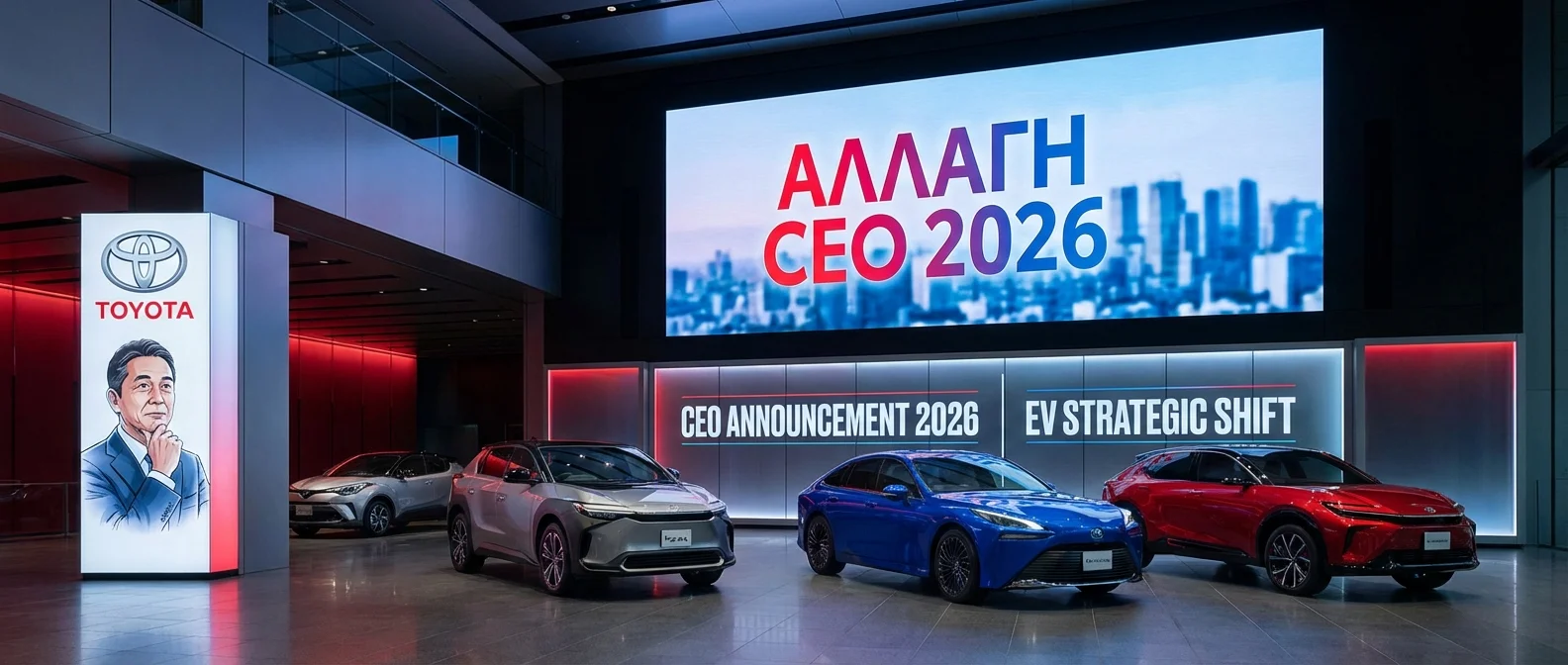
In January 2023, Akio Toyoda — grandson of the founder — announced he was handing over the reins to Koji Sato, former head of Lexus. Since April 2023, Sato has been CEO & President of the world's largest automaker. Three years later, Toyota is transforming: new EVs every quarter, a $14 billion battery plant in North Carolina, and solid-state batteries on the horizon.
📖 Read more: Solid-State Batteries: The Revolution That Will Change Electric Cars
Who Is Koji Sato?
Koji Sato (佐藤 公治) was born in 1969 and graduated from Waseda University with a mechanical engineering degree in 1992. He joined Toyota the same year.
His career trajectory through Toyota reads like a masterclass in automotive leadership:
- 1990s–2000s: Worked on suspension design for early hybrid models and led development of the Camry for North America (Wikipedia)
- 2016: Took charge of Lexus, Toyota's premium brand
- September 2020: Appointed President of Toyota Gazoo Racing (motorsports division)
- January 2021: Became Chief Branding Officer
- April 2023: Became CEO, replacing Akio Toyoda
- June 2023: Also became President of the company
Why this matters: Sato is the first non-Toyoda family CEO in 14 years. His technical background (mechanical engineer, hybrid development) combined with Lexus and motorsport experience makes him ideal for the EV transition.
Why Did Akio Toyoda Step Down?
Akio Toyoda — grandson of founder Kiichiro Toyoda — served as CEO from 2009 to 2023. Under his leadership, Toyota became the world's largest automaker, but faced intense criticism for lagging on electric vehicles.
Key points of criticism (according to Reuters, Bloomberg, Transport & Environment):
- December 2020: Toyoda called EVs "overly hyped" and claimed the transition would cost $135–358 billion in Japan alone
- June 2021: Transport & Environment ranked Toyota dead last among OEMs in BEV readiness by 2030
- June 2022: Recalled 2,700 bZ4X vehicles due to wheel problems — embarrassing debut for their first BEV
- 2023: Daihatsu scandal (falsified safety tests) across 64 models, Sato publicly apologized
In January 2023, Toyoda announced his departure. He remained as Chairman of the Board while Sato took over as CEO/President.
⚠️ Important clarification: Akio Toyoda did NOT leave entirely. He remains Chairman of the Board of Directors, overseeing strategic direction without handling day-to-day operations.
Sato's EV Strategy Transformation
Sato inherited the largest EV transformation in Toyota's history — a $70 billion (¥8 trillion) commitment announced in December 2021:
| Target | Details | Timeline |
|---|---|---|
| BEV models | 30 battery-electric vehicles | By 2030 |
| BEV sales | 3.5 million annually | By 2030 |
| Lexus 100% BEV | North America, Europe, China | By 2030 |
| Total investment | $70 billion (¥8 trillion) | Through 2030 |
| Carbon neutrality | 90% emissions reduction vs 2010 | By 2050 |
Toyota's EVs Today (2025–2026)
Under Sato, Toyota went from 1 BEV (bZ4X, 2022) to an entire electric lineup. According to Electrek (Feb 2026):
bZ (Beyond Zero)
The redesigned bZ ranks among best-selling EVs in the US (Jan 2026), outselling the Hyundai IONIQ 5.
🔥 Top seller USAbZ Woodland
Larger than the bZ, with standard AWD. Priced $10,000+ above the base bZ.
AWD standardC-HR EV
Under $35,000, ~300 miles range, NACS charging port. Toyota's most affordable EV SUV.
From ~$35KHilux BEV
Debuted November 2025 at Brussels Motor Show. Electric pickup — Toyota's first globally.
Europe first3-Row Electric SUV
Large 3-row SUV (likely Highlander EV), interior revealed Feb 2026.
Coming soonBattery Factory & Solid-State Technology
One of Sato's biggest bets is vertical integration in battery production:
North Carolina Factory ($13.9 billion)
- November 2025: Production began — Toyota's first battery factory outside Japan (Electrek)
- Size: 1,850 acres (~750 hectares) — equivalent to 121 football fields
- Toyota announced plans to expand the facility even further
Solid-State Batteries — The "Holy Grail"
- Partnership with Idemitsu Kosan (Japanese oil company) — January 2026 began construction of pilot plant for solid electrolytes (Electrek)
- Toyota holds over 1,000 patents in solid-state batteries (Wikipedia)
- Promise: +30% efficiency and corresponding cost reduction
- But: the company has repeatedly delayed — November 2025 postponed plans for new battery factory in Japan again (Electrek)
⚠️ Reality check: Toyota has been promising solid-state batteries for years, but mass production remains in pilot stage. The market should evaluate models that are available now, not future promises.
China: From Behind to Ahead
China represents a critical market — Toyota sold 1.77 million vehicles there in 2024. Under Sato:
- bZ3X: Starting price ~$15,000 — a "hit" in China (Electrek, Dec 2025)
- bZ7: Flagship electric sedan, pre-orders from ~$30,000 (Nov 2025)
- BYD Toyota EV Technology joint venture (established 2020) — developing BEVs with BYD
The "Multi-Pathway" Philosophy
Unlike companies like Tesla or BYD that focus exclusively on BEVs, Toyota under Sato maintains a "multi-pathway" approach:
BEV
Battery-electric — bZ series, C-HR EV, Hilux BEV
Hybrid/PHEV
Remain best-sellers — "barely cover the demand" (Nov 2025)
Hydrogen
Toyota Mirai, hydrogen trucks, £11.3M UK deal for hydrogen Hilux
This strategy draws criticism from environmental groups, but Toyota argues different markets need different solutions. At the G7 (May 2023), Toyoda stated: "BEVs are not the only solution."
What This Means Globally
Toyota is one of the most popular brands worldwide. The leadership change affects consumers directly:
- More electric options: Instead of just hybrid models, soon there will be bZ, C-HR EV, Urban Cruiser EV
- Competitive pricing: Chinese EVs are pressuring — Toyota is forced to cut costs (bZ3X at $15K in China)
- Hybrids still relevant: For buyers without access to charging, Toyota hybrids remain an excellent choice
- Incentives: New BEV models will qualify for government EV incentive programs
Bottom Line
The CEO change at Toyota wasn't just an internal matter. Koji Sato — engineer, former Lexus boss, motorsport enthusiast — takes over a company that sells 8.7 million vehicles annually (2024) but only recently started taking BEVs seriously. Three years later, the signs are encouraging: new factories, new models, top-selling EVs. But Toyota still trails BYD and Tesla in pure electric sales. Sato can close this gap — if the multi-pathway strategy doesn't slow him down.