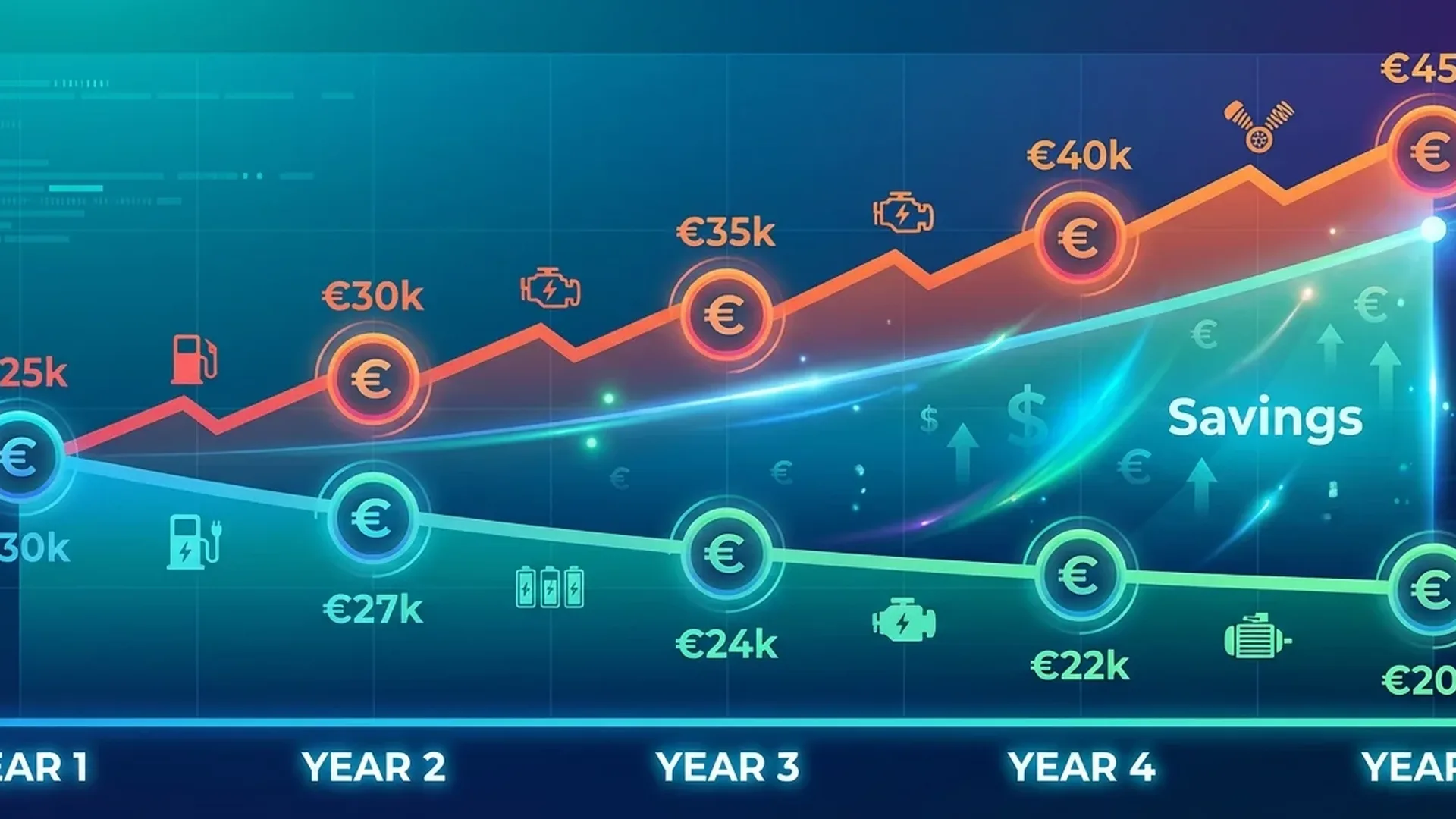
Buying an electric car isn't judged by the sticker price alone. The Total Cost of Ownership (TCO) includes every dollar you'll spend on energy, maintenance, insurance, taxes, and depreciation over the vehicle's lifetime. And that's where the equation shifts dramatically.
📖 Read more: 10 Common EV Owner Mistakes & How to Avoid Them
In this article, we break down every cost factor, comparing a typical EV with an equivalent gasoline car over a 5-year horizon in Greece. The numbers speak for themselves.
What Does TCO Include?
Total cost of ownership isn't simply “purchase price + gas.” It encompasses six key cost categories that, when combined, determine whether a car is truly affordable.
1. Purchase Price: The Big Barrier
The upfront price remains the biggest obstacle. A popular EV in Greece (e.g., MG4 Standard, BYD Atto 3, VW ID.3) costs $32,000–$41,000, while an equivalent gasoline compact (VW Golf, Toyota Corolla, Peugeot 308) ranges around $24,000–$32,000. The difference? Roughly $6,500–$11,000.
However, in Greece EVs are exempt from the luxury tax (0% registration fee) and, during certain periods, purchase subsidies are available. This can narrow the gap to $3,200–$5,400. The government also offers incentives for wallbox installation.
2. Energy Cost vs Fuel
Here's where the first major reversal appears. Based on 9,300 miles/year:
3. Maintenance: Fewer Moving Parts, Lower Costs
Electric motors have hundreds fewer moving parts than internal combustion engines. No oil changes, fuel filters, timing belts, or exhaust systems. According to Consumer Reports (2024) data, Tesla was the least expensive brand to maintain over a 10-year period.
Brakes wear much less thanks to regenerative braking. Only tires may wear slightly faster due to the heavier vehicle weight.
| Service / Part | EV (5 yrs) | ICE (5 yrs) |
|---|---|---|
| Oil changes | $0 | ~$815 |
| Brake pads | ~$110 | ~$435 |
| Timing belt | $0 | ~$545 |
| Filters (air, oil, fuel) | ~$55 | ~$325 |
| Tires (2 sets) | ~$980 | ~$870 |
| Regular service | ~$650 | ~$1,630 |
| TOTAL Maintenance | ~$1,795 | ~$4,620 |
4. Insurance
EV insurance premiums tend to be 10-20% higher than equivalent ICE vehicles, mainly due to higher repair costs in accidents (especially if the battery is involved). However, the gap is narrowing as insurers gain more experience.
5. Taxes & Road Fees
In Greece, electric vehicles are fully exempt from road tax. A gasoline car with 1,400-1,600 cc engine pays approximately $250-$325 annually. Over 5 years, that means $1,250-$1,630 in savings on road tax alone.
Additionally, EVs are exempt from the luxury tax (registration fee) and in many municipalities enjoy free parking in controlled zones.
6. Depreciation & Resale Value
Depreciation is the biggest hidden cost of any car. EVs that were once more vulnerable to depreciation (due to battery anxiety) are now improving significantly:
- Only 2.5% of EV batteries have been replaced globally to date
- Battery warranty: 8 years / 100,000 miles with guaranteed 70% capacity
- Battery pack prices dropped to $115/kWh (BloombergNEF 2024)
- LFP batteries in China: just $56/kWh (early 2024)
It's estimated that an EV loses 40-50% of its value in 5 years, while an ICE loses 45-55%. The trend shows convergence, with EVs improving their resale value.
The Big Comparison: 5-Year TCO
Let's see the full picture. Scenario: compact-class car, 9,300 miles/year, home charging, comprehensive insurance.
| Cost Category | ⚡ EV | ⛽ ICE | Difference |
|---|---|---|---|
| Purchase price | $35,860 | $28,260 | +$7,600 |
| Energy / Fuel | $2,600 | $9,250 | −$6,650 |
| Maintenance | $1,795 | $4,620 | −$2,825 |
| Insurance | $3,530 | $2,990 | +$540 |
| Road tax | $0 | $1,410 | −$1,410 |
| Depreciation (value loss) | $16,140 | $14,130 | +$2,010 |
| TOTAL TCO (5 YRS) | $59,925 | $60,660 | −$735 |
Even with a higher purchase price, the EV matches or beats an ICE in total economy over 5 years. If you drive more than 9,300 miles/year, savings are even greater. With solar panels or off-peak charging rates, the difference becomes $3,200-$5,400 in favor of the EV.
Hidden Costs & Watch Points
How to Maximize Your Savings
When Does an EV Truly Pay Off?
The answer depends on three factors:
According to the European Consumer Organisation (BEUC), in the EU and US, TCO of modern EVs is already lower than equivalent gasoline cars, thanks to reduced energy and maintenance costs. The more miles you drive annually, the greater the advantage.
Conclusion
The TCO of an electric car over 5 years is now competitive or better compared to an equivalent gasoline vehicle in Greece. The higher purchase price is fully offset by lower energy costs (−60%), maintenance costs (−50%), and zero road tax. With solar panels or off-peak electricity rates, savings become dramatic.
The message is clear: don't judge by the sticker price alone. Calculate the entire ownership period — and the numbers will speak for themselves.