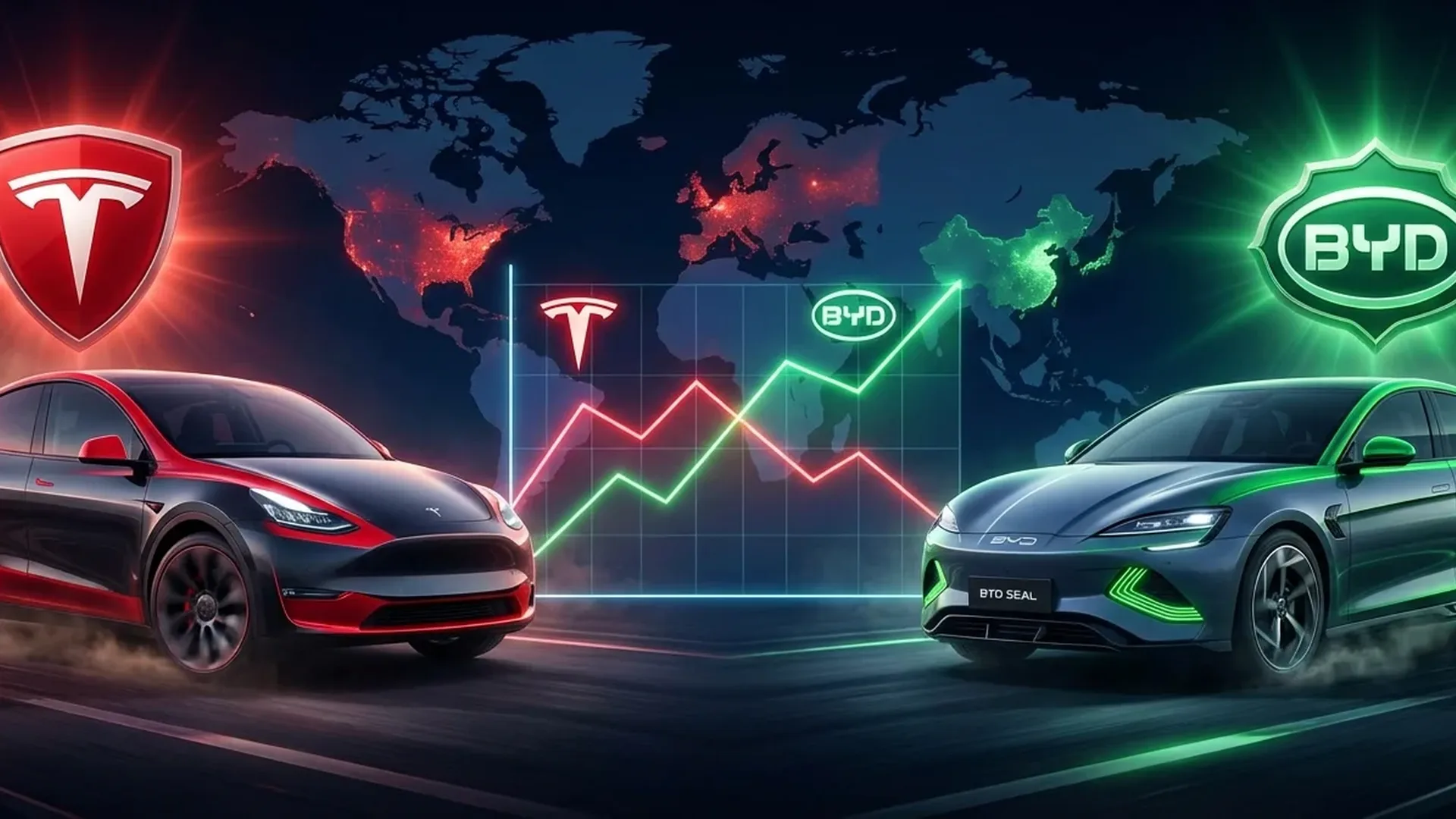
The battle for the top of the global electric vehicle market has never been more intense. On one side, Tesla — Elon Musk's pioneer that made EVs mainstream. On the other, BYD — Wang Chuanfu's Chinese colossus that started making phone batteries and is now the world's largest electric vehicle manufacturer. In 2025, BYD officially surpassed Tesla in global BEV sales — but the truth is far more complex than a single number.
Sales: The Numbers That Matter
Comparing Tesla and BYD sales requires a critical clarification: Tesla sells exclusively battery electric vehicles (BEV), while BYD sells both BEVs and plug-in hybrids (PHEV). This dramatically changes the comparison.
| Metric | Tesla 2024 | BYD 2024 | Winner |
|---|---|---|---|
| Total sales | ~1.79M | 4.27M | BYD |
| BEV only | ~1.79M | ~1.76M | Tesla (barely) |
| PHEV sales | 0 | ~2.49M | BYD |
| YoY growth | -1.1% | +41.3% | BYD |
| Revenue | ~$97.7B | ~$85.7B | Tesla |
In Q4 2023, BYD surpassed Tesla for the first time in quarterly BEV sales (526,409 vs 484,507). Throughout 2024, the BEV race was neck-and-neck, while in total NEV sales BYD was more than triple Tesla's numbers. In January 2026, it was confirmed that BYD claimed the title of the world's largest electric car seller for 2025.
Battery Technology: Blade vs 4680
BYD Blade Battery
- Chemistry: LFP (lithium iron phosphate)
- Advantage: Exceptional safety (nail test — no fire)
- Cost: Lower — no cobalt/nickel needed
- 1MW Charging: Flash battery 10C, 250 miles in 5 min
- Platform: Super e-Platform 1000V
Tesla 4680 Cells
- Chemistry: NMC (nickel-manganese-cobalt) + LFP
- Advantage: High energy density
- Cost: Target -50% with dry electrode
- Supercharger: V4 250kW+, network of 60,000+ stations
- Platform: Structural battery pack
BYD has a massive advantage: vertical integration. Its subsidiary FinDreams Battery manufactures cells in-house, and according to UBS analysis, 75% of a BYD Seal's components are made in-house — versus 46% for a China-made Tesla Model 3. This translates directly to lower production costs.
Conversely, Tesla has the world's most extensive fast-charging network (Supercharger V4 with over 60,000 stations), which is a massive competitive moat — especially in the US and Europe, where BYD charging infrastructure is virtually nonexistent.
Autonomous Driving & Software
Here Tesla maintains a clear lead. Full Self-Driving (FSD) has been in development for years, with millions of miles of training data. BYD responded in February 2025 with its "God's Eye" (TianShen) system — an ADAS platform using Nvidia Orin X or Qualcomm chips, now offered as standard on 21 of BYD's 30 models, including the cheapest Seagull. Whether it can match Tesla in full autonomy remains to be seen.
Did You Know? Tesla uses cameras exclusively (vision-only) for autonomous driving, while BYD combines cameras with radar. Tesla believes LiDAR/radar are “crutches” — BYD prefers multi-layered safety.
Geographic Dominance: Who Wins Where
Tesla Dominates
- USA: ~55% of EV market — BYD doesn't sell there
- Canada: Model Y #1 in EV sales
- Europe: Led the market until April 2025
- Scandinavia: Dominant brand in Norway, Sweden
BYD Dominates
- China: 34.1% of NEV market — #1 brand over VW
- SE Asia: Factories in Thailand, Indonesia
- Latin America: Brazil 76,713 sales, Mexico 40,000
- Europe: Surpassed Tesla in April 2025
A critical point: BYD does not sell passenger cars in the US — and likely won't in the foreseeable future, due to tariffs and political barriers. Stella Li, BYD's executive VP, stated plainly in February 2024: “We're not planning to come to the US.” Meanwhile, Tesla faces growing competition in China, where it holds just 6% of the NEV market.
Pricing & Value for Money
The biggest gap between Tesla and BYD shows in pricing strategy. BYD has sent shockwaves through the industry with ultra-low-cost models:
| Model | Price (China) | Price (US/EU est.) | Competitor |
|---|---|---|---|
| BYD Seagull | ~$7,800 | ~$21,000* | Nothing at this price |
| BYD Dolphin | ~$13,500 | ~$31,000 | Tesla Model 3 ($43,000+) |
| BYD Seal | ~$24,000 | ~$45,000 | Tesla Model 3 |
| Tesla Model Y | ~$28,000 | ~$45,000 | BYD Seal U / Song Plus |
*Estimated based on export pricing trends — BYD sells with 92–112% markup outside China (Rhodium Group).
The key number: according to Rhodium Group, BYD earns approximately $15,600 per Seal U sold in the EU — 11 times more than the $1,400 profit on the same model in China. Even with the new EU tariffs (17.4% additional + 15% existing = 32.4%), BYD remains profitable in Europe.
Production Capacity & Global Expansion
BYD is expanding at a staggering pace. By end of 2026, it will operate factories in Thailand (150,000/yr), Hungary (100,000+/yr — the first Chinese car factory in Europe), Turkey (150,000/yr), Indonesia (150,000/yr), Brazil (150,000/yr), Uzbekistan (50,000/yr), and Cambodia. In August 2025, BYD started exporting from Thailand to Europe, bypassing tariffs on China-manufactured EVs.
Tesla has four Gigafactories (Fremont, Austin, Berlin, Shanghai) but hasn't announced a comparable pace of new plant construction. However, Tesla leads in per-vehicle profitability, energy storage (Megapack), and the AI/robotics space (Optimus).
Model Range: Variety vs Focus
Tesla effectively sells 5 models: Model 3, Model Y (which accounts for ~75% of sales), Model S, Model X, and Cybertruck. The strategy is simplicity — few models, high volume.
BYD takes the exact opposite approach. With 4 brands (BYD, Denza premium, Yangwang luxury, Fangchengbao off-road) and over 30 models, it covers every market segment — from the $7,800 Seagull to the Yangwang U9 supercar. The Dynasty series (Han, Tang, Song, Qin, Yuan) uses Chinese dynasty names, while the Ocean series (Dolphin, Seal, Sealion) uses sea creature names.
What This Means for US & European Buyers
For consumers in the West, the Tesla-BYD rivalry is overwhelmingly positive. In Europe, BYD claimed the top spot in EV sales in April 2025, surpassing Tesla for the first time. The factory in Szeged, Hungary is expected to begin production in 2026, reducing import costs. BYD already sells in Germany, France, the Netherlands, the UK, Sweden, Spain, Belgium, Denmark, Austria, and Poland.
In the US, the picture is different. BYD has explicitly stated it has no plans to sell passenger cars in America due to prohibitive tariffs and political headwinds. For American buyers, Tesla remains the dominant domestic EV brand, and competition comes primarily from legacy automakers (Ford, GM, Hyundai/Kia) and newer entrants like Rivian. However, BYD's global pricing pressure still benefits US consumers indirectly by forcing all manufacturers to compete harder on value.
Strengths & Weaknesses
Tesla — Strengths
- FSD/autonomous driving pioneer
- Supercharger: best charging network
- Brand recognition & premium feel
- Profitability: higher margins
- Ecosystem: Energy, AI, Robotics
Tesla — Weaknesses
- Limited lineup (5 models)
- Declining sales in 2024 (-1.1%)
- Political controversy (Elon Musk)
- Quality issues (panel gaps)
- Weak in entry-level segment
BYD — Strengths
- Vertical integration (75% in-house)
- Massive lineup (30+ models, 4 brands)
- Low production cost
- Blade Battery: safety & reliability
- Sales momentum (+41.3% growth)
BYD — Weaknesses
- Absent from US — largest EV market
- PHEV reliance (58% of sales)
- EU tariffs (32.4%) & geopolitical risk
- Weaker brand recognition in the West
- Profit decline Q2 2025 (-29.9%)
2026 and Beyond: What to Expect
JPMorgan forecasts BYD will sell 6.5 million vehicles in 2026, though the company itself cut its 2025 target from 5.5 to 4.6 million. Tesla is expected to rebound with the refreshed Model Y (Highland) and the Cybercab robotaxi (Q2 2026). The battle will be decided on three fronts:
Production
Who scales new factories faster
Autonomy
Who delivers reliable Level 4 first
Price
Who makes EVs truly affordable
Verdict
There is no outright winner — at least not yet. BYD wins on volume, variety, cost, and production capacity. Tesla wins on software technology, brand value, charging infrastructure, and profitability. If you're looking for the most affordable EV, BYD will likely become your choice. If you want cutting-edge autonomous driving and a premium experience, Tesla remains the one to beat.
The real winner? The consumer. The rivalry between these two giants pushes prices down, improves technology, and accelerates the transition to electric mobility. And that benefits everyone.
Tags: #Tesla vs BYD #EV sales 2026 #global market #BYD Blade Battery #comparison