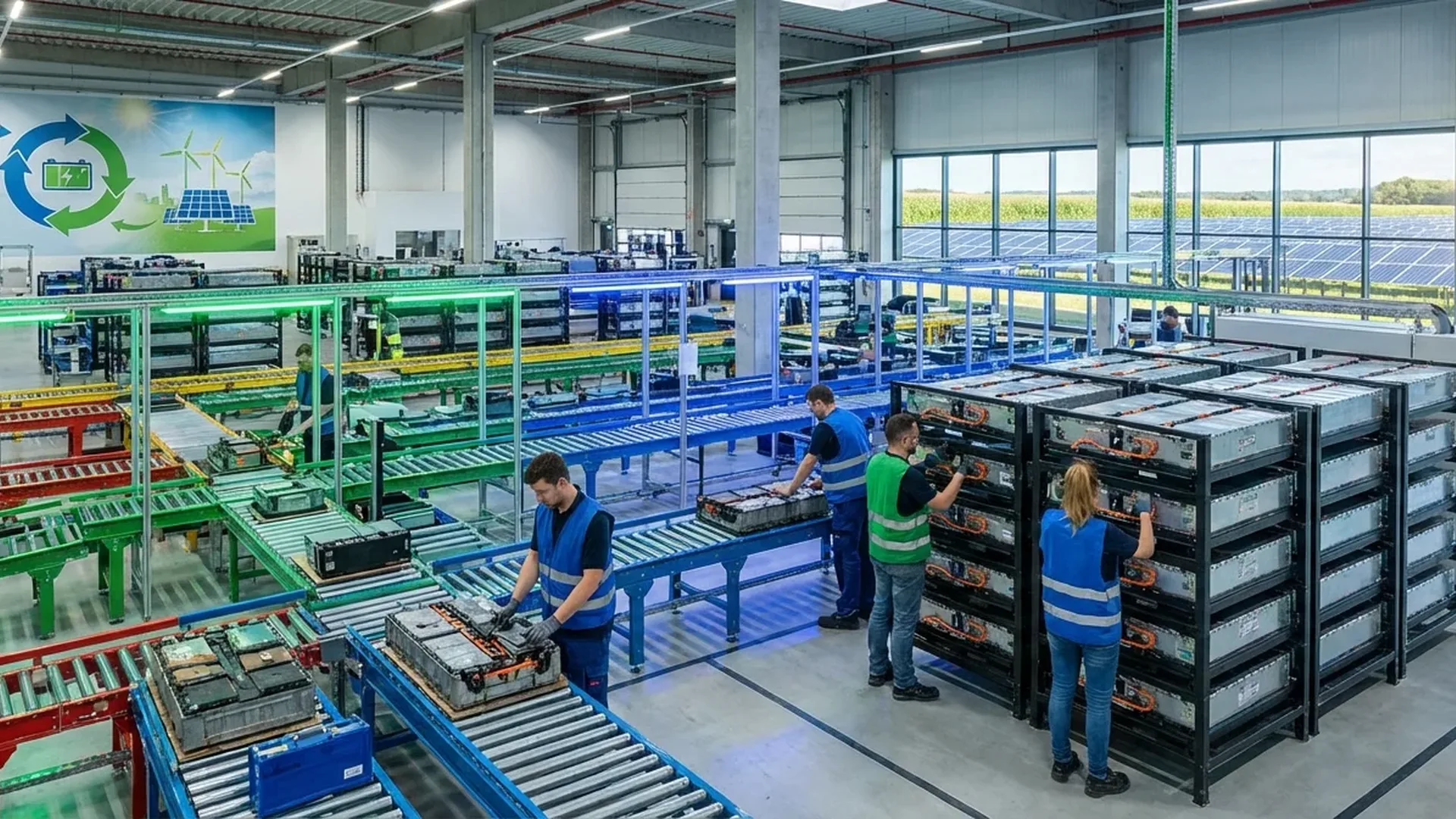
What happens to an EV battery when the car reaches end of life? The short answer: it starts over. Recent data shows lithium-ion batteries retain 70-85% of their original capacity even after 8-12 years of automotive use. That means thousands of kilowatt-hours of energy that can still be put to work — if we know how.
📖 Read more: Silicon Anode Batteries: A New Era of EV Range
Source: Generational UK (8,000+ tests, 36 manufacturers) & Electrek, February 2026
The Truth About Battery Longevity
The largest field study on EV batteries was published in February 2026 by UK-based Generational. Over 8,000 battery tests across 36 manufacturers were analyzed — from brand-new cars to models over 12 years old. The results upend many assumptions:
🔋 4-5 Year Old EVs
Median SoH: 93.53%
Bottom 25%: 91.64% | Top 25%: 96.49%
🔋 8-12 Year Old EVs
Median SoH: 85.04%
Bottom 25%: 82% | Top 25%: 90%
"Mileage is no longer the best indicator of battery health. A three-year-old fleet EV with 100,000 miles may have a healthier battery than a six-year-old car with 30,000 miles."
— Generational Battery Report, 2026
📖 Read more: Nio Battery Swap: Battery Change in Under 3 Minutes
What Happens After the Car
When an EV battery drops below ~70-80% of its original capacity, it's no longer ideal for automotive use (reduced range). But that doesn't mean it's useless — far from it. A 77 kWh battery at 75% still has 58 kWh of storage capacity. That's enough to power an average home for 2+ days.
Home Storage
Replaces Powerwall — stores solar energy for nighttime use or as backup during power outages
Charging Stations
Buffer batteries at DC chargers — reduce peak demand from the grid and lower electricity costs
Grid-Scale Storage
Massive installations stabilize the grid and store wind/solar energy for later dispatch
Real-World Examples
GM + Redwood Materials
Redwood Energy repurposes used GM batteries into energy storage systems. The installation in Sparks, Nevada (12 MW / 63 MWh) is the world's largest second-life battery project and the largest microgrid in North America.
Johan Cruyff Arena
In Amsterdam, 148 Nissan LEAF batteries power the stadium during peak demand, store solar energy from rooftop panels, and serve as backup during power outages.
BMW €10M Recycling Center
BMW built a €10M cell recycling plant in Germany. Goal: closed-loop production — new batteries made from old battery materials, without new mining.
Porsche Closed-Loop
Porsche is piloting a raw-material recycling program for high-voltage batteries. Target: new batteries without mining fresh lithium, cobalt, or nickel.
📖 Read more: EV Battery Degradation: Myths vs Reality
The Lifecycle
The “second life” sits between automotive use and final recycling. A battery retired from an EV at 75% SoH can serve as stationary energy storage — an application with much lower power demands than a car — for another 5-10 years. Only when it drops below ~50% does recycling become economically worthwhile.
Recycling technology has advanced dramatically. Hydrometallurgy now enables 95%+ recovery of lithium, cobalt, nickel, and manganese. The EU Battery Regulation (2027) introduces mandatory minimum recycled content in new batteries: 16% cobalt, 6% lithium, 6% nickel. This creates enormous demand for recycled materials.
The Market: Numbers & Trends
The global second-life battery market is projected to reach $70+ billion by 2035. The reason is simple: by then, millions of first-generation EVs — LEAF, Model S, i3, e-Golf — will be retiring simultaneously. Electricity demand from AI data centers is expected to triple as a share of US consumption (4.4% in 2023 → 12% by 2028).
"Electricity demand is accelerating at unprecedented rates. Both used GM batteries and new batteries can be deployed in Redwood's energy storage systems, providing fast, flexible power solutions."
— JB Straubel, CEO Redwood Materials (former Tesla CTO)
Conclusion
The “second life” of EV batteries is not a future scenario — it's already happening. GM with Redwood Materials is already operating the world's largest second-life project, BMW and Porsche are creating closed-loop recycling, and the Generational study proves batteries last far longer than we feared. With an average SoH of 95% and proven endurance beyond 350,000 miles, EV batteries have decades of life ahead — first in the car, then in the grid, and finally in recycling. The circular economy of electrification isn't theory — it's reality.