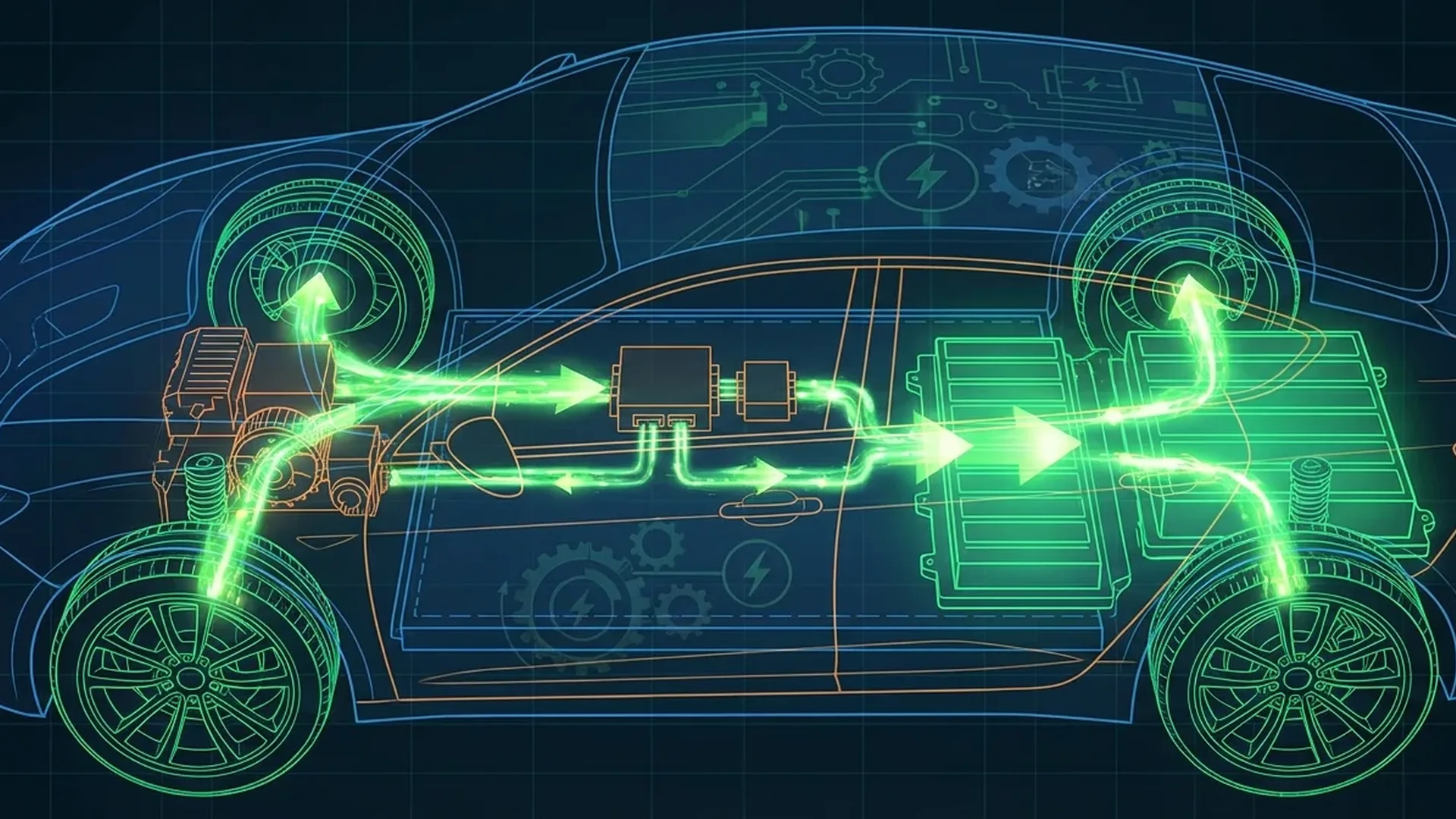
How Does Regenerative Braking Work?
An EV's electric motor also acts as a generator when the accelerator is released or the brake is pressed. Instead of converting kinetic energy into heat (as conventional brakes do), the motor reverses direction — the spinning of the wheels forces it to act as an electrical generator.
The generated current charges the battery or goes directly into the system. Efficiency depends on speed, deceleration profile, and settings — it can reach up to 70% under optimal conditions. Important detail: regen doesn’t work at very low speeds (below 5-8 km/h), because the motor cannot generate sufficient voltage. That’s why in many EVs with one-pedal driving, the conventional brake takes over automatically for the final stop. Also, when the battery is fully charged (100%), regen is completely disabled — there’s simply no room for more energy — which is why many drivers prefer to charge to 80-90% before routes with steep descents.
Regenerative Braking Levels
Most EVs offer selectable regen levels: from minimal (feels close to a petrol car) to maximum (one-pedal driving). Models like the Nissan Leaf and BMW i4 allow full deceleration nearly to a standstill without touching the brake pedal.
One-Pedal Driving: The Future of Urban Driving
With one-pedal driving enabled, a single pedal handles both acceleration AND braking. Release the accelerator and the car decelerates sharply — using regen to do so. In heavy stop-and-go city traffic, this means operating almost exclusively with one pedal. Perfect for city driving.
📖 Read more: One Pedal Driving: How It Works in EVs
Which Models Have the Best Regenerative Braking?
The Nissan Leaf was the pioneer with its e-Pedal system. Tesla Model 3 and Model Y offer adjustable regen. The BMW i4 and iX use the steering wheel paddle to control regen intensity. The Hyundai Ioniq 6 has pedal-based regen with 4 levels. Mercedes EQS features automatic adaptive regen based on GPS map data.
In plug-in hybrids (PHEVs), regenerative braking works alongside the petrol engine, helping to charge the small battery and reduce fuel consumption.
Regenerative braking can recover up to 70% of kinetic energy in optimal conditions — a key factor making EVs so efficient in urban traffic.
— U.S. Department of Energy, Office of Energy EfficiencyWhat Does It Mean for Brake Pads?
EVs use conventional brakes far less frequently — regen does the main work. Result: brake pads last 2-3x longer than in a petrol car. In many EVs, front brake pads don't need replacing until 100,000+ km.
Note: Brakes that go unused may develop surface rust if the car sits still for long periods — a well-known phenomenon among Tesla owners. It's harmless and clears after a few brake applications, but worth knowing about.
Less Brake Dust: An Environmental Bonus
A less-discussed advantage of regenerative braking concerns the environment. A 2025 study found that electric cars produce 83% less brake dust compared to petrol vehicles. This is because EVs rarely use their mechanical brakes — regen handles most deceleration. Brake dust contains microparticles of copper, iron, and asbestos compounds that pollute urban air. In dense cities with heavy traffic, these particulates become a serious public health concern, and regenerative braking significantly mitigates the problem.
📖 Read more: Electric Car on the Islands: Is It Worth It?
Advanced Regen Systems by Manufacturer
Regen technology is evolving rapidly. The Mercedes EQS uses GPS data, front camera, and radar signals to automatically adjust the recovery level: approaching a roundabout or traffic light, it increases regen automatically. The Porsche Taycan features a coasting mode on motorways, disabling regen entirely for maximum aerodynamic efficiency — and at low speeds engages strong regen. The BMW iX offers adaptive regen via paddle shifters on the steering wheel, giving drivers precise control without hands leaving the wheel.
In plug-in hybrid (PHEV) vehicles, regenerative braking works alongside the combustion engine. The algorithm decides how much regen goes to the battery versus how much is left to mechanical brakes. In many modern PHEVs (Toyota RAV4 Prime, BMW X5 xDrive50e), the battery can be partially charged from regen alone during city driving, meaning fewer charging stops and more electric range.
📖 Read more: Electric vs Hybrid 2026: Which One Is Worth It?
Regen in Extreme Weather Conditions
In cold weather (below 0°C), Li-ion batteries cannot accept charge as quickly, so many EVs automatically reduce regen until the battery warms up. In Teslas, you'll see yellow dots on the regen indicator — this means limited regenerative braking. After 10-15 minutes of driving, the battery warms and full regen is restored. On wet or icy roads, strong regen can cause the front wheels to lose traction — lower regen settings are recommended in slippery conditions. Modern EVs with ESC (Electronic Stability Control) manage this automatically, but driver awareness remains essential.
Practical Driving Tips for Maximum Recovery
To maximise regen benefits: anticipate stops early and release the accelerator well in advance. On downhill sections, use B mode or the strongest regen setting instead of braking — you recover energy while controlling speed. On the motorway, use lower regen or cruise control for smoother driving. And remember that in mountainous terrain with long descents, regen can recover substantial energy — some drivers report recovering 15-20% of battery on long mountain passes.
Conclusion
Regenerative braking is one of EVs' most important advantages — it increases range, reduces brake wear, protects the air from brake dust, and simplifies driving through one-pedal operation. Once you experience it, there's no going back to conventional braking.