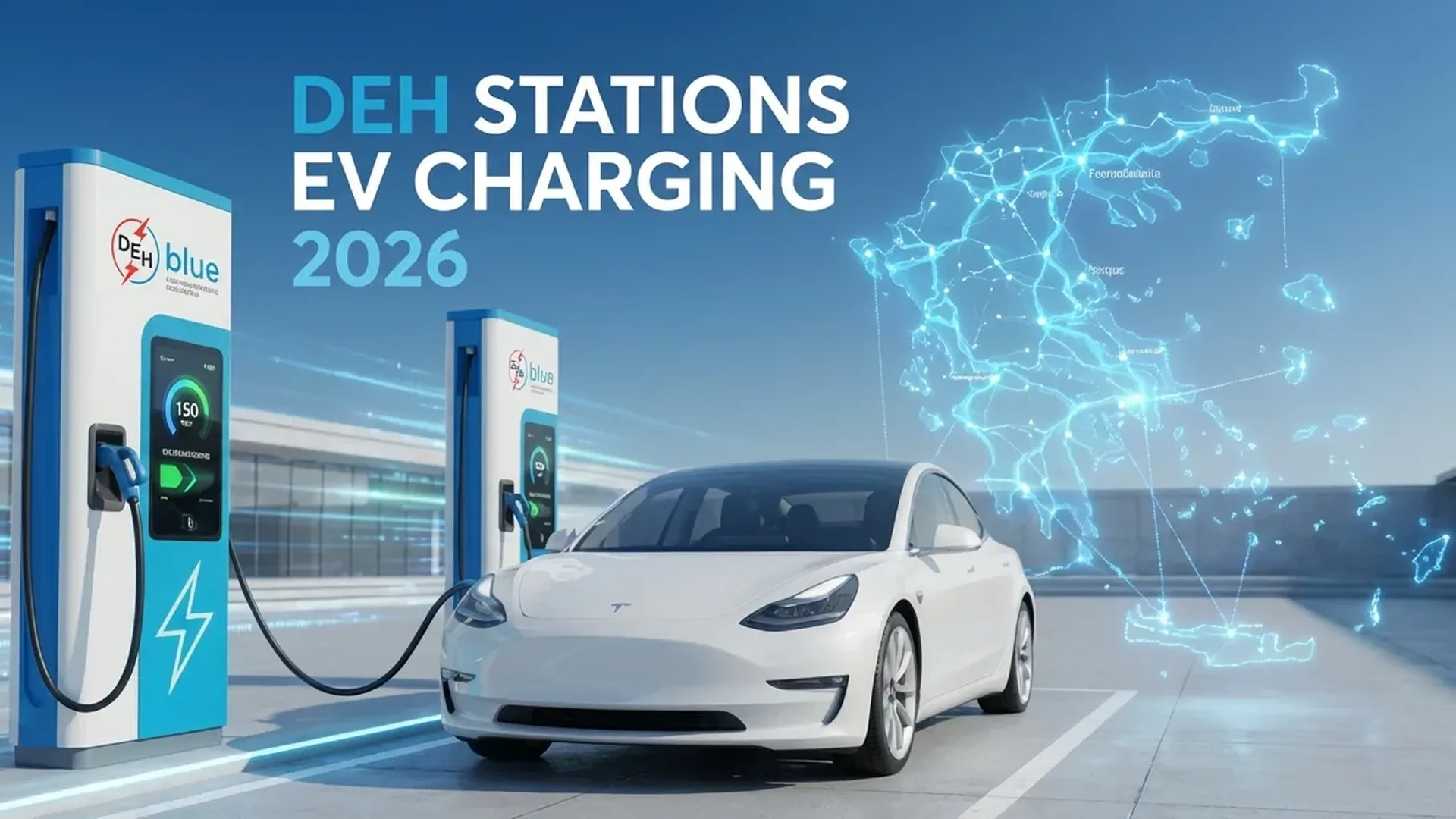
EV charging in Greece is evolving rapidly, with PPC (Public Power Corporation) and new private operators (CPOs) continuously expanding the public charging network. From 1,700 charging points in 2022, the country is heading toward thousands of new stations funded by the EIB and InvestEU. In this article, we analyze what applies in 2026, who the providers are, how to charge, and what it costs.
📖 Read more: EV Charging Costs: Public vs Home 2026
PPC and EV Charging in Greece
PPC (Public Power Corporation / DEI), the largest energy provider in Greece, announced in June 2020 an ambitious plan to install charging infrastructure. According to electrive.com, PPC signed two Memoranda of Understanding (MoUs) with private companies for:
- 1,000 charging stations within 2-3 years (short-term target)
- 10,000 charging stations medium-term across all of Greece
The plan is part of the government target announced by Prime Minister Kyriakos Mitsotakis: "every third car electric by 2030″. Additionally, the Prime Minister emphasized that “every new building must have EV charging infrastructure” (electrive.com, June 2020).
Important: PPC doesn't act alone — it partners with private operators through MoUs, while new CPOs (Charge Point Operators) like Joltie are rapidly expanding the network.
The State of Public Charging Stations (2026)
According to Wikipedia (Plug-in electric vehicles in Greece), Greece had approximately 1,700 public charging stations in June 2022. Since then, development has accelerated significantly thanks to European funding and private investment.
Key network facts:
Charger Types
Greece operates AC chargers (three-phase, 7-22 kW) for slow charging and DC fast chargers (50-240 kW) for fast charging. The European CCS Combo 2 standard is used at all new stations.
Charging Speeds
A 50 kW DC charger can deliver ~19 kWh in 22 minutes — enough for ~100 km of range. The new 240 kW chargers offer 10-80% charging in less than 25 minutes for the latest models.
Geographic Coverage
Stations are expanding along national highways, urban centers, and even islands. A notable example: Astypalea, which was transformed into a “green island” in partnership with Volkswagen (electrive.com, 2023).
Joltie: Greece's Largest CPO
One of the most important players in EV charging in Greece is Joltie, founded in 2022 by Eunice Energy. According to electrive.com (September 2025), Joltie represents approximately 1/3 of all installed charging points in Greece.
The European Investment Bank (EIB) provides €17.5m venture debt to Joltie through the InvestEU program, recognizing it as a key pillar in the development of charging infrastructure in Greece and Cyprus (electrive.com, September 2025).
EV Market Evolution in Greece
The Greek electric vehicle market has seen impressive growth in recent years, making the expansion of the charging network even more critical:
Source: Wikipedia — Plug-in electric vehicles in Greece. Refers to plug-in vehicles (BEV + PHEV).
Incentives for EV Owners in Greece (2026)
Beyond charging, the Greek government provides significant incentives that dramatically reduce the cost of owning an electric vehicle:
📖 Read more: EV Highway Charging in Greece: Complete Map Guide
Free Parking
Free parking in municipal lots for BEVs and vehicles ≤50g CO2/km. Valid until December 31, 2026. A special badge is required via gov.gr (Ministry of Infrastructure & Transport).
Road Tax €0
Fully electric vehicles (BEVs) are 100% exempt from road tax under Law 4710/2020. This means savings of €120–€1,380+ annually.
New Building Requirements
According to government guidelines, every new building must have EV charging infrastructure — a major decision that makes home charging easier.
Comparison: Public vs Home Charging
The choice between public and home charging depends on your needs. Here's a comparison based on current data for Greece:
Important note: Public charging prices vary depending on the provider, station location, and charger type. Always check through each CPO's app before starting a charge. Home charging remains the most affordable option.
How to Find Charging Stations
Finding charging stations in Greece is easy through digital tools:
- CPO Apps: Each provider (PPC, Joltie, etc.) has a mobile app with maps, availability, and real-time pricing
- Plugshare / ABRP: Pan-European platforms that show charging stations regardless of provider — ideal for road trips
- Google Maps: Now displays EV charging points integrated into the map, with information about connector type and power
- In-car navigation: Many modern EVs (Tesla, Hyundai, BMW, etc.) include trip planning with automatic charging stops
What's Next: Greece in 2029
Based on announced plans and funding, Greece's charging infrastructure is expected to be transformed in the coming years:
📈 PPC Target
10,000+ stations across the entire country — from national highways to islands and remote areas.
🔌 Joltie Target
~2,200 charging points in Greece and Cyprus by 2029 — quadrupling the current 500+ chargers.
🇪🇺 European Support
The EIB and InvestEU are actively funding Greek companies, while AFIR (Alternative Fuels Infrastructure Regulation) mandates minimum stations per km on TEN-T networks.
Verdict: Greece may have started late in electromobility, but the combination of government incentives (Law 4710/2020, free parking, subsidies), European funding (EIB/InvestEU), and dynamic CPOs (Joltie, PPC) creates the conditions for a reliable charging network. With EV market share more than doubling in one year (5.4% → 12.4%), demand is rising — and infrastructure is following.