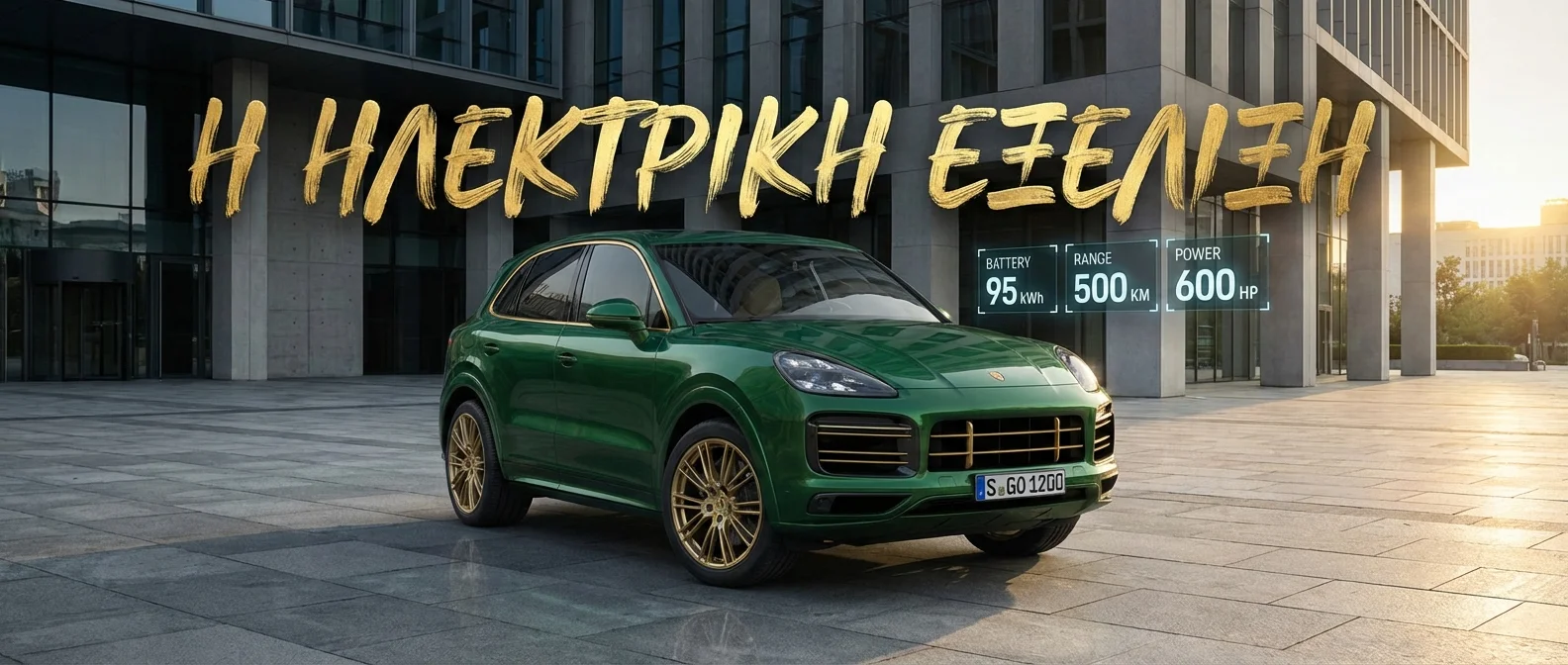
The SUV That Saved Porsche — Now Electric
The Cayenne is historically the model that "saved" Porsche financially in the early 2000s. Now, the 4th generation marks a radical shift: fully electric powertrain, built on the Premium Platform Electric (PPE) shared with the new-generation Porsche Macan.
📖 Read more: Kia EV3: The Small Electric SUV That Changes Everything
The reveal happened on November 19, 2025, with orders opening immediately. Serial production started February 3, 2026 at the Volkswagen plant in Bratislava, Slovakia. Worth noting that the third generation (with internal combustion engine) will continue to receive updates in parallel.
113 kWh Battery: The Largest in Porsche's Lineup
The Cayenne Electric packs a 113 kWh battery (108 kWh net usable), consisting of 6 modules bolted to the chassis. Each module houses 4 packs, with 8 pouch cells connected in series. Energy density is ~7% higher compared to the Porsche Taycan's battery.
⚡ 400 kW Charging: The Cayenne Electric supports DC charging up to 400 kW, reaching from 10% to 80% in just 16 minutes. It supports both NACS and J1772 plugs. Also, it offers 11 kW inductive (wireless) charging at home.
The cooling system uses 15% less energy, and predictive thermal management preheats the battery during driving and charging. Weight hits 2,645 kg — Motor1 called the Cayenne Electric Turbo "the heaviest Porsche ever built."
Powertrain: 804 hp — Surge Power 1,072 hp
The dual-motor Turbo represents the most powerful production model in Porsche history:
| Mode | Power | Details |
|---|---|---|
| Normal operation | 804 hp (600 kW) | Continuous dual-motor power |
| 10-second Surge | 938 hp (700 kW) | Overboost for 10 seconds |
| Launch Control | 1,072 hp (800 kW) | Maximum launch power |
The motors use direct stator cooling with non-conductive oil and silicon carbide (SiC) inverters, achieving 98% motor efficiency. Regenerative braking reaches 600 kW, supporting over 0.5G deceleration — without even touching the brake pedal.
Interior: OLED Displays & Flow Display
The interior marks a new era for Porsche:
Instrument Display
14.25″ OLED digital instrument cluster behind the steering wheel
Flow Display
12.25″ curved OLED central infotainment screen. Android Auto & Apple CarPlay.
Passenger Display
Optional 14.9″ screen for the passenger
📖 Read more: Mercedes EQA: Premium Small Electric SUV
3D HUD
Optional augmented 3D heads-up display projected onto the windshield
PPE Platform: The Foundation of Electric Porsche
The Premium Platform Electric (PPE) was co-developed with Audi and is already used in the Porsche Macan II and Audi Q6 e-tron / A6 e-tron. Key advantages:
- 3,024 mm wheelbase — 129 mm longer than the 3rd generation, ensuring massive interior space
- 4,985 mm length — slightly larger than the current model
- Floor-integrated battery — lower center of gravity
- 800V architecture platform — ultra-fast charging capability
Safety: 5-Star Euro NCAP Rating
The Cayenne Electric achieved 5 stars in Euro NCAP testing:
| Adult Protection | 91% |
| Child Protection | 89% |
| Pedestrians & Cyclists | 81% |
| Safety Systems | 79% |
Technical Specifications
| Platform | Premium Platform Electric (PPE) |
| Battery | 113 kWh (108 kWh net) |
| DC Charging | 400 kW (10-80% in 16 minutes) |
| Wireless Charging | 11 kW Inductive |
| Power (Turbo) | 804 hp / Surge 938 hp / Launch 1,072 hp |
| Regen Braking | 600 kW (>0.5G) |
| Wheelbase | 3,024 mm |
| Length × Width × Height | 4,985 × 1,980 × 1,674 mm |
| Weight | 2,645 kg |
| Manufacturing | Bratislava, Slovakia |
| Euro NCAP | ⭐⭐⭐⭐⭐ |
Cayenne Electric vs Competition
| Cayenne Electric Turbo | BMW iX M60 | Mercedes EQS SUV | |
|---|---|---|---|
| Power | 804 hp (surge 1,072) | 619 hp | 536 hp |
| Battery | 113 kWh | 111.5 kWh | 118 kWh |
| Max DC Charging | 400 kW | 195 kW | 200 kW |
| Regen | 600 kW | 200 kW | 186 kW |
The Cayenne Electric dominates in charging (400 kW vs 195-200 kW), power (1,072 hp launch control), and regenerative braking (600 kW). Porsche pushes the technical envelope once again.
Pricing & Global Availability
The Cayenne Electric is a luxury SUV, and the price reflects that. While pricing hasn't been announced for all markets yet, it's expected to start around €90,000-100,000 for the base version, reaching €150,000+ for the Turbo.
⚠️ Weight — The Elephant in the Room: At 2,645 kg, the Cayenne Electric is heavier than many full-size SUVs. This could negatively impact tire wear, driving dynamics, and braking distance. Porsche compensates with exceptional 600 kW regenerative braking.
Pros & Cons
✅ Pros
- ✓ Incredible power — up to 1,072 hp
- ✓ 400 kW charging — fastest in the market
- ✓ 600 kW regenerative braking
- ✓ Premium OLED displays & 3D HUD
- ✓ 5⭐ Euro NCAP
- ✓ Wireless charging 11 kW
- ✓ 98% motor efficiency (SiC inverters)
❌ Cons
- ✗ Weight 2,645 kg — very heavy
- ✗ Premium pricing (€90K+)
- ✗ No Coupé variant offered (yet)
- ✗ WLTP range not announced yet
- ✗ Tire wear due to weight