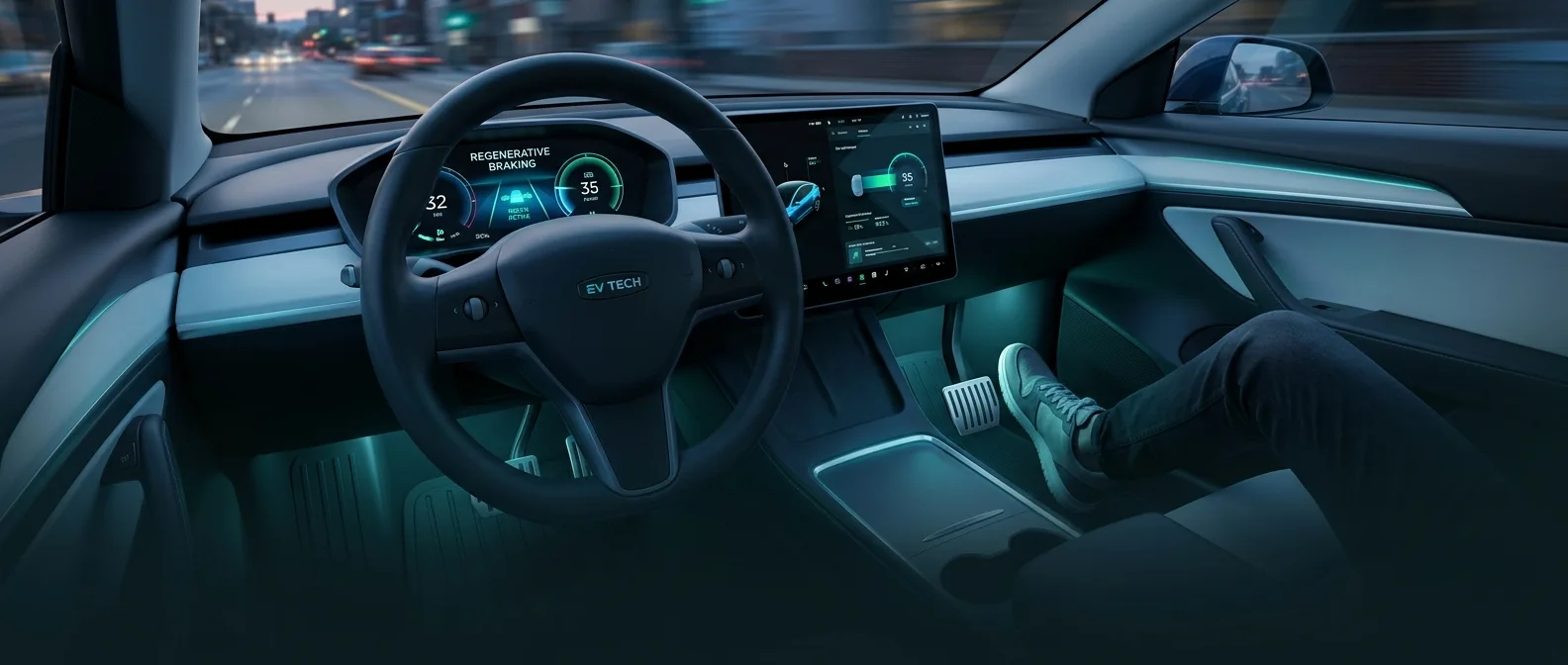
If you've never driven an electric car, the idea of one pedal driving sounds strange: controlling the car almost entirely with the accelerator pedal. Press to accelerate, lift and the car slows down on its own — possibly to a complete stop. You only need the brake in emergencies.
📖 Read more: Regenerative Braking in EVs: How It Works & Maximise It
This feature, which leverages regenerative braking, fundamentally changes the driving experience. Let's explore how it works, why it matters, and whether it's right for you.
What Is One Pedal Driving?
One pedal driving (OPD) is a feature that allows the driver to control both acceleration and deceleration through a single pedal — the accelerator. When the driver lifts their foot off the gas, instead of the car coasting freely like in a gas-powered vehicle, strong deceleration is automatically applied.
This deceleration doesn't come from mechanical brakes. The electric motor operates in reverse — as a generator — converting the car's kinetic energy into electrical energy that's stored back in the battery. Essentially, every time you slow down, you're recovering energy.
📖 Read more: Solid-State Batteries: The Revolution That Will Transform Electric Cars
How Does It Actually Work?
The physics behind it are elegantly simple:
- Press the accelerator: The battery powers the motor, the motor drives the wheels. The car accelerates.
- Lift your foot: The motor becomes a generator. The resistance it creates slows the wheels, while the generated electricity flows back to the battery.
- Adjust foot position: More pressure = acceleration. Less pressure = gradual deceleration. Full release = maximum regenerative braking.
- Complete stop: In some models (Nissan Leaf e-Pedal, Tesla, BMW i3), the car comes to a full stop and holds position without the parking brake.
Brake lights activate automatically when deceleration exceeds a certain threshold, so drivers behind are properly alerted.
The Benefits: Why EV Drivers Love It
The reasons one pedal driving has gained millions of fans:
1. Increased range (10-25% more miles)
Every deceleration becomes an energy recovery opportunity. In urban driving with frequent stop-and-go, regenerative braking can recover up to 20-25% of the energy that would otherwise be lost as heat in the brakes. On highways, recovery is lower (~5-10%), but still significant.
📖 Read more: Wireless EV Charging: The Cable-Free Future is Coming
2. Dramatically reduced brake wear
Mechanical brakes are barely used — mainly for emergency stops. This means brake pads and rotors can last two to three times longer compared to a gas-powered car. Fewer replacements, lower costs, less brake dust.
3. More engaged city driving
Many EV drivers describe one pedal driving as more “intuitive” after the first few days. Instead of constantly switching pedals, you control speed with subtle pressure changes on your right foot. In the city, it becomes almost a precision game.
4. Less fatigue in traffic
In bumper-to-bumper traffic, constantly switching between gas and brake is tiring. With OPD, you simply modulate one pedal. Many owners report they never want to go back to the traditional two-pedal system.
The Drawbacks: Not for Everyone
However, one pedal driving isn't perfect:
📖 Read more: Bidirectional Charging: Your EV Powers Your Home
- Adaptation period: 1-2 weeks to get used to it. Initially, the deceleration may feel “too strong.”
- Passenger motion sickness: Abrupt acceleration-deceleration changes can bother passengers, especially if the driver isn't smooth.
- Doesn't always fully stop: Some models (e.g., VW ID.3/ID.4 in B mode) decelerate strongly but don't come to a complete stop — the brake pedal is needed for the last few feet.
- On downhills: Regenerative braking may not be sufficient on steep grades, especially if the battery is already full (100%).
- Icy roads: Aggressive regenerative braking can cause skidding on ice or snow, though modern EVs automatically adjust the intensity.
Which Models Offer One Pedal Driving?
Nearly every modern EV has some form of regenerative braking, but the intensity and implementation varies:
| Model | System | Full Stop? | Adjustable? |
|---|---|---|---|
| Tesla (all) | Regen Standard/Low | Yes | Now Standard only |
| Nissan Leaf | e-Pedal | Yes | On/Off |
| BMW i3 / iX / i4 | Strong regen (B mode) | Yes | D/B mode |
| Hyundai Ioniq 5/6 | i-Pedal + Paddles | Yes | 4 levels + auto |
| Kia EV6 / EV9 | i-Pedal + Paddles | Yes | 4 levels + auto |
| VW ID.3 / ID.4 | B mode | No | D/B mode |
| Chevy Bolt | One Pedal + Regen paddle | Yes | Paddle on demand |
Hyundai/Kia stand out with their paddle shifters behind the steering wheel that let the driver change regenerative braking intensity “on the fly” — like gear changes in a race car. The auto mode even learns driving behavior and adapts automatically.
📖 Read more: Lucid Air: 800+ km Range Explained
How to Learn: Tips for Beginners
If you just got an EV with one pedal driving, follow these steps:
- Start on a quiet road or parking lot. Test how quickly the car decelerates when you fully release the pedal.
- Find the "balance point": The foot position where the car neither accelerates nor decelerates.
- Gradually increase usage: First week, use both pedals normally. Second week, try to avoid the brake.
- Watch your passengers: Make smooth transitions. Abrupt lifts = discomfort.
- On downhills, always keep your foot near the brake as a precaution.
One Pedal vs Coasting: Which Is Better?
There's an ongoing debate in the EV community: is one pedal driving more efficient than coasting (free-rolling without regeneration)? The answer depends:
- In the city: OPD wins — lots of stop-and-go = lots of energy recovery.
- On the highway: Coasting may be more efficient if you look ahead and let the car roll before a light or turn.
- The best strategy: A combination. OPD in the city, light regen or coasting on the highway.
Conclusion: A Change Worth Making
One pedal driving isn't just a gadget — it's a new way of driving that maximizes the physics of electric motors. After a few days of adaptation, most drivers say they can't imagine going back to traditional driving.
More range, less brake wear, more relaxed city driving. If you're considering an EV, this feature will quickly become your favorite habit.