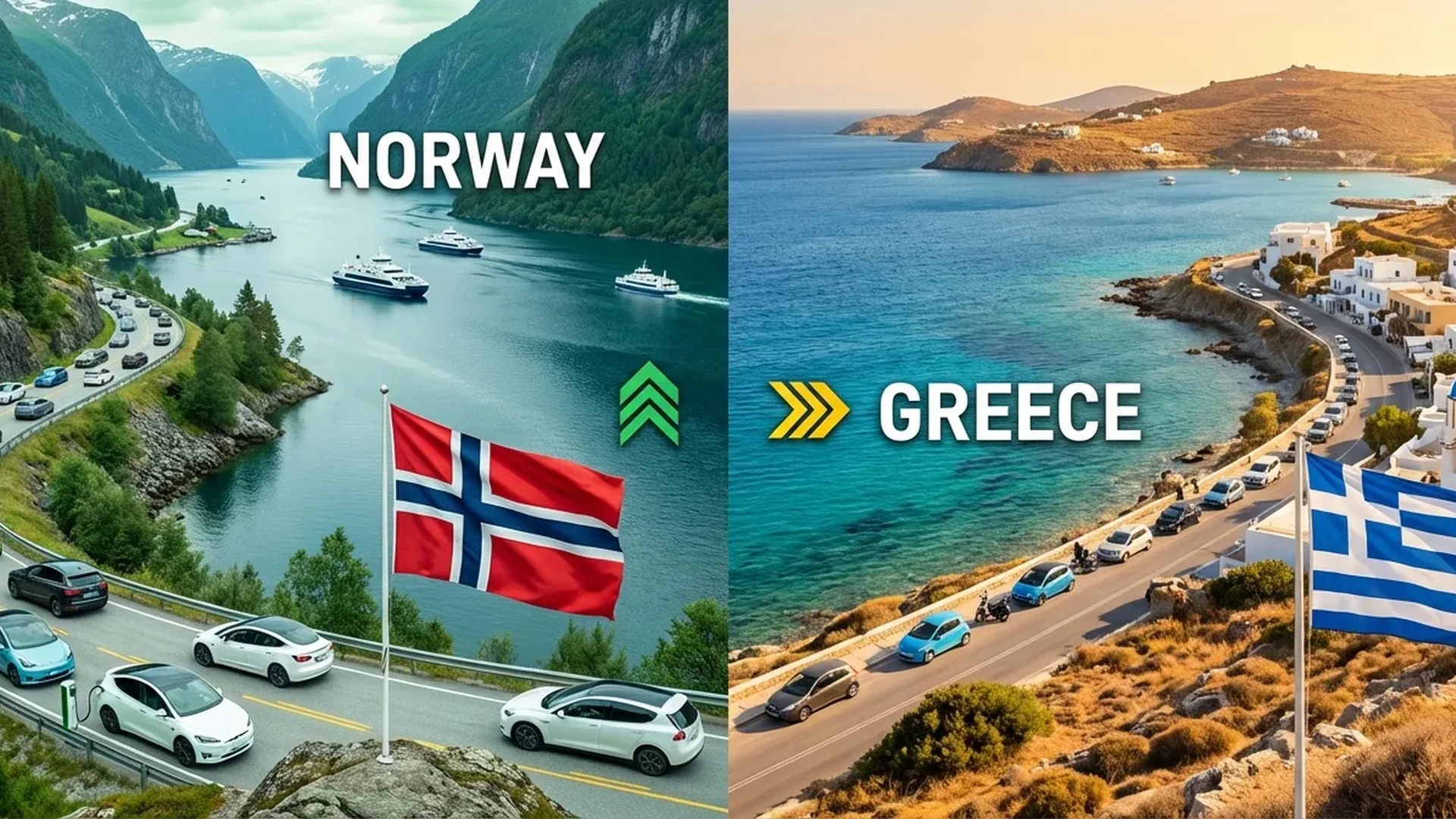
There is one country in the world that serves as a “living laboratory” for electrification: Norway. With a 97.4% market share in new electric car sales in 2025 (according to Reuters), the Scandinavian country isn't just a “leader” — it's proof that a complete transition to electric mobility is achievable. But what can Greece, a country with an entirely different economic and geographic reality, learn from this?
📖 Read more: Electric Car Leasing: Is It Worth It in 2026?
Norway by the Numbers
The journey began long before electric cars went mainstream. The Norwegian government started supporting EVs back in 1990, creating a framework of incentives that lasted 35 years and transformed a country of 5.5 million people into a global model.
The Incentive Timeline
The biggest difference between Norway and the rest of Europe wasn't a single measure, but the consistency and cumulative power of dozens of incentives over time:
Key insight: Norway didn't ban gasoline cars — it made them more expensive through high registration taxes (based on weight, CO₂, NOx), while EVs were cheaper thanks to 0% VAT. A VW Golf petrol cost ~$42,000, while a Nissan Leaf cost ~$42,500 — virtually the same price, with a huge operating cost advantage for the EV.
Why It Worked in Norway
Five factors explain the success:
1. 99% Hydroelectric power: Norway generates nearly all its electricity from hydroelectric dams. This means every EV on its roads runs entirely on renewable energy — making the environmental argument irrefutable.
2. High income: With per capita GDP exceeding $80,000, Norwegians could invest in new technology even before prices dropped significantly.
3. Stable tax framework: The incentives didn't come and go — they remained consistent for 35 years, building trust among consumers and the industry.
4. Charging infrastructure: Over 13,700 public charging points (2019 data) in a country of 5.5 million people — that's one station per ~400 residents. Tesla Superchargers, CHAdeMO, CCS Combo 2 — full coverage even in sparsely populated areas.
5. Social acceptance: A 2013 survey showed that 95% of owners could charge at home (garage or apartment building parking), effectively eliminating range anxiety.
Norway vs Greece: Comparison
| Criterion | Norway | Greece |
|---|---|---|
| EV Market Share (2025) | 97.4% | ~12.4% |
| EV Market Share (2023) | 90.4% | 5.4% |
| GDP Per Capita | ~$82,000 | ~$22,000 |
| Electricity Source | 99% hydroelectric | ~40% renewables (solar, wind) |
| VAT on EVs | 0% (until recently) | 24% (standard rate) |
| EV Incentives | 35 years, consistent | Recent, changing |
| Climate | Cold (14°F winters) | Hot (95°F+ summers) |
| Public chargers/capita | ~1 per 400 | Developing |
The income gap is massive (nearly 4x), but that's not the only reason. Denmark (71.1% share in 2025), Sweden (63.2%), and the Netherlands (56.5%) prove that the right policies work even without Norwegian oil wealth.
📖 Read more: Electric Car Subsidy in Greece 2026
What Greece Can “Copy”
Stable Tax Incentives
Greece needs consistent reductions in circulation and registration taxes for EVs, not for 1 year but for 10+. Norway proved that consistency matters more than the size of the incentive.
Public Charging Network
Investment in fast chargers on highways, islands, and tourist destinations. Estonia (small country, low income) was the first in the world with nationwide DC coverage — Greece can do it too.
Apartment Building Charging
In Norway, 95% charge at home. In Greece, apartment buildings need a legal framework for wallbox installation without requiring unanimous building assembly consent.
Leverage Solar Energy
Norway has hydroelectric, Greece has sunshine. The combination of home solar panels + EV can dramatically reduce driving costs in a country with 300+ sunny days per year.
The “Downsides” of the Norwegian Model
No model is perfect. Norway faced several unintended consequences:
Cost of incentives: The VAT exemption cost the state ~4 billion kroner (~$640 million) in 2014 alone. Critics argued that the cost per ton of CO₂ reduction was disproportionately high.
Bus lane congestion: EVs with bus lane access overwhelmed the lanes — a December 2013 count showed EVs made up 74.5% of bus lane traffic, while buses accounted for just 7.5%. Several municipalities restricted or eliminated this perk.
Ferry revenue loss: Free EV access to ferries created significant revenue losses for local transport operators, particularly in high-EV-penetration regions like Hordaland.
Free parking: Free public parking created a shortage of spaces for conventional cars. By January 2018, only 24 of 58 major municipalities still offered it.
Where Greece Stands Today
With a plug-in market share of ~12.4% (2025), Greece is in an early growth phase — roughly where Norway was around 2013-2014. The upward trend is encouraging: from 2.8% (2023) to 5.4% (2024) to ~12.4% (2025) — a quadrupling in 2 years.
Key barriers remain: high purchase prices relative to incomes, insufficient charging infrastructure (especially on islands and rural areas), difficulty installing chargers in apartment buildings, and dependence on imported digitally-controlled technology.
However, Greece has one unique advantage: solar irradiation. The combination of rooftop solar panels with an electric car can virtually eliminate “fuel” costs — something impossible even in Scandinavia's dark winters.
Conclusion
Norway didn't become an EV champion through wealth or magic — it happened through 35 years of consistent policy. Greece doesn't need to copy every Norwegian measure — it just needs to learn the core principles: incentive stability, massive charging infrastructure, legal frameworks for apartment buildings, and leveraging the renewable resources it already has. If Portugal (38.4% share in 2025), Romania (31.8%), and Ireland (34%) can do it, Greece certainly can — it just needs political will and time.