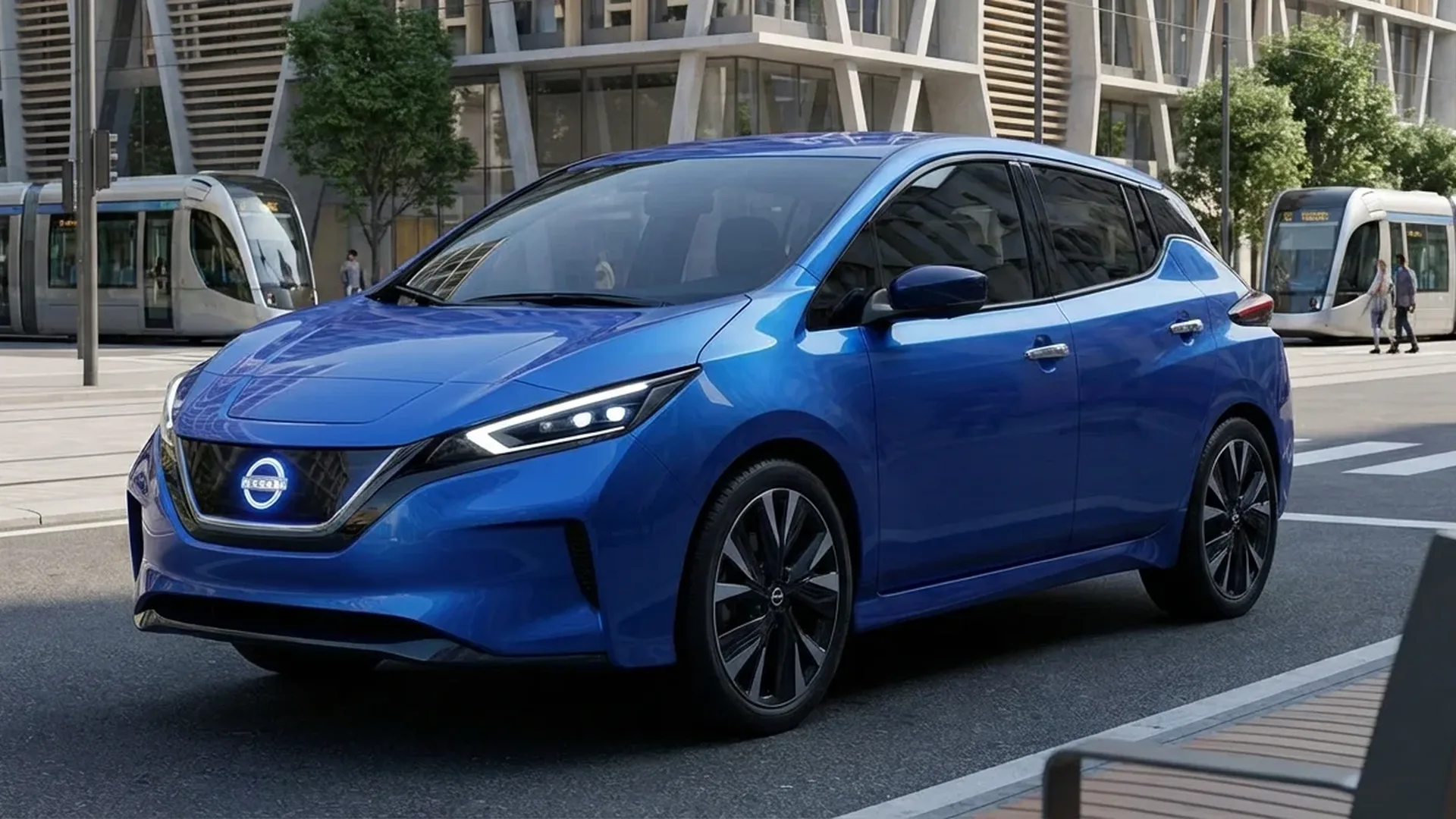
If you asked what the most important electric car in history is, the answer would probably be the Nissan Leaf. Unveiled in 2009 and entering mass production in 2010, it became the world's first mass-market electric vehicle, earning "European Car of the Year 2011″ and “World Car of the Year 2011.” By 2022, over 577,000 units had been sold globally. Now, the third generation — model year 2026 — changes everything: new platform, new body style, new batteries, and range reaching 375 miles (WLTP).
From Hatchback to Crossover SUV
The biggest change in the new Leaf is the transition from a classic hatchback to a subcompact crossover SUV. The move isn't accidental — the compact crossover EV market is growing rapidly, and Nissan couldn't ignore the trend. Design-wise, the new Leaf clearly draws inspiration from the Chill-Out Concept of 2021, with more dynamic lines, an aerodynamic profile (Cd 0.25 — significantly improved from the previous generation's 0.29), and a coupé-like rear.
External dimensions show a wider but slightly shorter car: length 171.3 in (4,350 mm), width 71.3 in (1,810 mm), height 61.0 in (1,550 mm), wheelbase 105.9 in (2,690 mm). The platform is the AmpR Medium (formerly CMF-EV), the same one used by the larger Nissan Ariya. This means the architecture was designed from scratch for electric vehicles — something that wasn't fully true for previous generations.
Liquid-Cooled Batteries — Finally
One of the biggest complaints from Leaf owners was the air-cooled battery, which in hot climates led to noticeable degradation after a few years. The third generation solves this problem definitively: both battery packs are now liquid-cooled with an active thermal management system. This ensures consistent performance in extreme temperatures and much better long-term durability.
The two battery options are:
| Specification | 52 kWh | 75 kWh |
|---|---|---|
| Chemistry | NMC | NMC |
| Manufacturer | AESC | AESC |
| Motor | 130 kW (174 hp) | 160 kW (214 hp) |
| Torque | 254 lb-ft | 261 lb-ft |
| Range (WLTP) | ~271 mi (436 km) | ~375 mi (604 km) |
| Range (EPA) | ~259 mi | ~303 mi |
| DC Fast Charging | 150 kW | 150 kW |
| 10-80% DC | ~30 min (EU) | ~30 min (EU) |
| Cooling | Liquid-cooled | Liquid-cooled |
The 375-mile WLTP range on the 75 kWh version is impressive — nearly triple the 106 miles WLTP of the first generation. Even the base 52 kWh offers ~271 miles, which is more than enough for the vast majority of daily needs.
Why liquid cooling matters in hot climates: At summer temperatures of 95–104°F, an air-cooled battery can lose fast-charging speed (thermal throttling) or degrade prematurely. Liquid cooling keeps cells at optimal temperature (77–95°F) regardless of external conditions.
Charging: CCS2, 150 kW & NACS
Fast charging jumps to 150 kW DC — a significant upgrade from the 50–100 kW of the second generation. In Europe, the connection uses CCS Combo 2, while in North America the new Leaf is the first Nissan with NACS (North American Charging Standard), making it compatible with the Tesla Supercharger network. This abandons CHAdeMO, which had been the Leaf's signature connector for 15 years.
Charging from 10–80% completes in approximately 30 minutes on the European version — satisfactory for a car in this price range. Home AC charging uses a Type 2 connector.
Drivetrain & Platform
The drivetrain remains front-wheel drive (FWD) with a single motor — there's no all-wheel-drive option, unlike the Ariya. However, 214 hp and 261 lb-ft of torque in the 75 kWh version deliver lively performance for a compact crossover. The AmpR Medium platform, designed exclusively for EVs, ensures a low center of gravity, flat interior floor, and proper weight distribution.
One-pedal driving naturally remains — a feature Nissan pioneered in the Leaf that's now copied by virtually every manufacturer.
Three Generations — The Evolution
1st Generation (2010–2017)
- Battery: 24/30 kWh
- Range: 73–107 mi EPA
- Power: 80 kW (110 hp)
- Cooling: Passive (air)
- DC Charging: 50 kW CHAdeMO
- Body: Hatchback
3rd Generation (2025/2026)
- Battery: 52/75 kWh
- Range: 259–303 mi EPA
- Power: 130–160 kW (174–214 hp)
- Cooling: Active liquid cooling
- DC Charging: 150 kW CCS2
- Body: Crossover SUV
The progress over 15 years is remarkable: range nearly quadrupled, power doubled, fast charging tripled, and liquid cooling finally arrived. The 577,000+ cars of the first two generations prove Nissan knows how to make affordable EVs — the third generation brings the technical specifications to match.
Competitors & Positioning
In Europe, the new Leaf will directly compete with the VW ID.3, Renault Mégane E-Tech, MG4, Hyundai Kona Electric, and Peugeot e-2008. With 375 miles WLTP range on the large battery, it ranks among the best. Pricing is expected to start around $35,000–$38,000 for the base 52 kWh, with the 75 kWh around $42,000–$47,000 — competitive against the Ariya ($50,000+).
Manufacturing takes place at the Tochigi plant (Japan) and Sunderland (United Kingdom), ensuring fast European delivery. The new Leaf is confirmed for North America, Europe, Japan, and Australia, with availability expected throughout 2026.
Safety & Technology
The second-generation Leaf earned 5-star Euro NCAP ratings (93% adult, 85% child, 71% pedestrian), and the third generation is expected to improve those numbers thanks to the next-gen ProPilot Assist — SAE Level 2 semi-autonomous driving with lane centering, adaptive cruise, automatic emergency braking, and traffic jam assistance.
The AmpR Medium platform brings an upgraded digital architecture, larger infotainment screen with wireless Android Auto & Apple CarPlay, digital instrument cluster, and heads-up display on top trims.
Worth It? Our Assessment
The third-generation Nissan Leaf isn't just an update — it's a complete rebirth. The transition to crossover SUV form, liquid-cooled battery, AmpR Medium platform, 150 kW DC charging, and range up to 375 miles WLTP make it competitive in an exploding segment. For those who trust Nissan — and there are 577,000+ reasons to do so — the new Leaf is an excellent choice for daily use, road trips, and zero emissions. The move from air to liquid cooling alone makes this a generational leap that Leaf loyalists have been waiting years for.