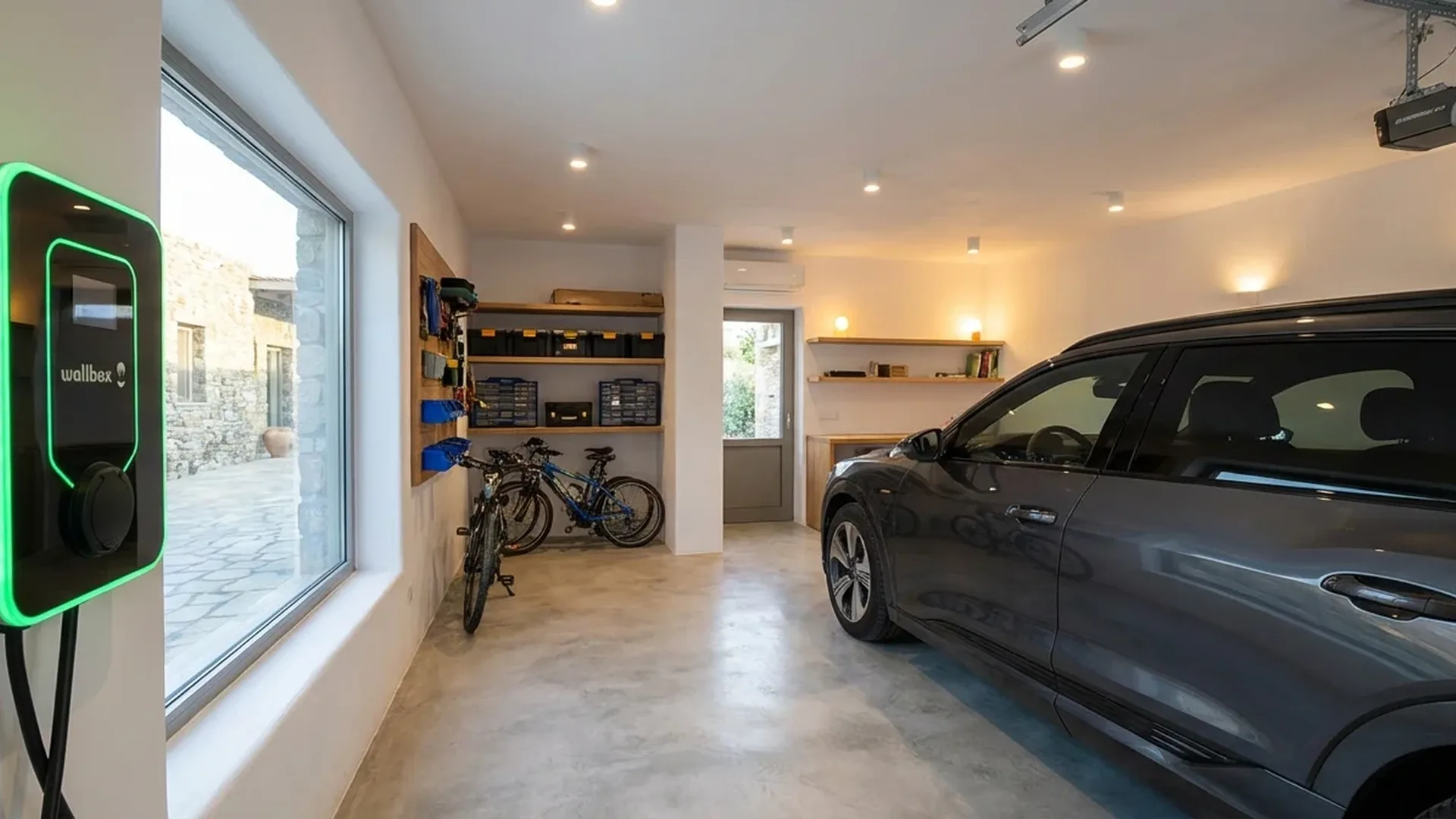
Home Charging Options Explained
Why NOT to Use a Standard Socket Daily?
The standard Schuko socket (2.3kW) can be used for emergencies, but is not suitable for daily charging. Key problems: risk of overloading circuits not designed for 8-12 hours of continuous load, slow charging (77kWh battery = 33 hours), and lack of smart protection.
For safe and reliable charging, a dedicated 32A Type 2 circuit (wallbox) is the right choice.
Popular Wallbox Models in Greece
- Wallbox Pulsar Plus: 7.4/22kW, smart, app-controlled, popular
- Easee One: 7.4/22kW, minimalist design, load balancing
- Zaptec Go: 7.4/22kW, Scandinavian design, safe
- ABB Terra AC: Industrial grade, reliable, B2B focused
- KEBA KeContact: Austrian quality, wide warranty
Wallbox Installation Steps
Wallbox installation requires a certified electrician. Here is the process in detail:
📖 Read more: Cupra Tavascan: Sporty Electric Coupé-SUV Review
Step 1 — Assessment: The electrician inspects your consumer unit, total supply (single-phase or three-phase), and available capacity. If your home has a single-phase 25A supply, you may need an upgrade to three-phase for an 11kW+ wallbox.
Step 2 — Dedicated Circuit: A dedicated 32A circuit is installed with RCD Type A or Type B protection (essential for DC fault current safety in EVs). Cable should be 6mm² for distances up to 15 metres, or 10mm² for longer runs.
Step 3 — Mount & Configure: The wallbox is mounted (wall or stand), connected to Wi-Fi, paired with its app, and test-charged. In apartment buildings: management committee approval, an engineer's assessment, and metering from your own supply are required.
Safety & Maintenance
Modern wallboxes include built-in protection: thermal monitoring, DC fault current detection, and automatic shutdown on failure. Maintenance is minimal — an annual check of connections and temperature is sufficient. Important: never install a wallbox without a certified electrician, as faulty installation can pose a fire risk.
85% of EV charging happens at home — making home charging infrastructure the backbone of the EV revolution.
— International Energy Agency (IEA), EV Outlook 2025Subsidies for Wallbox in Greece
Through the "Ilektrokinisi" (Electric Mobility) programme and ESPA, some households qualified for wallbox installation subsidies. Always check current actions from the Greek Ministry of Environment and Energy (ypen.gov.gr).
Smart Charging: Save Money Overnight
Modern smart wallboxes let you schedule charging during off-peak hours. In Greece, night tariff rates apply from approximately 23:00 to 07:00, dropping from ~€0.25/kWh to ~€0.14/kWh — nearly half price. For an EV consuming 18 kWh/100 km, that means €2.50 instead of €4.50 per 100 km. The annual savings for 15,000 km exceed €300.
Most smart wallboxes (Easee, Zaptec, Wallbox Pulsar) support scheduling via their app. You set charging to start at 23:00 and finish by 07:00 — no intervention needed. Some models even support dynamic pricing: if your energy provider offers hourly rates, the wallbox automatically charges during the cheapest windows. While Greece doesn't yet have widespread hourly tariffs, the Regulatory Authority for Energy (RAE) is pushing for their adoption.
Apartment Buildings: The Big Challenge
If you live in an apartment building — and in Greece, most people do — wallbox installation is possible but requires specific steps. First, you need approval from the building's general assembly or at minimum informing the building manager (Law 4710/2020 on electric mobility simplified this process). Power must be drawn from your own meter so consumption is billed exclusively to you. When multiple EVs share a building, load balancing distributes available power fairly without overloading the main supply.
A practical example: an apartment building with a 50 kVA supply and 4 EVs installs 4 Easee One wallboxes with load balancing. Each car charges simultaneously at 4-7 kW instead of 22 kW, but since charging happens overnight (8+ hours), the time is more than sufficient. Total installation costs €3,000-5,000 for all four units, working out to €750-1,250 per EV owner.
Solar Panels + EV: The Perfect Combination
The peak of smart charging is combining solar panels with EV charging. A 6 kWp residential system in Southern Greece produces 8,000-9,000 kWh annually. If an EV consumes 2,700 kWh per year (for 15,000 km), you can literally charge for free on sunny days. Modern wallboxes with solar surplus charging detect when panels produce excess energy and automatically route it to your car instead of the grid.
V2G (Vehicle-to-Grid) technology takes this a step further: the EV itself becomes an energy storage unit that can power your home or even sell energy back to the grid during peak hours. While still in early stages in Greece, V2G is expected to go mainstream by 2028-2030, with vehicles like the Nissan Leaf, Hyundai Ioniq 5, and Ford F-150 Lightning already supporting it. According to Juniper Research, global home EV charging spend surpassed $16 billion in 2026, up from just $3.4 billion in 2021 — a clear sign that residential charging infrastructure is the backbone of the EV revolution.
"I installed an Easee One in January. Every night I plug in before bed, and every morning I start with a full battery. I worry about charging as much as I used to worry about filling up petrol — which is to say, not at all."
— VW ID.4 owner, Piraeus, Greece