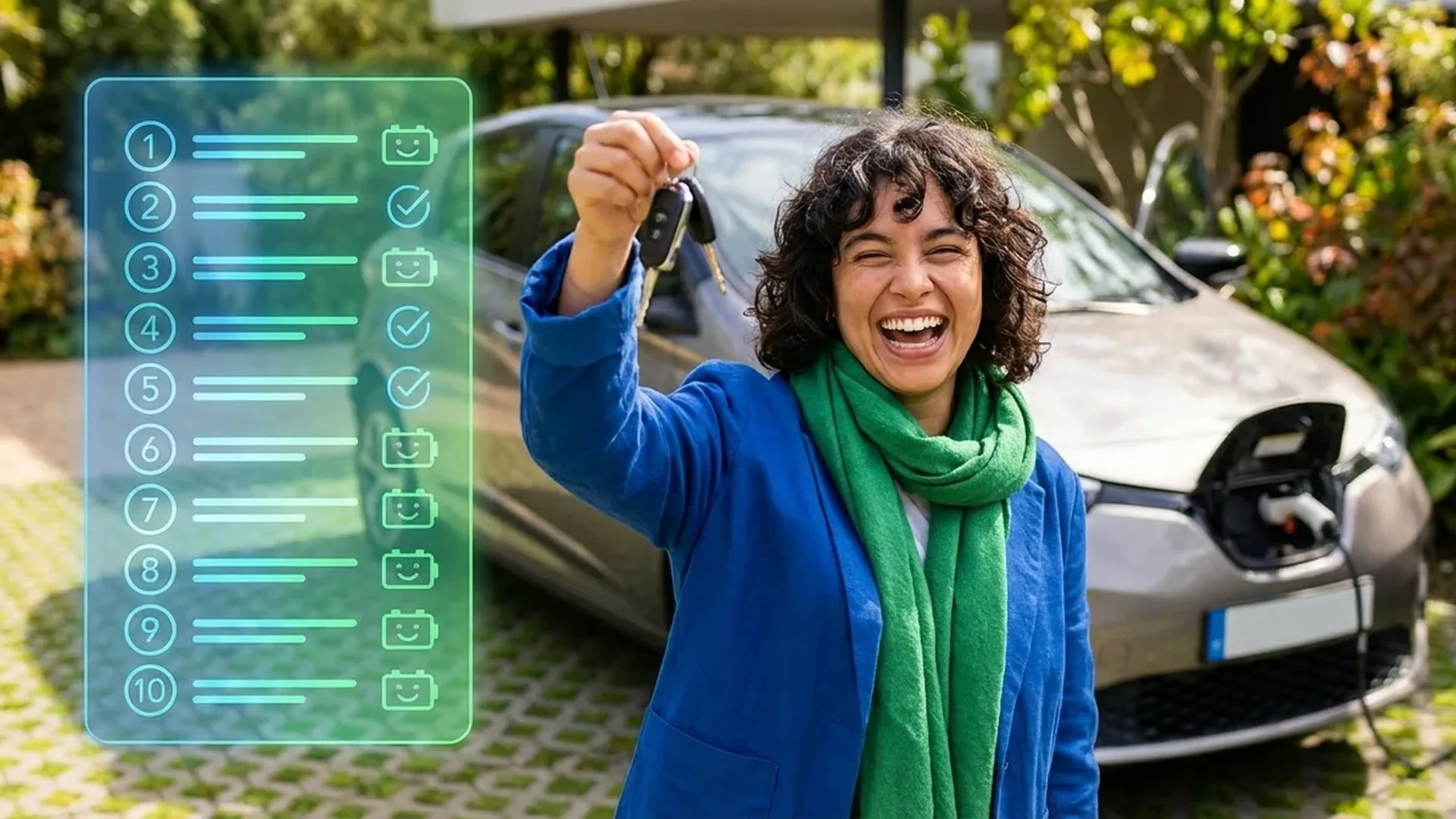
Thinking about buying your first electric car? The switch from gas/diesel to EV is a bigger change than you think — you're not just changing fuel, you're changing your entire mindset. This guide covers the 10 things you should know before signing the contract, so you can avoid surprises and fully enjoy the experience.
1 WLTP Range ≠ Real-World Range
Every EV advertises WLTP range — a lab-measured figure you'll never hit exactly on the road. In practice, expect 15-25% less than the WLTP number, depending on driving style, temperature, and terrain. A car rated at 250 miles WLTP will give you 190-210 miles in daily use.
2 Home Charging Changes Everything
If you can charge at home, the EV experience becomes completely effortless. A 7 kW wallbox (single-phase) fills a 60 kWh battery in ~9 hours — plug in at night, wake up with a full charge. With three-phase power, an 11 or 22 kW wallbox cuts the time dramatically.
Without home charging, you depend on public stations — practical but more expensive ($0.40-0.65/kWh vs $0.10-0.20 at home) and less convenient. Before buying an EV, find out if you can install a wallbox where you park.
3 DC Fast Charging: Fast, but Not Always
DC fast chargers (50-350 kW) fill from 10-80% in 20-40 minutes depending on the model. But beware: charging speed isn't constant. It slows dramatically after 80%, which is why you never charge to 100% at a fast charger — it's not worth the time.
Architecture matters: 800V cars (Hyundai Ioniq 5, Kia EV6, Porsche Taycan) charge much faster than 400V models. If you take frequent road trips, this is a key selection criterion.
4 Winter Is the EV's Enemy
In cold temperatures, range drops 20-35%. Why? The battery operates less efficiently in the cold, and cabin heating consumes energy instead of using waste heat from the engine (which doesn't exist in EVs).
- Heat pump: Reduces winter consumption by 30-40%. If you live in a cold climate, it's essential.
- Pre-conditioning: Heat the car while it's still plugged in — warm up the cabin and battery without losing range.
- Heated steering wheel/seats: They warm you, not the whole cabin — much more efficient.
5 The Battery Lasts Much Longer Than You Think
The biggest concern for prospective EV buyers: “will the battery die?” The answer: almost certainly no. According to recent studies, only 2.5% of EV batteries have been replaced to date — and many of those were on very early models.
The standard battery warranty is 8 years / 100,000 miles with a minimum 70% capacity guarantee. In practice, modern batteries last 15-20 years in the car and can then serve years more in stationary energy storage.
6 Maintenance Costs Are Half
An EV has no oil, no filters, no timing belts, no multi-speed transmission, no catalytic converter, and no exhaust. Data shows ~50% lower maintenance costs compared to equivalent gas-powered cars. Even brake pads last 2-3x longer thanks to regenerative braking.
What do you service on an EV? Tires, brake fluid, cabin filter, wiper fluid — things that cost very little. Tesla was rated the least expensive brand for 10-year maintenance, according to Consumer Reports' 2024 analysis.
7 Total Cost of Ownership Can Be Lower
Yes, EVs cost more upfront. But in the EU and US, the total cost of ownership (TCO) over 5-10 years is often lower. You save roughly 60% on fuel (especially with home charging on off-peak rates) and 50% on maintenance.
The more miles you drive per year, the faster the higher purchase price “pays for itself.” If you drive 12,000+ miles/year, the savings become very noticeable. Battery prices keep falling — they were $660/kWh in 2010, now close to $100/kWh, pulling car prices down.
8 The Driving Experience Is Addictive
The instant torque of an electric motor delivers acceleration that no naturally aspirated gas engine can touch. Even a “slow” EV with 150 HP feels more lively in the city than a gas car with similar power, because torque is 100% available from 0 rpm.
The silence is stunning. The absence of vibrations completely changes the feel. One-pedal driving (regenerative braking) makes you feel like you're controlling the car with surgical precision. After a month with an EV, driving a gas car feels ancient.
9 Incentives & Subsidies Vary Widely
Many countries offer EV purchase incentives — reduced registration fees, tax exemptions, purchase subsidies. But incentives change frequently and vary enormously by country. Norway sells 9 out of 10 new cars as electric thanks to generous tax advantages, while other countries are gradually reducing subsidies.
- Check what's available in your country before you buy
- Some incentives apply only to new cars, others also to used
- Look into local perks — some cities offer free HOV lane access or reduced tolls
- In the US: federal tax credit up to $7,500 plus state-level incentives
10 Resale Value & Battery Replacement
The used EV market is growing fast, but resale value depends heavily on the model. Tesla and popular models hold their value well. Less popular brands or models with small batteries may depreciate faster.
The big “fear” — out-of-warranty battery replacement — costs $5,000-$16,000 depending on size. But remember: only 2.5% have ever been replaced, prices keep dropping (LFP cell cost just ~$56/kWh in early 2024), and the 8-year warranty has you covered. Statistically, battery replacement is rarer than a major engine failure in a gas car.
Bonus: What to Check Before You Buy
- Can you install a wallbox where you park?
- How many miles do you drive daily? (if <60 mi, even a small battery is enough)
- Do you frequently take trips >200 miles? Check DC charging speed and charger network along your route
- Verify battery warranty and service network in your area
- Test drive: try one-pedal driving and energy recovery
- Compare 5-year TCO, not just purchase price
The truth is simple: if you can charge at home or at work, a modern EV with a 50+ kWh battery covers the needs of 90% of drivers. The technology has matured, prices are falling, and the driving experience is superior. Don't let myths and fears hold you back — research, test drive, and decide based on data.