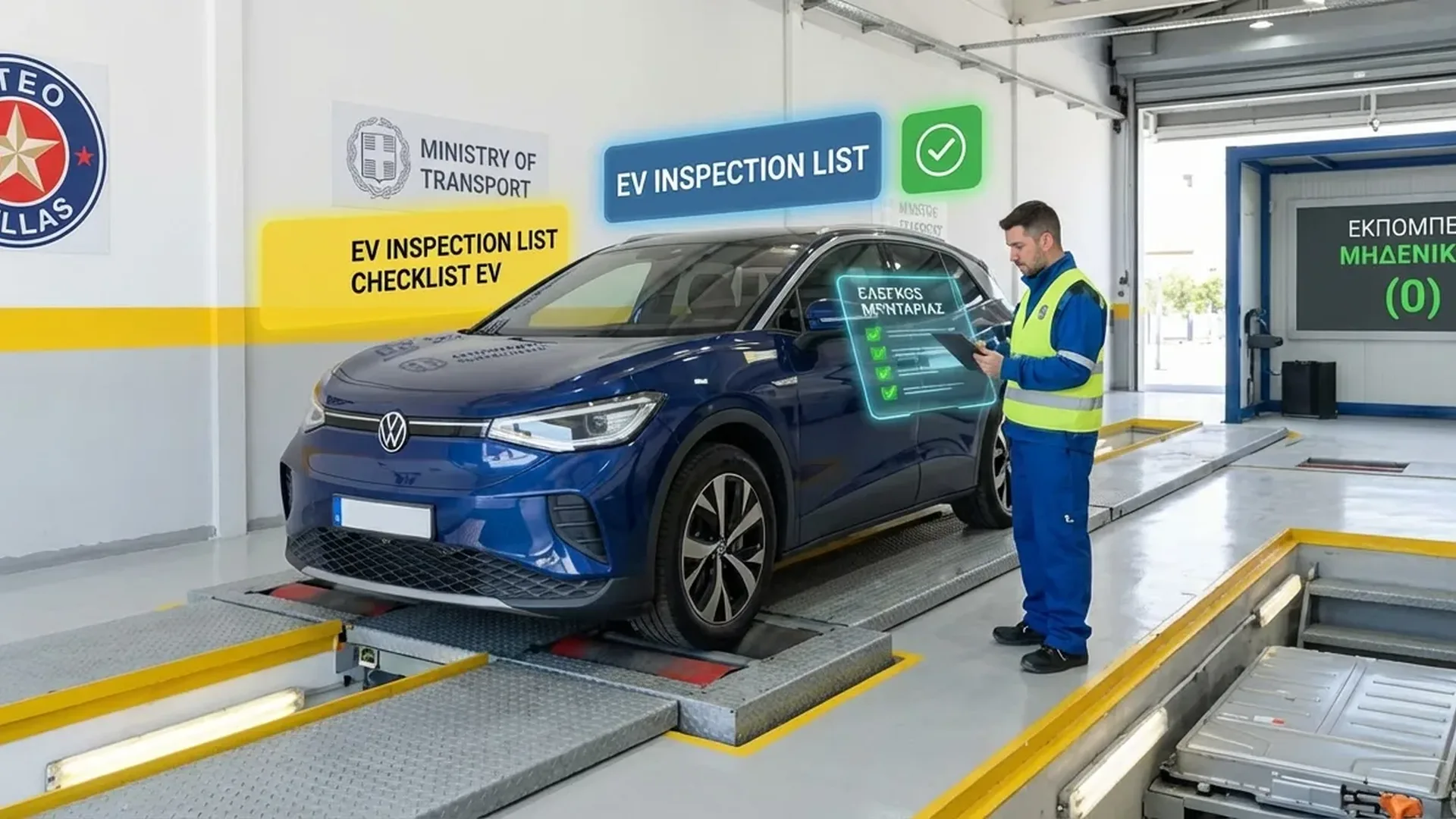
The KTEO (Vehicle Technical Inspection Center) is mandatory for all vehicles in Greece — including electric ones. But what exactly is inspected on an EV, what are the differences compared to a conventional car, and how much does it cost? In this guide, we cover everything.
📖 Read more: EV Tires: Why You Need Special Tires for Electric Cars
When You Need to Get a KTEO Inspection
According to Greek legislation, which is aligned with EU Directive 2014/45/EU, the KTEO vehicle inspection applies under exactly the same rules for electric and conventional cars:
| Vehicle Category | First Inspection | Subsequent Inspections |
|---|---|---|
| Private Passenger Cars (& EV) | 4 years after first registration | Every 2 years |
| Taxis / Rental Vehicles | 1 year after first registration | Every year |
| Trucks / Buses | 1 year after first registration | Every year |
| Driving school vehicles | 1 year after first registration | Every year |
Important: There is no special KTEO category for electric cars. If you bought a new EV, the first inspection takes place 4 years later — exactly the same as any private passenger car. After the initial one, inspections are repeated every 2 years.
What's Inspected at the KTEO
The technical inspection covers 9 main categories according to Directive 2014/45/EU. However, some inspection points do not apply to electric cars, while new ones are added:
| Inspection Category | Gasoline/Diesel | Electric (BEV) |
|---|---|---|
| Vehicle identification (VIN) | ✅ | ✅ |
| Braking system | ✅ | ✅ |
| Steering system | ✅ | ✅ |
| Visibility (windshield, mirrors) | ✅ | ✅ |
| Lights & electrical system | ✅ | ✅ |
| Axles, wheels, tires, suspension | ✅ | ✅ |
| Chassis & body | ✅ | ✅ |
| Exhaust / emissions | ✅ Exhaust gas check | ❌ Not applicable |
| Fuel system | ✅ Tank, fuel lines | ❌ Not applicable |
| Catalytic converter | ✅ | ❌ Not applicable |
| High-voltage electrical safety | ❌ | ✅ Additional check |
| Battery condition (SoH) | ❌ | ✅ Additional check |
| Pedestrian acoustic warning (AVAS) | ❌ | ✅ Additional check |
EV Advantages at the KTEO
Electric cars have several advantages over conventional ones, making them more likely to pass the technical inspection with ease:
Zero Emissions
No exhaust gas check = no risk of failure on the most common reason for KTEO rejection. Gasoline cars often fail due to a worn catalytic converter or poor combustion.
Greater Brake Durability
Thanks to regenerative braking, the mechanical brakes are used less. Brake pads last 2-3 times longer — they rarely fail at the KTEO.
📖 Read more: EV Battery: How Many Years Does It Really Last?
Simpler Mechanics
Without a gearbox, clutch, exhaust system, or timing belt, EVs don't have the typical mechanical issues that lead to KTEO failure.
No Oil Leaks
EVs don't have engine or transmission oil — a common issue in older gasoline cars that can lead to KTEO failure.
Special Inspections for Electric Cars
While EVs skip several inspection categories, there are certain additional checks that apply exclusively to electric vehicles:
Electrical Safety (ISO 6469)
Inspection of the high-voltage system (400V-800V), insulation, wiring, and connections. The automatic disconnect during an accident is also verified.
Battery Condition
Inspection of battery State of Health (SoH), battery pack mounting, and signs of moisture or coolant leakage. The warranty covers 8 years / 160,000 km.
AVAS (Acoustic Warning System)
Since July 2021, all new EVs must emit an artificial sound at speeds below 20 km/h for pedestrian safety. Its proper operation is checked.
📖 Read more: EV Battery Warranty: What Every Brand Covers
KTEO Cost
The cost of the KTEO vehicle inspection in Greece depends on the type of center (public or private) and the vehicle type. Electric cars do not pay any additional cost compared to conventional ones.
| KTEO Type | Cost | Features |
|---|---|---|
| D-KTEO (Public) | €40-€55 | State-run centers, lower cost, longer wait times |
| I-KTEO (Private) | €55-€80 | Private centers, faster service, ISO 9001:2008 certified |
| Re-inspection | €15-€30 | If you fail, fix the issues and return |
| Emissions test card | €0 (EV) | Not required for electric cars! |
EV Savings: Gasoline cars require a separate emissions test card (€15-€25) before the KTEO. Electric cars don't need one. Additionally, the lower chance of failure means fewer repair costs before re-inspection.
What to Check Before the KTEO
Even though EVs are more “reliable” at the KTEO, there are things you should check before you go:
🔧 Mechanical
- Tires: tread depth >1.6mm
- Brakes: pad & disc condition
- Suspension: noises, play
- Steering: free play
💡 Lighting
- All lights working (LED/xenon)
- Proper headlight alignment
- Anti-glare
- Turn signals, brake lights, high beams, reverse
📋 Documents
- Vehicle registration
- Valid insurance certificate
- ID / driver's license
- Service book (optional)
🔋 EV-Specific
- Battery charge >20%
- AVAS activated
- Charging port undamaged
- No active warning lights
Common Failure Causes: EV vs Gasoline
| KTEO Failure Causes | Gasoline/Diesel | Electric |
|---|---|---|
| Emissions exceeded / exhaust | Very common | Impossible |
| Worn brake pads/discs | Common | Rare (regen braking) |
| Oil leakage | Moderate frequency | Impossible |
| Exhaust system issue | Moderate frequency | Not applicable |
| Worn tires | Common | Same (EVs are heavier) |
| Lights not working | Moderate | Same (LEDs more durable) |
| Windshield issue | Moderate | Same |
The Battery at the KTEO
Many EV owners worry about the battery check at the KTEO. The data is reassuring: according to studies, only 2.5% of EV batteries worldwide have been replaced to date, and most of those were under warranty (e.g., recalls), not due to wear.
EV Battery Warranty
This means that during the first 8 years/160,000 km, if the battery drops below 70% capacity, the manufacturer replaces it for free.
📖 Read more: First EV: 10 Things You Need to Know
D-KTEO vs I-KTEO: Where to Go
Public KTEO (D-KTEO)
- ✅ Lower cost (€40-55)
- ✅ Government agency
- ⚠️ Longer wait times
- ⚠️ Fewer service locations
- ⚠️ Possible lack of EV equipment
Private KTEO (I-KTEO)
- ✅ Faster service
- ✅ More modern equipment
- ✅ ISO 9001:2008 certified
- ✅ Online appointments
- ⚠️ Higher cost (€55-80)
Tip: If you own an electric car, ask before booking an appointment whether the KTEO center has the equipment to inspect electric vehicles. Most modern I-KTEO centers are equipped, but not all D-KTEO centers are.
Conclusion
The KTEO vehicle inspection for electric cars follows the same schedule (4 years + every 2 years) and costs the same (€40-80) as conventional ones. However, EVs have a clear advantage: they're not tested for emissions (the most common cause of failure), their brakes wear less, and they don't have the typical mechanical problems. Battery replacements only in 2.5% of EVs, with an 8-year warranty. In short: the KTEO is not a concern for EV owners.