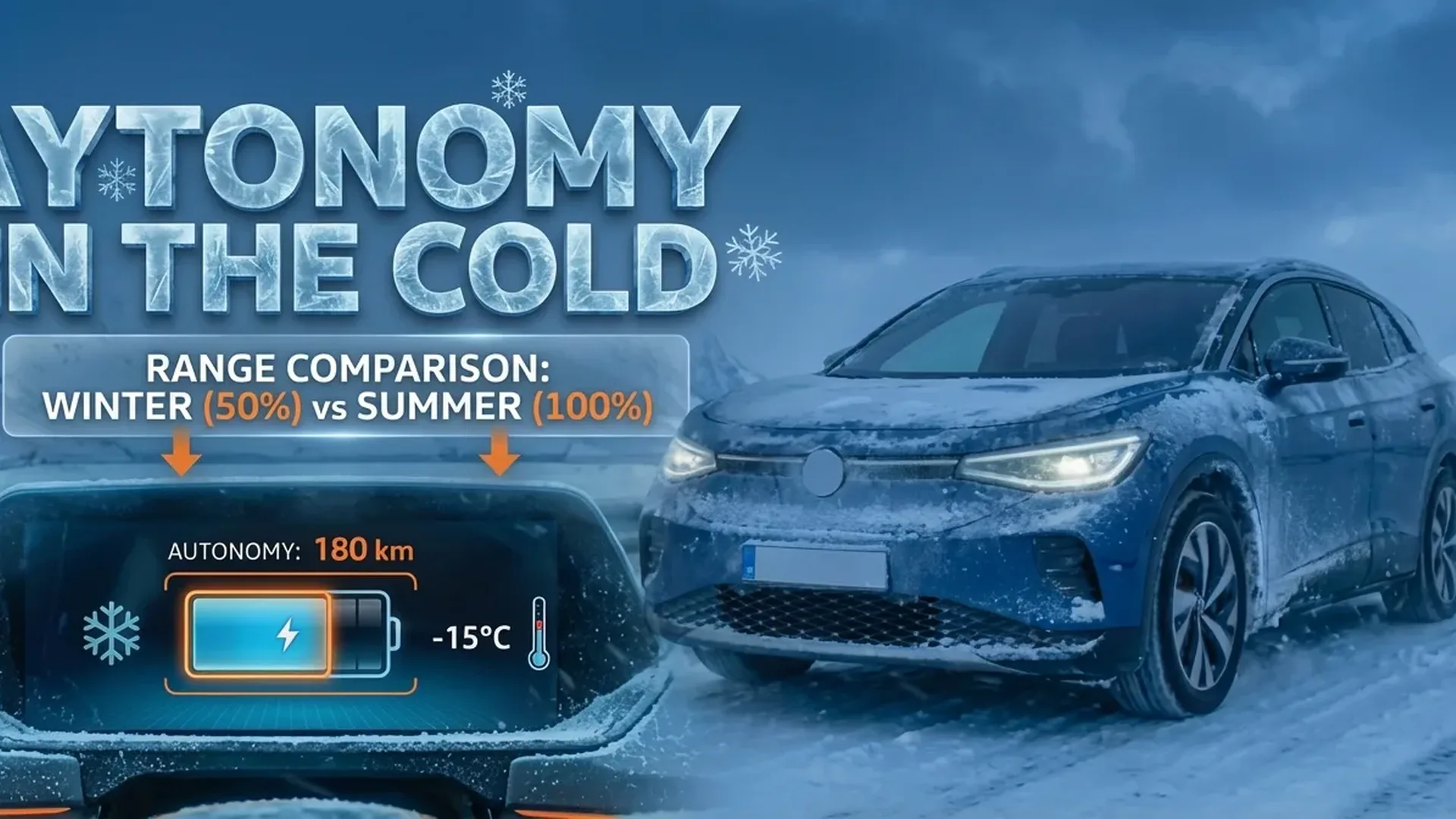
How Much Range Do You Actually Lose?
Let's clarify something first: gasoline cars also lose fuel efficiency in the cold. The difference is that with EVs the loss is more visible because range is measured in kilometers rather than liters.
The most reliable study on EV range in cold weather is by Recurrent (November 2025), which analyzed real-world data from 30,000+ electric vehicles in the US, across 34 different models. The findings:
| Temperature | Avg. Range | Example (500 km WLTP) |
|---|---|---|
| 21°C (ideal) | ~100-115% | 500-575 km |
| 0°C (freezing) | ~78% | ~390 km |
| -7°C (very cold) | ~70% | ~350 km |
| -15°C (polar) | ~54% | ~270 km |
Sources: Recurrent (30,000 vehicles, Nov. 2025) & Geotab (4,200 EVs, 5.2M trips)
Important
Range loss in cold weather is temporary. It does not damage the battery. Once the temperature rises, range returns to its normal levels.
Why Do You Lose Range in the Cold?
Many people think the battery is to blame. In reality, the main reason is cabin heating. Let's explain:
Cabin Heating
In a gasoline car, the engine produces huge amounts of “waste” heat that warms the cabin for free. In an EV, the electric motor is so efficient that it doesn't produce enough heat — it has to use energy from the battery. According to Geotab, cabin heating consumes 3,000-5,000 watts.
Battery Chemistry
The chemical reactions in lithium batteries slow down in cold weather, reducing available power. Additionally, the Battery Thermal Management system consumes energy to keep the battery at a safe temperature. However, this has a smaller impact than cabin heating.
According to Geotab, at the optimal temperature (~21.5°C) EVs achieve 115% of their rated range. That means a car with 400 km WLTP range can do 460 km in ideal conditions. The “loss” in cold weather appears larger because you're starting from a higher baseline.
Which Models Perform Best in the Cold?
The Recurrent study (2025/2026) ranked 34 EV models based on their winter performance. The results:
🏆 Top 10 in the Cold (ranking at 0°C)
| # | Model | Heat Pump |
|---|---|---|
| 1 | Tesla Cybertruck | ✓ |
| 2 | Tesla Model X | ✓ |
| 3 | Tesla Model S | ✓ |
| 4 | Rivian R1S | ✓ |
| 5 | Tesla Model Y | ✓ |
| 6 | Tesla Model 3 | ✓ |
| 7 | Ford F-150 Lightning | ✓ |
| 8 | Kia Niro EV | ✓ |
| 9 | Hyundai Ioniq 6 | ✓ |
| 10 | Audi e-tron | ✓ |
Source: Recurrent, “Best EV for Winter & Cold Weather Range”, November 2025 (30,000+ vehicles)
Tesla Dominates in the Cold
Recurrent notes that Tesla invested early in cold-weather technology. Since 2021, it introduced the Octovalve in the Model Y — a multi-channel thermal management system that controls heat exchange between the cabin, battery, and drivetrain. This explains why Tesla occupies 4 of the top 6 positions.
Heat Pump: The Secret Ally
The heat pump is perhaps the most important factor for good winter range. According to Recurrent:
Resistance Heater (Conventional)
Works like a space heater — converts electricity to heat 1:1. For every 1 kWh of electricity, it produces 1 kWh of heat. Simple but energy-intensive.
Heat Pump
Works like a reverse air conditioner — it transfers heat from the outside air. For every 1 kWh of electricity, it produces 3-4 kWh of heat. 3-4x more efficient!
According to Recurrent, EVs with a heat pump retain 10% more range at 0°C compared to those without. That means 88% instead of 78% — so for a 500 km EV, you gain ~50 km.
Note
At very low temperatures (below -15°C), heat pump efficiency drops significantly and it becomes nearly equivalent to a resistance heater. In Greece, however, such temperatures are rare outside mountainous areas.
What Does This Mean for Greece?
Greece has milder winters than northern countries, which means less range loss:
In practice, if you have an EV with 400 km WLTP range:
- In Athens during winter: You'll get 340-370 km — more than enough for daily use
- In Thessaloniki during winter: You'll get 310-350 km — still excellent
- Road trip in the snow: Expect 280-310 km real-world — plan one extra charging stop
7 Tips for Maximum Winter Range
According to the Recurrent and Geotab studies, here's what you can do:
Preconditioning
Warm up the car while it's still plugged in. This way the energy for heating comes from the grid, not from the battery. All modern EVs have scheduled departure.
Heated Seats Instead of Cabin Heating
According to Geotab, heated seats and a heated steering wheel consume only ~75 watts, while cabin heating uses 3,000-5,000 watts. A huge difference!
Keep It Plugged In on Cold Days
If you're not driving, leave the EV plugged in (without actively charging). The car will use grid power for battery thermal management instead of draining the battery.
Eco Mode in Winter
Eco mode reduces motor power, saving energy. Bonus: It also reduces wheel spin on snow and ice!
Check Your Tires
Tire pressure drops in cold temperatures, increasing rolling resistance. Check them monthly during winter.
Use GPS for Charging
If you set a fast charger as your destination in the navigation, many EVs will automatically precondition the battery so it can accept fast charging. In the cold, charging is slower — this helps a lot.
Park Indoors
A garage, even unheated, is 5-10°C warmer than outdoors. This means less energy needed for battery and cabin heating.
Summary: Should You Worry?
The short answer: No, if you live in Greece.
At typical Greek winter temperatures (0-12°C), range loss is in the 10-22% range — much less than most people imagine. For daily use (40-60 km/day avg.), even an EV with 300 km range comfortably covers you for a full week without charging.
The Good News
- The loss is temporary — it doesn't damage the battery
- Greece has mild winters — 10-20% loss max
- Heat pump +10% range in the cold
- Preconditioning nearly eliminates the loss
- Newer models (2024+) are much better
Watch Out
- Road trips in the cold → plan one extra stop
- DC charging is slower with a cold battery
- Mountainous areas → expect -30% range
- Energy regeneration (regen braking) decreases in the cold
Verdict
Range loss in cold weather is real but manageable. With preconditioning, a heat pump, and heated seats, you can drastically reduce the losses. In the Greek climate, winter range is not a problem for daily use. For road trips, simply plan one extra charging stop.
📌 Also Read
- → Road Trip with an EV: Athens to Thessaloniki
- → Where and How to Charge Your EV in Greece
- → LFP vs NMC Batteries: Which Is Better?
- → All EV Articles