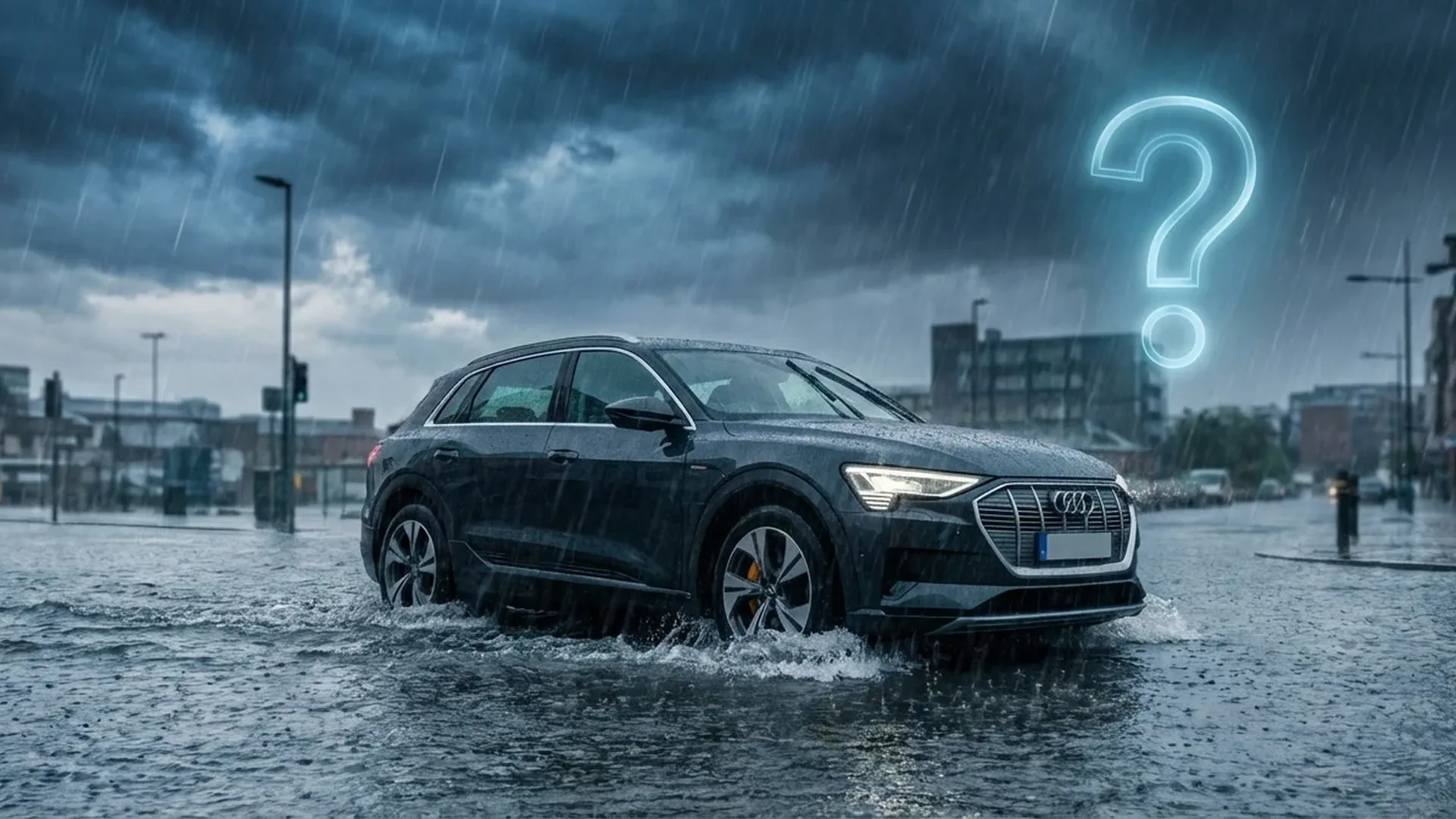
Every time a road floods, the first question EV owners ask is: "Will I get electrocuted?" The short answer? No. Electric cars are engineered with multiple layers of protection that make them, in many scenarios, safer than gasoline cars in flood conditions. Let's break down why.
📖 Read more: Chinese EVs: Why Greece Is the Next Target
What IP67 and IP68 Mean for EVs
Every EV battery pack carries an IP (Ingress Protection) certification per the IEC 60529 standard by the International Electrotechnical Commission. The code consists of two digits:
1st Digit: Solid Particle Protection
6 = Full dust protection (dust-tight). No particles can enter. This means the battery is completely sealed against solids.
2nd Digit: Liquid Ingress Protection
7 = Withstands immersion up to 1 meter for 30 minutes. 8 = Withstands continuous immersion beyond 1 meter (manufacturer specifies depth/duration).
The vast majority of modern EVs carry IP67 or IP68 battery pack ratings. This means the battery can withstand full submersion — something no internal combustion engine can claim. A gasoline car can hydro-lock if water enters the air intake, while an EV has no such intake.
Wading Depths by Model
Each manufacturer specifies a maximum wading depth through which the vehicle can safely pass. Exceeding this limit increases risk — not of electrocution, but of mechanical damage.
| Model | Wading Depth | Battery IP |
|---|---|---|
| Rivian R1T / R1S | ~33 in (850mm) | IP67 |
| Range Rover Electric | ~33 in (850mm) | IP68 |
| BMW iX xDrive50 | ~20 in (500mm) | IP67 |
| Ford F-150 Lightning | ~18 in (460mm) | IP67 |
| Tesla Model Y / 3 | ~12 in (300mm) | IP67 |
| Hyundai Ioniq 5 / 6 | ~12 in (300mm) | IP67 |
| Volkswagen ID.4 / ID.5 | ~12 in (300mm) | IP67 |
| BYD Atto 3 / Dolphin | ~12 in (300mm) | IP67/IP68 |
Why There's No Risk of Electrocution
This is the most common concern — and the most unfounded. EVs have multiple layers of electrical isolation that make electrocution virtually impossible:
- Galvanic Isolation: The high-voltage circuit (400V or 800V) is completely isolated from the chassis and body. There's no electrical connection between them — even if the battery floods, the car doesn't become “electrified.”
- Automatic Disconnect: The Battery Management System (BMS) continuously monitors insulation. If it detects current leakage or water ingress, it activates pyrotechnic disconnectors that instantly cut the high-voltage circuit.
- Sealed Enclosure: The battery sits inside a sealed aluminum or steel housing, often reinforced with structural adhesive and waterproof gaskets.
- Cable Insulation: All high-voltage cables (orange by convention) have double or triple insulation and are shielded.
Important
📖 Read more: Electric Motorcycles Greece 2026: Best Models & Guide
Per ECE R100 and FMVSS 305 standards, every EV must demonstrate that even in a crash, voltage on exposed parts does not exceed 60V DC or 30V AC — well below dangerous thresholds. In water, this applies even more thanks to automatic disconnection systems.
EV vs ICE: Which Is Safer in Water?
It may sound counterintuitive, but the evidence shows EVs have an advantage in floods:
Electric Vehicle
- No air intake — cannot hydro-lock
- Sealed IP67/68 battery pack
- Automatic high-voltage disconnect
- Can continue driving through shallow water
- No exhaust pipe to get blocked
Gasoline / Diesel
- Hydro-lock: Water in air intake = engine destruction
- Exhaust gets blocked in deep water
- Electronics without IP rating
- Stalls in moderate water depth
- Risk of timing belt slippage
Real-World Incidents: EVs in Floods
In recent years, multiple real-world events have demonstrated EV resilience:
- Hurricane Ian (2022, Florida): Despite catastrophic flooding, EVs didn't show increased fire incidents from water exposure. The NHTSA recorded very few cases, mostly involving already-recalled Chevrolet Bolts.
- Zhengzhou Floods (2021, China): BYD Han and Tesla Model 3 vehicles were photographed crossing 20+ inch deep water while gasoline cars were stranded. BYD even released footage of a Han “swimming” through deep water.
- Hurricane Harvey (2017, Houston): One of the first major flood tests for EVs — very few serious incidents reported involving Tesla Model S vehicles.
- Dubai Floods (2024): Multiple Teslas were seen “floating” through flooded streets without electrical failure, though mechanical damage remained a concern.
Important note: The fact that an EV can technically pass through water doesn't mean it should. Driving through flooded roads is dangerous regardless of powertrain type — due to visibility, currents, hidden obstacles, and potential damage.
The Real Risks After a Flood
While electrocution isn't a realistic risk, flooding can cause serious damage to an EV in other ways:
- Electronics Corrosion: Low-voltage systems (12V) — infotainment, sensors, cameras — don't always have IP67 protection. Slow corrosion can appear weeks later.
- Saltwater vs Fresh Water: Saltwater is extremely dangerous due to high conductivity. It can cause short circuits in areas fresh water wouldn't affect.
- Seal Degradation: Gaskets and seals age over time. An 8-year-old EV may no longer maintain de facto IP67 protection.
- Motor Damage: If water reaches the electric motor bearings, replacement may be necessary.
- Insurance Total Loss: Insurance companies almost always consider flooded EVs a total loss — even if they appear functional — due to the high cost of inspection and potential battery replacement ($7,500-$38,000).
📖 Read more: Electric vs Hybrid 2026: Which One Is Worth It?
Charging an EV in the Rain: Is It Safe?
A related question: is it safe to charge your EV in the rain? The answer is yes, absolutely. Charging ports (CCS2, Type 2, CHAdeMO) are designed per IEC 62196 standards that require:
- Pins only activate after full connection is established (handshake protocol)
- If moisture or leakage is detected, charging stops automatically
- Charging stations carry IP54 or higher ratings
- Even during thunderstorms, charging is safe — millions of EVs charge daily in rain across Northern Europe
Only exception: Don't charge if the outlet or charger is submerged in standing water (e.g., flooded garage). The problem in that case isn't the car but the 230V/110V AC power supply.
What to Do If Your EV Gets Flooded
If your car is exposed to deep water, follow these steps:
Don't Start It Immediately: If the water significantly exceeded the wading depth, don't try to start it. There may be water in critical areas.
Call Roadside Assistance: Specify it's an EV — it needs special handling (flatbed transport, not towing).
Authorized Service Center Inspection: Request a full diagnostic check — especially of the BMS, insulation sensors, and 12V systems.
Don't Charge: If you suspect moisture in the system, don't connect a charger until a technical inspection is done.
Document Everything: For insurance claims, take photos/videos of the water level and any visible damage.
Conclusion
Electric vehicles are inherently safer than gasoline cars in flood conditions: sealed IP67/68 battery, automatic high-voltage disconnect, no air intake to hydro-lock. However, no car is amphibious. The goal isn't to drive through floods, but if it happens, your EV handles it better. After any exposure to deep water, always get a professional inspection — safety isn't guaranteed without one.