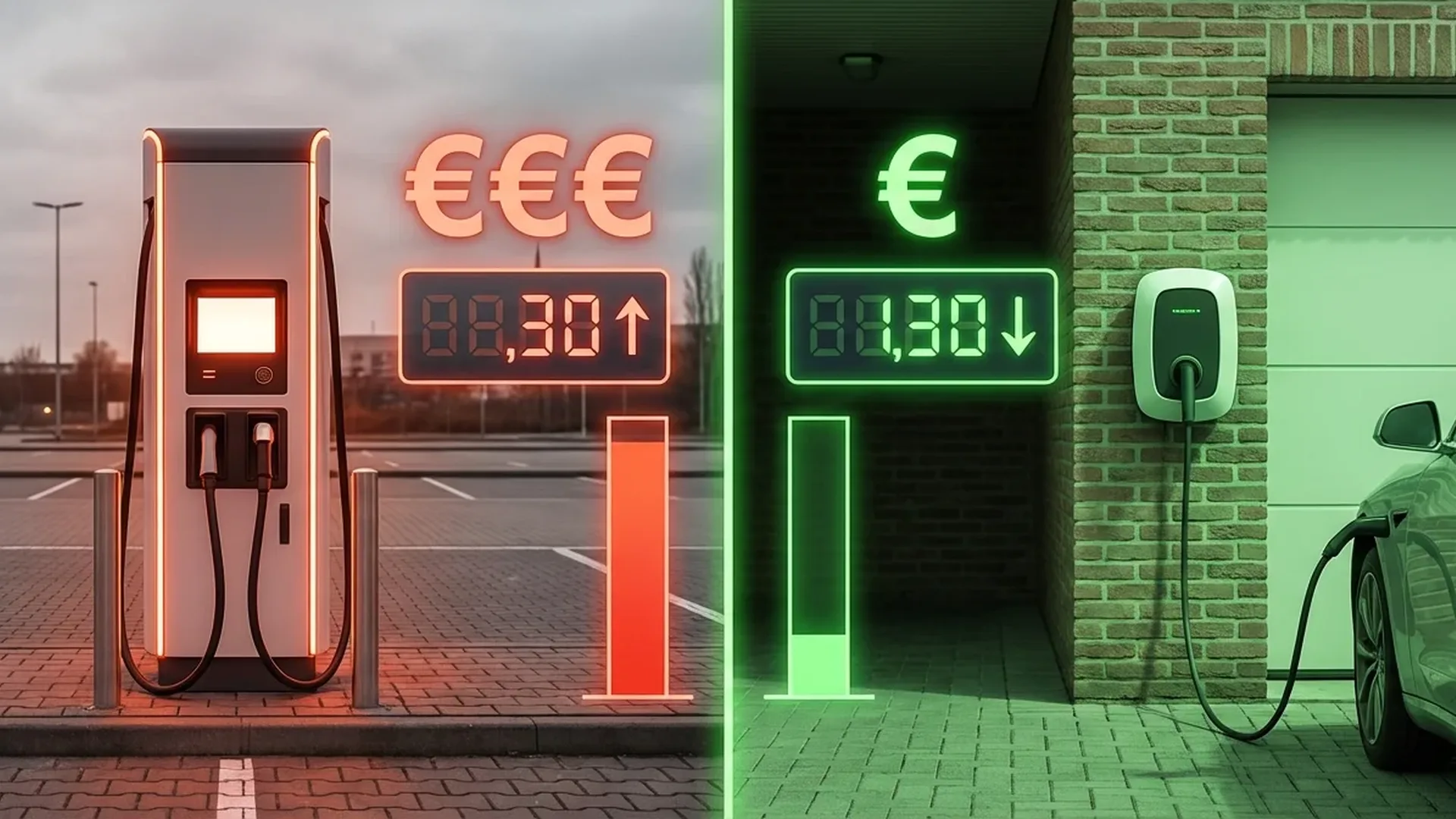
One of the first questions every prospective EV owner asks: "How much will charging cost me?" The answer depends heavily on where you charge. Home, public AC station, DC fast charger — each option comes with a completely different bill.
In this comprehensive guide, we put real numbers on the table. Price per kWh across different scenarios, monthly costs for typical usage, provider comparisons and practical examples — everything you need to make the right choice in 2026.
The Quick Comparison
Home Charging: The Most Affordable Option
Over 80% of EV charging worldwide happens at home — and for good reason. Home charging takes advantage of the lowest electricity rates, especially with off-peak or time-of-use (TOU) plans. In 2026, the economics strongly favor EV owners who charge at home.
Standard Outlet (Level 1)
- Power: ~1.4–1.9 kW (120V × 12–16A)
- Full charge time: 20–40 hours
- Cost per 100 mi: $2.50–$3.50
- Only suitable for overnight top-ups
EVSE / Wallbox (Level 2)
- Power: 7.2–9.6 kW (240V × 30–40A)
- Full charge time: 4–10 hours
- Cost per 100 mi: $2.50–$3.50
- The ideal solution — fast + affordable
Practically, if you pay $0.14/kWh and your car consumes 28 kWh/100 mi, every 100 miles costs just $3.92. By comparison, a gas car averaging 30 MPG at $3.50/gallon costs $11.67 — that's 3 times more.
Practical Example: Monthly Home Charging Cost
| Parameter | Value |
|---|---|
| Monthly mileage | 1,000 miles |
| EV consumption | 28 kWh/100 mi |
| Monthly electricity usage | 280 kWh |
| Electricity rate (residential) | $0.14/kWh |
| Monthly charging cost | $39.20 |
* Comparison: gas for 1,000 miles ≈ $117. Savings: ~$78/month
Tip: Off-Peak / TOU Rates — Many utilities offer time-of-use plans where electricity drops to $0.08–$0.10/kWh between midnight and 6 AM. Schedule charging via your car's app or EVSE and save 30–50%.
Public Charging: What You Actually Pay
Public charging infrastructure is expanding rapidly worldwide. In the US alone, over 84,000 public charging stations were available by early 2025. There are three main categories of public charging, each with completely different pricing.
| Type | Power | Price/kWh | 60 kWh (10→80%) | Time |
|---|---|---|---|---|
| AC Level 2 | 7–19.2 kW | $0.25–$0.40 | $15–24 | 3–8 hours |
| DC Fast (DCFC) | 50–150 kW | $0.40–$0.55 | $24–33 | 25–60 min |
| Ultra-Fast DC | 150–350 kW | $0.50–$0.70 | $30–42 | 15–25 min |
The per-kWh price at public stations includes electricity cost, equipment maintenance, network fees and taxes. That's why it's 2× to 4× more expensive than home charging. Some providers also charge based on connection time (per minute), which can drive costs even higher.
Major Charging Networks in 2026
The public charging market is increasingly competitive. Here are the major networks and their typical pricing:
ChargePoint
AC: $0.25–0.35/kWh | DC: $0.40–0.55/kWh
Largest US network with 27,000+ locations. Prices set by station hosts, so rates vary.
Electrify America
DC: $0.43–0.48/kWh
Premium DC-only network along major highways. Pass+ members save ~25%.
Tesla Supercharger
DC: $0.35–0.50/kWh
3,400+ stations globally, now open to non-Tesla EVs via NACS adapter. Competitive pricing.
EVgo / Blink
DC: $0.40–0.60/kWh
Urban-focused networks. Blink has 50,000+ connectors. Subscription plans can reduce per-kWh rates.
Watch out for hidden fees: Some networks charge $0.10–0.20/min idle fees after charging completes if you don't unplug. Always check terms in the app before starting a session.
The Big Comparison: Monthly Cost by Charging Method
Let's see how monthly costs break down for a typical driver covering 1,000 miles/month with an EV consuming 28 kWh/100 mi (280 kWh/month):
| Charging Method | $/kWh | Monthly Cost | Annual Cost |
|---|---|---|---|
| Home (off-peak) | $0.09 | $25.20 | $302 |
| Home (standard) | $0.14 | $39.20 | $470 |
| Public AC (Level 2) | $0.32 | $89.60 | $1,075 |
| Public DC Fast | $0.48 | $134.40 | $1,613 |
| Gasoline (30 MPG) | $3.50/gal | $116.67 | $1,400 |
Even the most expensive public DC charging is comparable to gasoline costs. But the gap between home and public charging is massive — DC fast is nearly 5× more expensive than off-peak home charging.
When Each Option Makes Sense
Home
- Daily commute charging
- City/work commuting
- Off-peak rates = gold
- Level 2 EVSE is ideal
Public AC
- Shopping/dining stops
- No home garage
- Apartment dwellers
- Moderate cost
DC Fast
- Road trips / long distance
- Emergency top-ups
- Highway corridors
- Use sparingly
Home EVSE Installation Costs
If home charging is the most affordable option, the upfront EVSE investment pays for itself quickly.
| Component | Cost |
|---|---|
| Level 2 EVSE (32A / 7.6 kW) | $350–600 |
| Level 2 EVSE (48A / 11.5 kW) | $500–900 |
| Smart EVSE (WiFi, scheduling) | $600–1,200 |
| Electrician installation | $200–800 |
| Total (typical) | $550–1,500 |
With savings of ~$75–$90/month versus gasoline, the initial investment pays for itself in 6–18 months. Popular home EVSE options: ChargePoint Home Flex, Wallbox Pulsar Plus, Grizzl-E, JuiceBox 48, and Tesla Wall Connector.
AC vs DC: What It Means Practically
AC Charging
Alternating current from the grid → converted to DC by the car's onboard charger. Limitation: the onboard charger typically handles 7–11 kW. That's why AC charging is slower but cheaper — less infrastructure cost.
DC Fast Charging
The station converts AC→DC externally and feeds power directly to the battery. Power levels of 50–350 kW mean 10–80% in 15–45 minutes. But station construction costs $30,000–$150,000 — hence the higher per-kWh price.
Connectors & Standards
In North America, these are the dominant charging standards:
J1772
AC Level 2 (up to 19.2 kW)
Universal US standard
Home + public stations
CCS Combo 1
DC fast charging (50–350 kW)
J1772 + 2 DC pins
Most common DCFC
NACS (Tesla)
AC + DC (up to 250 kW)
Adopted by most automakers
Becoming new US standard
8 Tips for Cheaper Charging
Use off-peak rates — The #1 trick. Charge midnight–6 AM and save 30–50%.
Install Level 2 EVSE — Level 1 wastes time and isn't much cheaper.
Compare networks — Use apps like PlugShare, ABRP, or A Better Route Planner.
Use free chargers — Many malls, hotels and workplaces offer free Level 2 charging.
Charge to 80% — Charging slows dramatically above 80%. Save time + money.
Don't overstay — Idle fees after charging completes can add up fast.
Get a subscription plan — Some networks offer monthly plans with lower per-kWh rates.
Solar panels + EV — If you have rooftop solar, home charging becomes virtually free.
What's Changing Going Forward
The charging market is evolving rapidly. Key trends affecting pricing:
- More competition: As networks multiply, public charging prices continue dropping. The US market has already seen 10–20% decreases since 2024.
- Dynamic pricing: Some stations already offer lower rates during off-peak hours — you might get DC charging at near-AC prices at midnight.
- Federal regulations: NEVI program stations must accept credit cards without app downloads and display clear per-kWh pricing.
- Ultra-fast 400 kW+: New standards (BYD 1 MW charging) mean 5-minute charges — but potentially new pricing tiers.
- V2G (Vehicle-to-Grid): In the future, you'll be able to sell surplus energy back to the grid, reducing your real charging cost to near zero.
Conclusion
Home charging remains the gold standard — with off-peak rates, we're talking about $25/month instead of $117 for gasoline. Public AC Level 2 is a solid alternative for apartment dwellers, while DC fast charging should be reserved for road trips and emergencies.
If you're considering buying an EV in 2026, remember: gasoline costs ~$1,400/year, home charging costs ~$302. That's a $1,098 annual savings. Over 5 years, that means over $5,400 less spent on “fuel” alone.