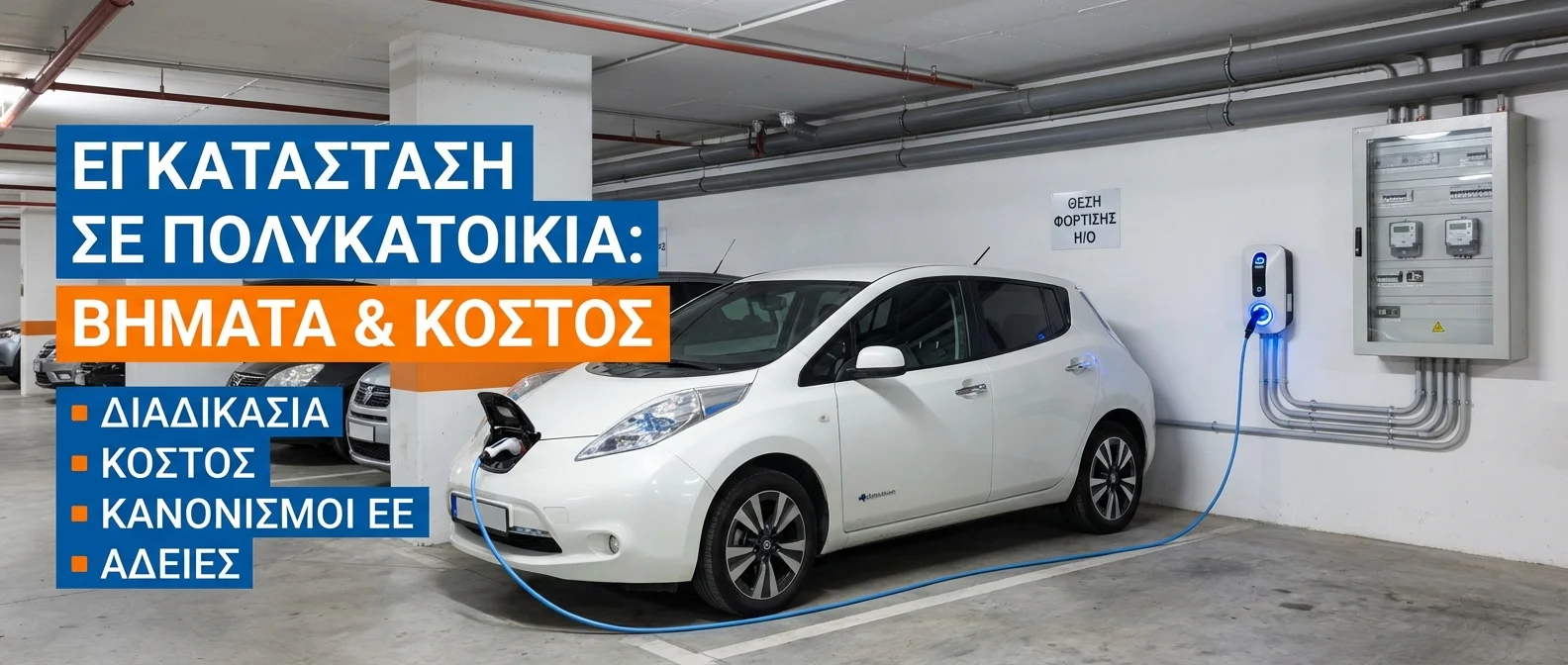
Installing an EV charger in a Greek apartment building just got a lot easier. Law 4710/2020 for electromobility — passed in July 2020 after Prime Minister Kyriakos Mitsotakis announced the plan — establishes a clear legal right to install charging stations without requiring unanimous approval from the building's general assembly. Here's exactly what the law says, how the process works, and what it costs.
What Law 4710/2020 Says About Apartment Charging
Law 4710/2020 "Promotion of Electromobility" is Greece's foundational framework for electric vehicle adoption. Passed in July 2020 following the prime ministerial announcement on June 5, 2020, where Kyriakos Mitsotakis declared that "every new building must have electric vehicle charging infrastructure" (electrive.com, 2020).
Core right: Every apartment owner or tenant has the right to install a charging point at their parking space, without requiring unanimous consent from the building's general assembly of co-owners.
This regulation represents a major breakthrough. Previously, installing electrical infrastructure in shared spaces required unanimity — a practically insurmountable obstacle. The law aligns with EU Directive 2018/844 (EPBD) encouraging member states to promote e-mobility infrastructure in buildings.
Requirements by Building Type
Installation Process — Step by Step
Notify Building Manager
Inform the building manager in writing of your intention to install a charging point. No approval needed — just notification. Recommend sending a registered letter or email with delivery receipt.
Electrical Engineer Assessment
A licensed electrician must check the building's available electrical capacity, panel condition, and design the supply line. If existing supply is insufficient, you may need a capacity upgrade from DEDDIE.
Charger Installation
The electrician installs the wallbox charger at your parking space. Connection is made to your individual meter so shared areas aren't burdened. Installation includes grounding, RCD Type B safety relay, and appropriate cable gauge.
Electronic Declaration & Subsidy
Declare the installation electronically and apply to the "Kinoumailektrika 3" program for a €400 home charger subsidy. Applications are submitted through kinoumeilektrika3.gov.gr platform.
Apartment Charger Installation Costs
Total cost depends on charger type, distance from the electrical panel, and any necessary upgrades. Here's a detailed breakdown:
Home Charger Types
Schuko Socket (Mode 2)
- Power: 2.3 kW (10A)
- 0-100% charge: 20-30 hours
- Cost: ~€0 (existing socket)
- ⚠️ Not recommended — overheating risk
Wallbox 7.4 kW (Mode 3)
RECOMMENDED- Power: 7.4 kW (single-phase, 32A)
- 0-100% charge: 6-8 hours
- Cost: €400-€800
- ✅ Perfect for overnight charging
Wallbox 11 kW (Mode 3)
- Power: 11 kW (three-phase, 16A/phase)
- 0-100% charge: 3-5 hours
- Cost: €600-€1,200
- Requires three-phase supply
Common Problems & Solutions
Co-owner resistance: Despite legal protection, some residents may object. Remember that you don't need their consent under Law 4710/2020. If necessary, you can invoke the law through legal counsel.
Problem: Insufficient electrical capacity
Solution: Apply for capacity upgrade with DEDDIE. Alternatively, install a "smart" charger with dynamic load balancing that automatically adjusts charging current.
Problem: Long distance panel to parking
Solution: Use a separate meter/sub-meter near the space. In some cases, shared supply cable for multiple points (backbone cabling) significantly reduces costs.
Problem: No owned parking space
Solution: If using shared space, charger installation requires general assembly approval. Alternatively, use public charging stations — over 1,700 in Greece (2022).
Problem: Tenant, not owner
Solution: Tenants have installation rights but need written owner consent. Cost burden falls on the applicant unless otherwise agreed.
Home Charging vs Public Station Costs
Tip: Take advantage of DEH night-time rates (02:00-08:00) for home charging. Most wallbox chargers have scheduling features. With night electricity, 100 km costs just €1.50-€2.00 — up to 90% cheaper than gasoline!
Subsidies & Incentives 2026
The Greek government provides generous electromobility incentives through the "Kinoumailektrika 3" program (kinoumeilektrika3.gov.gr). Incentives launched in 2020 with €100 million for 18 months, targeting 25% of the cost for ~14,000 electric vehicles (Wikipedia).
Charger Subsidy
For purchase & installation of home wallbox charger — "Kinoumailektrika 3" program
Vehicle Subsidy
Base subsidy + bonuses (scrappage €1,500, young drivers €500, disabled €1,000, large families €2,000) — up to €8,400
Tax Incentives
Zero road tax, free parking in regulated spaces, tax deduction for charging expenses
New vs Old Buildings — What Changes
New Buildings (post-2020)
- ✅ Mandatory pre-cabling at every parking space
- ✅ Provision for separate EV electrical panel
- ✅ Adequate electrical capacity from the start
- ✅ Installation cost: €400-€800 (wallbox only)
- ✅ Aligned with EU EPBD Directive 2018/844
Old Buildings (pre-2020)
- ⚠️ No pre-cabling — new line required
- ⚠️ Possible need for DEDDIE capacity upgrade
- ⚠️ Longer cable runs (increased cost)
- ⚠️ Installation cost: €800-€2,700 (wallbox + work)
- ✅ Installation right guaranteed by Law 4710/2020
Safety Rules & Standards
Required
- Licensed electrician installer
- RCD Type B (30mA leakage relay)
- Grounding per ELOT HD 384
- Appropriate cable gauge (≥6mm²)
- CE/IEC 61851 certified charger
Prohibited
- Long-term charging from Schuko socket
- Using extension cords or power strips
- Connection to shared meter
- Installation without circuit breaker
- DIY installation without electrician
Bottom Line
Law 4710/2020 eliminated the biggest obstacle to EV charging in Greek apartments. At €400-€2,700 (before subsidies), installing a home wallbox is one of the best investments for EV owners — overnight home charging costs up to 90% less than gasoline and 60-70% less than public DC fast charging. With "Kinoumailektrika 3" subsidies (€400 for charger + up to €8,400 for vehicle), the transition to electromobility has never been more affordable.
Related Articles
DEH Charging Stations 2026
Greece's public charging network expansion
EV Subsidies Greece 2026
Complete "Kinoumailektrika 3" guide
Electricity vs Gasoline: Costs
Per-kilometer cost comparison EV vs ICE
EV Road Tax 2026
Zero fees, free parking & tax benefits