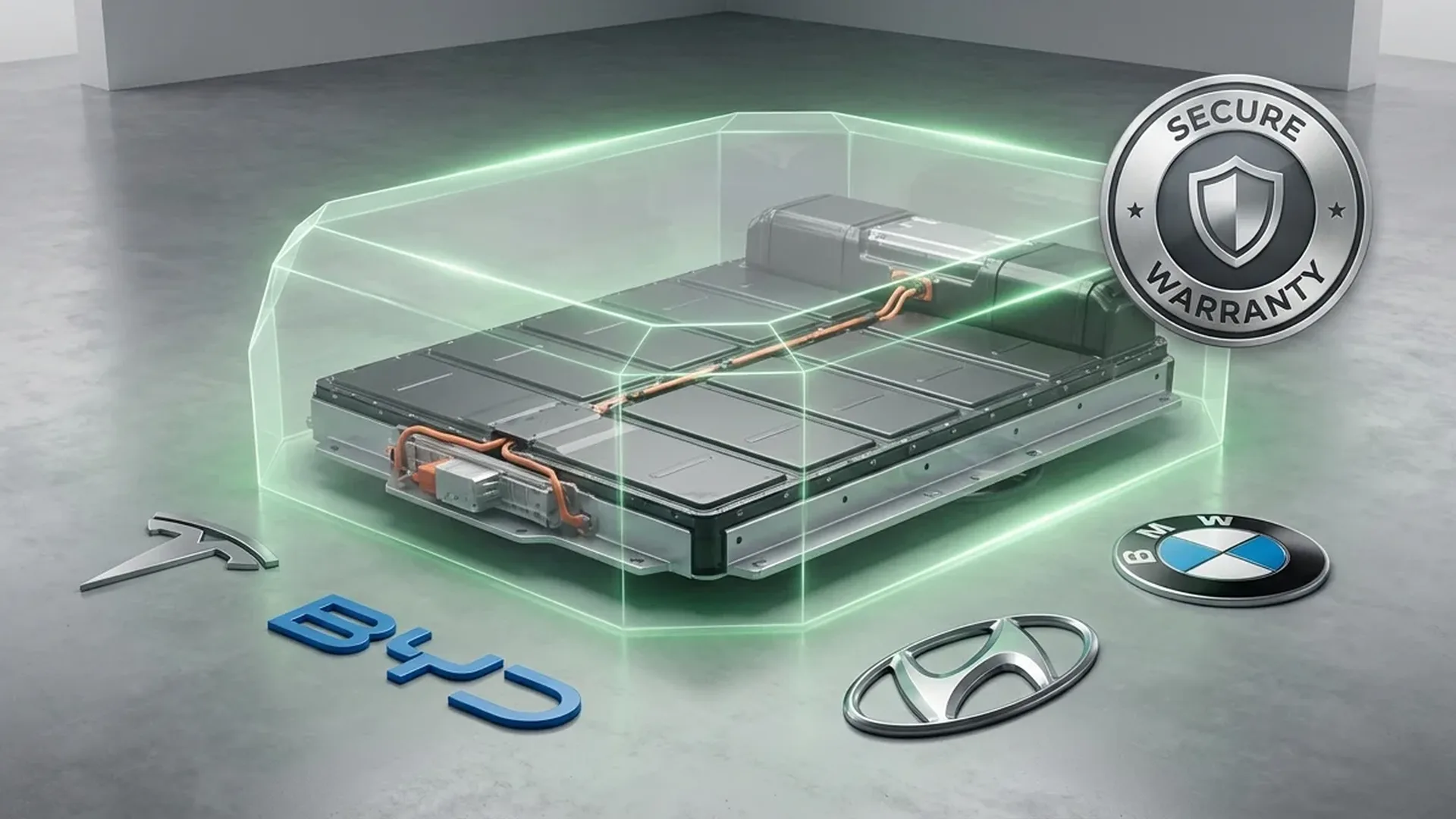
The battery is the most expensive component of an electric vehicle — representing 30-50% of the car's value. Naturally, the battery warranty is one of the first things every prospective EV buyer examines. But what exactly does each manufacturer cover? How many years and miles does it last? And what does the “70% State of Health” you see everywhere actually mean?
In this guide, we break down the battery warranties from every major manufacturer, what's covered and what's not, real-world replacement data from 30,000+ electric cars, and how you can maximize your battery's lifespan.
What “70% SoH” Means
State of Health (SoH) expresses how much capacity the battery retains compared to its original capacity. When a manufacturer guarantees “70% SoH,” it means that if the battery drops below this percentage during the warranty period, they are obligated to replace it free of charge.
What This Means in Practice
If you buy an EV with a 77 kWh battery and a 70% SoH warranty, the battery is covered if it drops below 53.9 kWh. This doesn't mean the car stops working — it just means the range will have noticeably decreased. A car with an original range of 310 miles would now do about 217 miles, which remains sufficient for most users.
Battery Warranties by Manufacturer (2025-2026)
The table below compiles battery warranties from the most important EV manufacturers. Data reflects current models (2024-2026).
| Manufacturer | Years | Miles | Min SoH | Notes |
|---|---|---|---|---|
| Tesla | 8 | 100K-150K | 70% | Model 3 RWD: 100K, LR/Perf: 120K, S/X: 150K mi |
| Hyundai | 10 | 100,000 | 70% | Ioniq 5/6 — best-in-class coverage |
| Kia | 10 | 100,000 | 70% | EV6, EV9 — same platform as Hyundai (E-GMP) |
| BMW | 8 | 100,000 | 70% | iX, i4, i5, i7 — unified policy |
| Mercedes-Benz | 10 | 155,000 | 70% | EQS, EQE — premium coverage |
| Volkswagen | 8 | 100,000 | 70% | ID.3, ID.4, ID.5, ID.7 — MEB platform |
| BYD | 8 | 124,000 | 70% | Blade Battery LFP — lifetime in some markets |
| Nissan | 8 | 100,000 | ~66% | Leaf: covered below 9/12 capacity bars |
| Rivian | 8 | 175,000 | 70% | R1T, R1S — best mileage coverage |
| Porsche | 8 | 100,000 | 70% | Taycan — 800V architecture |
| Polestar | 8 | 100,000 | 70% | Polestar 2, 3, 4 — Volvo/Geely platform |
| Ford | 8 | 100,000 | — | Mustang Mach-E — no explicit SoH threshold |
Who Offers the Most
Longest Time Coverage
Hyundai / Kia / Mercedes
10 years of warranty — 2 years more than the industry standard
Highest Mileage Coverage
Rivian
175,000 miles — ideal for high-mileage use, adventure and road trips
What's Covered (and What's NOT)
The EV battery warranty isn't a blanket coverage for “everything that could go wrong.” There are specific terms that vary between manufacturers, but the general rule is:
Covered
- Natural degradation below the SoH threshold
- Manufacturing defects in cells/modules
- BMS (Battery Management System) failure
- Internal short circuits or thermal events
- Recalls due to design issues
NOT Covered
- Damage from accidents or collisions
- Use of unauthorized chargers or modifications
- Negligence (e.g., parking in flooded areas)
- Commercial/fleet use (for some brands)
- External battery housing damage
What Real-World Data Shows
Recurrent Auto tracks over 30,000 electric cars in the US, providing the most reliable data on real-world EV battery lifespan. The findings are encouraging:
<4%
Total battery replacement rate (all generations)
0.3%
Replacement in modern EVs (2022+)
8.5%
Replacement in 1st gen EVs (pre-2016)
The data shows that batteries are holding up far better than initially expected. For second-generation EVs (e.g., early Chevrolet Bolt EV, Tesla Model 3), the replacement rate is just 2%. Lithium-ion batteries follow an S-shaped degradation curve: a small initial drop, a long period of stability, and a sharp decline only at end of life — something rarely observed in today's cars.
Software Updates & “Hidden” Capacity
According to Recurrent's data, several manufacturers maintain 100% of original range even after 5 years — not because the battery doesn't degrade, but because they use software updates that improve efficiency and release “hidden” capacity held as a buffer. Physical degradation occurs, but the driver doesn't notice it.
Major Battery Recalls: What the Market Learned
Two major recalls shook the EV world in recent years, and they're worth mentioning because they show how manufacturers respond to serious issues:
Chevrolet Bolt EV (2017-2022): Defective cells from LG Energy Solution created a fire risk. GM recalled 143,000 vehicles and fully replaced the batteries — costing GM over $2 billion. Every owner received a brand-new battery free of charge.
Hyundai Kona EV (2019-2022): Again LG Energy cells — same problem, battery replacement in tens of thousands of vehicles worldwide. Hyundai covered the cost and improved quality control in partnership with LG.
More recently, Ford performed module replacements on the F-150 Lightning under warranty, while GM replaced batteries in 2022 Hummer EVs. Rivian has also been replacing R1T batteries under warranty. In all cases, the manufacturer fully covered the cost.
5 Ways to Protect Your Battery
Even if your warranty provides peace of mind, proper usage can extend battery life well beyond the 8-10 year mark:
Charge Between 20-80%
Avoiding the extremes (0% and 100%) significantly reduces stress on the cells. Tesla recommends a daily limit of 80%, and most manufacturers agree.
Limit DC Fast Charging
High-power DC charging (150+ kW) heats the battery. Use it for road trips, but daily home charging (AC 7-11 kW) is much gentler.
Watch the Temperature
Heat is the worst enemy: park in the shade during summer, use preconditioning before charging, and don't charge immediately after hard driving.
Keep Software Updated
OTA updates frequently improve thermal management and charging algorithms. Tesla, for example, replaces NMC batteries with LFP in warranty replacements, ensuring longer lifespan.
Don't Stay at 0% for Long
Leaving your car parked for weeks with a very low battery can cause permanent cell damage. Keep at least 20% if you won't be using it.
Battery Warranty in Europe
In the European market, battery warranties are fully honored through official dealerships. Here are some key points:
- Warranties apply EU-wide — you can get warranty service in any EU country
- For used imported EVs, the battery warranty transfers to the new owner (depends on brand)
- The EU Battery Regulation 2027 will require a “battery passport” with complete history for every EV battery
- BYD, NIO and other Chinese manufacturers operating in Europe comply with European warranty standards
- EU consumer law provides 2 years of general warranty protection, beyond manufacturer warranty
An important tip: before buying a used EV, request a battery health report from a specialized center or through services like Recurrent (US) or Aviloo (Europe). An SoH above 90% after 3-4 years of use is considered excellent.
Out-of-Warranty Replacement Costs
If a battery replacement is needed after the warranty expires, costs vary significantly:
| Model | Estimated Cost |
|---|---|
| Nissan Leaf (40 kWh) | $8,000 - $10,000 |
| Tesla Model 3 (60-82 kWh) | $13,000 - $20,000 |
| VW ID.4 (77 kWh) | $16,000 - $22,000 |
| BMW iX (105 kWh) | $22,000 - $33,000 |
| Mercedes EQS (107 kWh) | $27,000 - $38,000 |
Replacement costs are steadily declining — battery cell prices have dropped by 90%+ since 2010, and new chemistries like LFP (Lithium Iron Phosphate) and sodium-ion promise even cheaper packs. Additionally, the battery refurbishment market is growing, offering remanufactured packs at 40-60% of new pricing.
Conclusion
The EV battery warranty is one of the strongest “safety nets” in the automotive industry. With 8-10 years of coverage from most manufacturers, a 70% SoH guarantee, and real-world data showing a replacement rate of just 0.3% in modern EVs, battery anxiety should not be a barrier to purchasing an electric car. Technology is improving, warranties are expanding, and batteries are lasting far longer than anyone expected.