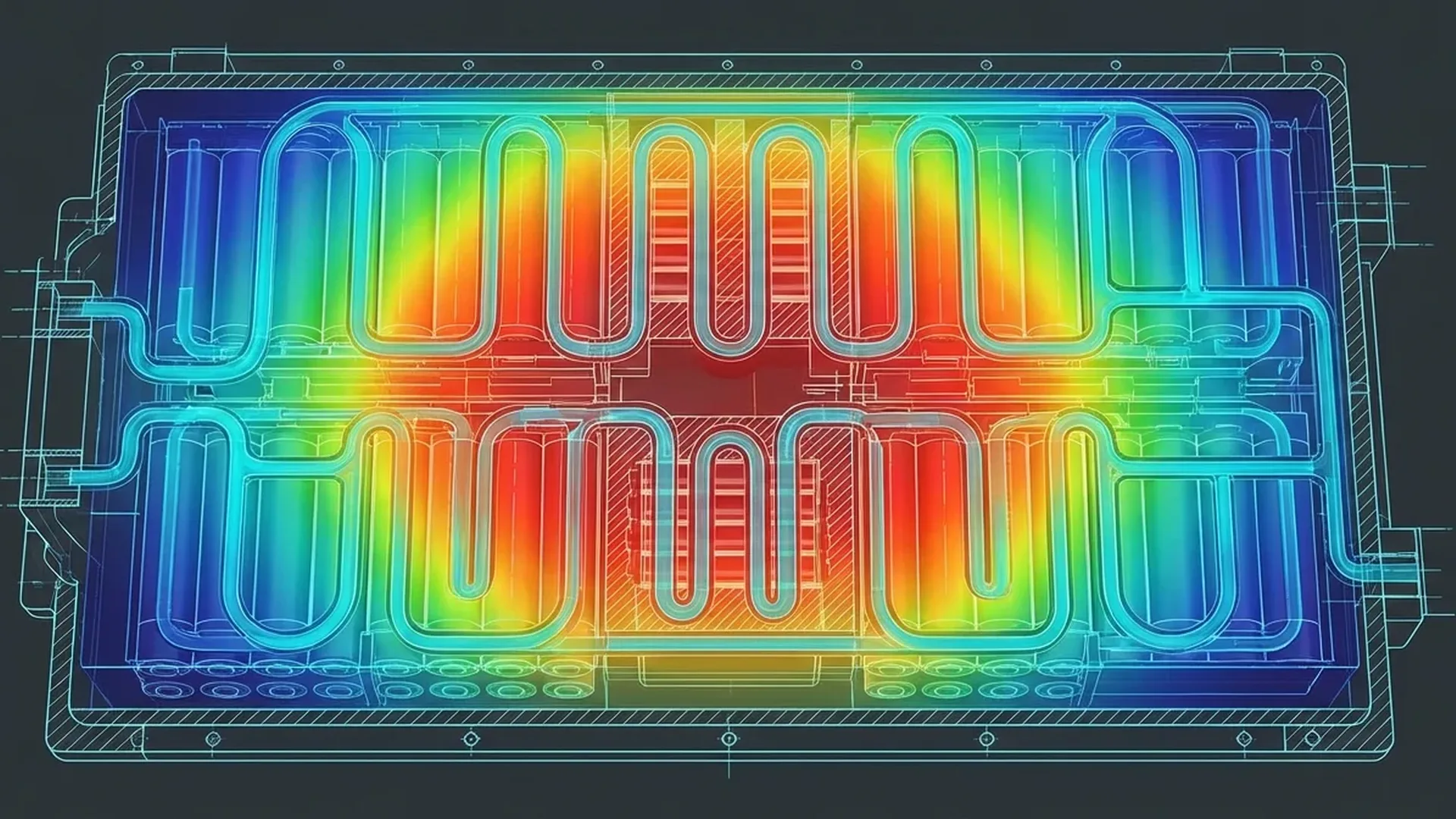
An EV battery is like the human body: it performs best within a specific temperature range. Too cold? You lose range and charging slows to a crawl. Too hot? The battery ages prematurely. That's why every modern EV has a sophisticated thermal management system. Let's explore how it works — and why it matters so much.
📖 Read more: EV Battery Recycling: How It Works & Why It Matters
Why Temperature Matters So Much
Below 32°F (0°C)
Chemical reactions slow down. Range drops 20-40%. Risk of lithium plating during charging.
Above 113°F (45°C)
Accelerated SEI layer growth. Electrode decomposition. Permanent capacity loss.
According to Battery University data, a Li-ion battery stored at 77°F (25°C) retains 96% of its capacity after one year. At 104°F (40°C) it drops to 85%, and at 140°F (60°C) to just 75% — in only 3 months if the battery is fully charged. Temperature isn't a comfort issue — it's a survival issue.
What Cold Does to Your Battery
Temporary Effects
- Range reduced 10-12% from temperature alone (AAA)
- Up to 40% loss with cabin heating active
- Slower charging — up to 3x longer (Idaho National Labs)
- Increased internal resistance
Permanent Damage (without BMS)
- Lithium plating: metallic deposits on anode
- Reduced available lithium
- Permanent internal resistance increase
- Possible short-circuits in extreme cases
Lithium plating is the most serious cold-weather threat. When you charge a battery below 32°F, lithium ions move so slowly they can't intercalate into the graphite anode structure. Instead, they deposit as metallic lithium on the surface, permanently reducing capacity. That's why modern EVs automatically preheat the battery before fast charging.
What Heat Does to Your Battery
While cold effects are mainly temporary, heat causes permanent damage. Temperature accelerates all chemical reactions — both the desired ones (energy production) and the unwanted ones (degradation). The main mechanism is growth of the SEI (Solid Electrolyte Interphase) — a protective layer on the anode that consumes available lithium.
| Storage Temperature | 40% SoC (1 year) | 100% SoC (1 year) | Rating |
|---|---|---|---|
| 32°F (0°C) | 98% capacity | 94% | Excellent |
| 77°F (25°C) | 96% | 80% | Good |
| 104°F (40°C) | 85% | 65% | Fair |
| 140°F (60°C) | 75% | 60% (3 months!) | Critical |
Source: Battery University — Estimated recoverable Li-ion capacity after 1 year of storage.
Types of Cooling Systems
Liquid Cooling
Glycol-water coolant circulates through channels or plates surrounding the cells. The most common system today.
Used by: Tesla, BYD, Hyundai/Kia, VW, Rivian, Ford
Air Cooling
Passive or active cooling with airflow. Cheap but ineffective in extreme temperatures. Now considered outdated.
Used by: Nissan Leaf (early generations)
Direct Refrigerant
Refrigerant passes directly through the battery without an intermediate water circuit. Faster heat transfer.
Used by: BMW iX, BMW i4
Immersion Cooling
Cells are submerged in non-conductive liquid. Excellent heat transfer. Technology under development.
Researching: Mercedes, CATL, StarPower
Did You Know? The first-generation Nissan Leaf used passive air cooling — no coolant pump. In hot climates (Arizona, Texas, southern Europe), many owners saw 30-40% capacity loss within 3-4 years. It was the perfect proof that thermal management isn't a luxury.
Heating Systems: Heat Pump vs PTC
Cooling is only half the picture. In winter, the battery needs to be warmed up before it can operate efficiently. Two technologies play a role:
Heat Pump
- COP 3-4x: 1 kWh electric → 3-4 kWh thermal
- "Recycles" waste heat from motor & electronics
- +15-20% winter range vs PTC
- More complex, more expensive
Available in: Tesla (Model 3/Y), Hyundai Ioniq 5/6, BMW iX, Kia EV6/EV9, VW ID.4/5
PTC Heater (Resistive)
- COP 1: 1 kWh electric → 1 kWh thermal
- Converts electricity directly to heat
- Drains range for heating
- Simpler, cheaper system
Used by: Older models, budget Chinese EVs, some PHEVs
How Tesla's Thermal Management Works
Tesla is a pioneer in EV thermal management. The Model 3 and Model Y use a unique system — the "Superbottle" (or octovalve) — an 8-way valve that controls coolant flow between the battery, motor, cabin, and heat pump.
Notable: Tesla activates thermal management even when the car is off or unplugged. If battery temperature reaches critical levels, the system kicks in automatically. This may use some range, but it protects long-term battery health.
Preconditioning: What It Is and Why It Matters
Preconditioning means warming or cooling the battery before use. There are three main methods:
During Charging
Automatic before fast charging. The BMS warms/cools cells to optimal range.
Via Navigation
Set a charger as destination = battery prepares en route. Tesla, Hyundai, BMW.
Scheduled Departure
Set departure time and battery + cabin are ready. Ideal while charging at home.
Navigation-based preconditioning is particularly important: if you set a Supercharger as your destination on a Tesla, the battery starts warming up 15-20 minutes before arrival, so you achieve maximum charge speed immediately. Without it, you might start at 30-50 kW instead of 250 kW.
OEM Comparison
| Manufacturer | Cooling | Heat Pump | Nav Precon. | Rating |
|---|---|---|---|---|
| Tesla | Liquid (octovalve) | ✅ | ✅ | ⭐⭐⭐⭐⭐ |
| Hyundai/Kia | Liquid | ✅ | ✅ | ⭐⭐⭐⭐⭐ |
| BMW | Refrigerant | ✅ | ✅ | ⭐⭐⭐⭐⭐ |
| BYD | Liquid | ✅ (newer) | Some | ⭐⭐⭐⭐ |
| VW Group | Liquid | ✅ | ✅ | ⭐⭐⭐⭐ |
| Nissan (Leaf) | Air (passive) | ❌ | ❌ | ⭐⭐ |
Practical Tips for EV Owners
Winter
- Precondition battery + cabin while plugged in
- Set charger as GPS destination before arriving
- Charge in a garage when possible
- Avoid DC fast charging below 32°F (0°C)
- Use heated seats instead of air heating
Summer
- Park in shade or garage — especially above 104°F
- Avoid charging to 100% unless needed
- Don't charge immediately after a long drive
- Keep daily charge between 20-80%
- Schedule overnight charging for cooler temps
The 20-80 Rule: Charging between 20% and 80% dramatically reduces degradation. According to Chalmers University research, using only 50% of capacity (instead of 100%) increases battery lifespan by 44-130%.
The Future: What's Coming
Immersion Cooling
Cells submerged in non-conductive liquid. Eliminates hot spots, +30% cooling efficiency.
Solid-State
Solid electrolyte = wider temperature tolerance, less cooling needed.
AI Thermal Control
Predictive thermal management using AI based on driving style, weather, route.
Conclusion
Battery thermal management isn't a “technical detail” — it's the single most important factor determining how long your battery will last, how fast it charges, and how much range you'll get in extreme weather. In hot climates like the southern US, Mediterranean, and Middle East, where temperatures can exceed 110°F, proper thermal management isn't a luxury — it's a necessity.
If you're considering an EV purchase, look beyond kWh and miles of range. Ask: what cooling system does it use? Does it have a heat pump? Does it support preconditioning? The answer will determine how much that battery is worth in 8 years.
Tags: #thermal management #EV battery #heat pump #liquid cooling #preconditioning