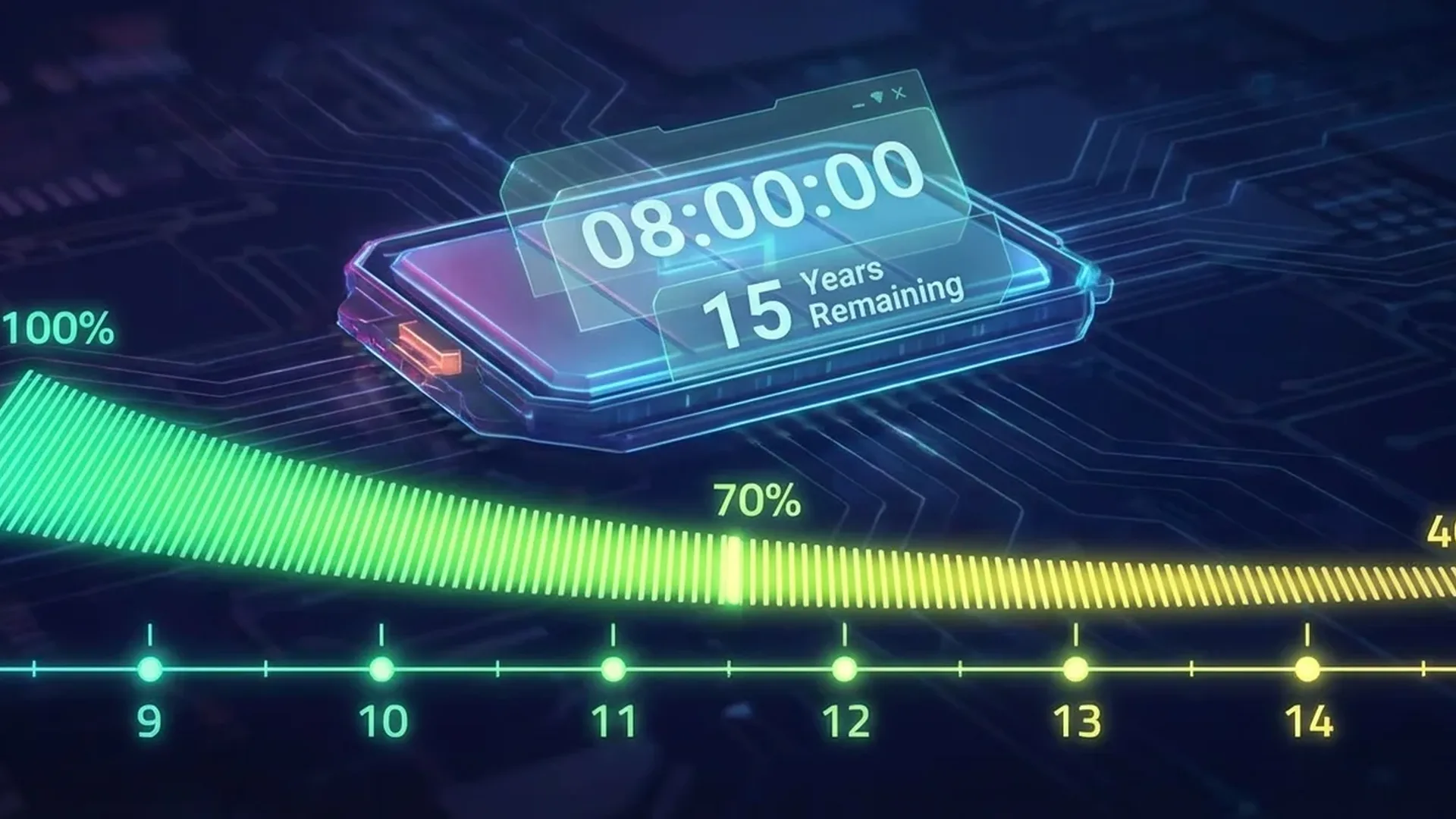
The most common question from every prospective EV buyer: "How many years does the battery last?" The short answer is “far longer than you think.” The detailed answer requires understanding chemistry, charge cycles, temperature — and data from millions of real cars on the road.
How Does an EV Battery Degrade?
Lithium-ion (Li-ion) batteries gradually lose capacity through two mechanisms:
Cycle Degradation
Every charge-discharge cycle consumes a small percentage of capacity. A Solid Electrolyte Interface (SEI) layer grows on the anode, permanently trapping lithium ions. This intensifies with fast charging and high temperatures.
Calendar Aging
Even if you don't drive, the battery ages. Internal resistance increases over time — especially at high states of charge (>90%). According to IEEE, the battery reaches “end of life” when it drops to 80% of its original capacity.
What Does Real-World Data Show?
Lab data tells one story. Real cars on the road tell a rather different — and more optimistic — one.
According to a study published in Nature Energy (December 2024), EV batteries in real-world conditions can last up to 38% longer than laboratory predictions. This is because lab tests use extreme conditions (full charge-discharge cycles, elevated temperatures) that don't represent typical daily use.
In practice, the industry reports that the average EV battery retains 90% of its capacity after 6.5 years of service. That means if you start with 250 miles of range, after 6+ years you'll still have ~225 miles — more than enough for 99% of daily needs.
How Many Charge Cycles Can It Handle?
The answer depends critically on the battery chemistry:
| Battery Type | Cycle Life (80% SoH) | Heat Tolerance | Used By |
|---|---|---|---|
| NMC (Nickel-Manganese-Cobalt) | 1,500 – 5,000 | Moderate | BMW, Mercedes, VW, Hyundai |
| LFP (Lithium Iron Phosphate) | 3,000 – 7,000 | High | Tesla (SR+), BYD, MG |
| NCA (Nickel-Cobalt-Aluminum) | 1,500 – 3,000 | Moderate | Tesla (LR/Performance) |
| LTO (Lithium Titanate) | 10,000+ | Very High | Buses, specialty vehicles |
If an LFP battery handles 5,000 cycles and you charge every 2 days, that equals ~27 years. Even the “weakest” NCA at 1,500 cycles gives you 8+ years — and that's with full 0-100% cycles, which nobody does in practice.
The 5 Factors That Affect Battery Lifespan
1. Temperature: The #1 enemy. The ideal range is 59-95°F (15-35°C). Above 122°F (50°C), degradation accelerates dramatically. Below 41°F (5°C), metallic lithium can deposit on the anode (lithium plating), permanently reducing capacity. That's why modern EVs (Tesla, BMW, Hyundai) have active thermal management — liquid cooling/heating the battery 24/7.
2. DC Fast Charging: Every DC fast charge stresses the battery slightly more, especially in heat. Studies (e.g., CleanTechnica) show that heat + fast charging cause more degradation than age or mileage. A Nissan Leaf without active cooling degrades 2× faster than a Tesla with liquid cooling.
3. Depth of Discharge (DoD): Charging above 80% and discharging below 10% drastically accelerates wear. The ideal zone: 20-80%. That's why Tesla recommends a “Daily limit 80%” in its settings.
4. Storage State of Charge: Leaving your EV at 100% for weeks causes significant degradation. The ideal storage level: 50-60%. Calendar aging at 100% SoC + heat can cause a sharp capacity drop.
5. Battery Chemistry: LFP batteries are barely affected by high SoC — you can charge them to 100% without concern. NMC/NCA batteries, on the other hand, require more care.
Manufacturer Warranties: What Do They Cover?
Manufacturers offer extended battery warranties — far longer than the general vehicle warranty:
| Manufacturer | Warranty | Minimum Capacity |
|---|---|---|
| Tesla | 8 years / 150,000 mi | 70% |
| Hyundai/Kia | 8 years / 100,000 mi | 70% |
| BMW | 8 years / 100,000 mi | 70% |
| Mercedes | 10 years / 155,000 mi | 70% |
| BYD (Blade/LFP) | 8 years / unlimited mi | 70% |
Important: the 70% capacity warranty threshold is the minimum. Most EVs exceed this level by a wide margin. Studies show batteries reach 80% after 1,000-2,000 full cycles at 77°F (25°C) — equivalent to 150,000-300,000+ miles of real-world driving under normal use.
What Happens After “End of Life”?
When an EV battery drops to 80% (the IEEE definition of “end of life”), it doesn't die — it simply becomes less suitable for automotive use. A second life follows:
Second-Life Storage
Stationary energy storage for homes, solar panels, or the grid. The battery can live another 10+ years in this role.
Recycling
Recovery of lithium, nickel, and cobalt. The EU requires 70%+ recycling by 2030. Methods: hydrometallurgy, pyrometallurgy, and direct recycling.
5 Rules for Maximum Battery Lifespan
If you want your battery to last 15+ years, follow these rules:
1. Charge to 20-80% daily — 100% only before road trips.
2. Whenever possible, charge with AC (wallbox) instead of DC fast charging.
3. Don't leave the car in the sun during heat — park in shade or a garage.
4. Don't leave the battery below 5% or at 100% for extended periods.
5. Prefer EVs with active thermal management (liquid cooling) — avoid air-cooled models.
Battery Replacement Cost
If replacement is needed (rare within warranty), costs are dropping rapidly. In 2024, the average Li-ion pack price is ~$108/kWh (BloombergNEF), down from ~$1,100/kWh in 2010 — a 90% reduction. For a 60 kWh battery, that's roughly $7,000-9,000 including labor. With LFP packs, the cell-level price drops even further (~$70/kWh).
Within 5 years, analysts predict prices below $80/kWh — making a battery replacement cheaper than a transmission rebuild on a gasoline car.
Conclusion
A modern EV battery isn't a consumable — it's one of the most durable components in the entire car. With proper use (20-80% charging, avoiding extreme temperatures, LFP chemistry), an EV battery can realistically last 15-20 years in the vehicle and another 10 years in second-life applications. The real question isn't “will my battery last?” — but “will the body of the car outlast it?”