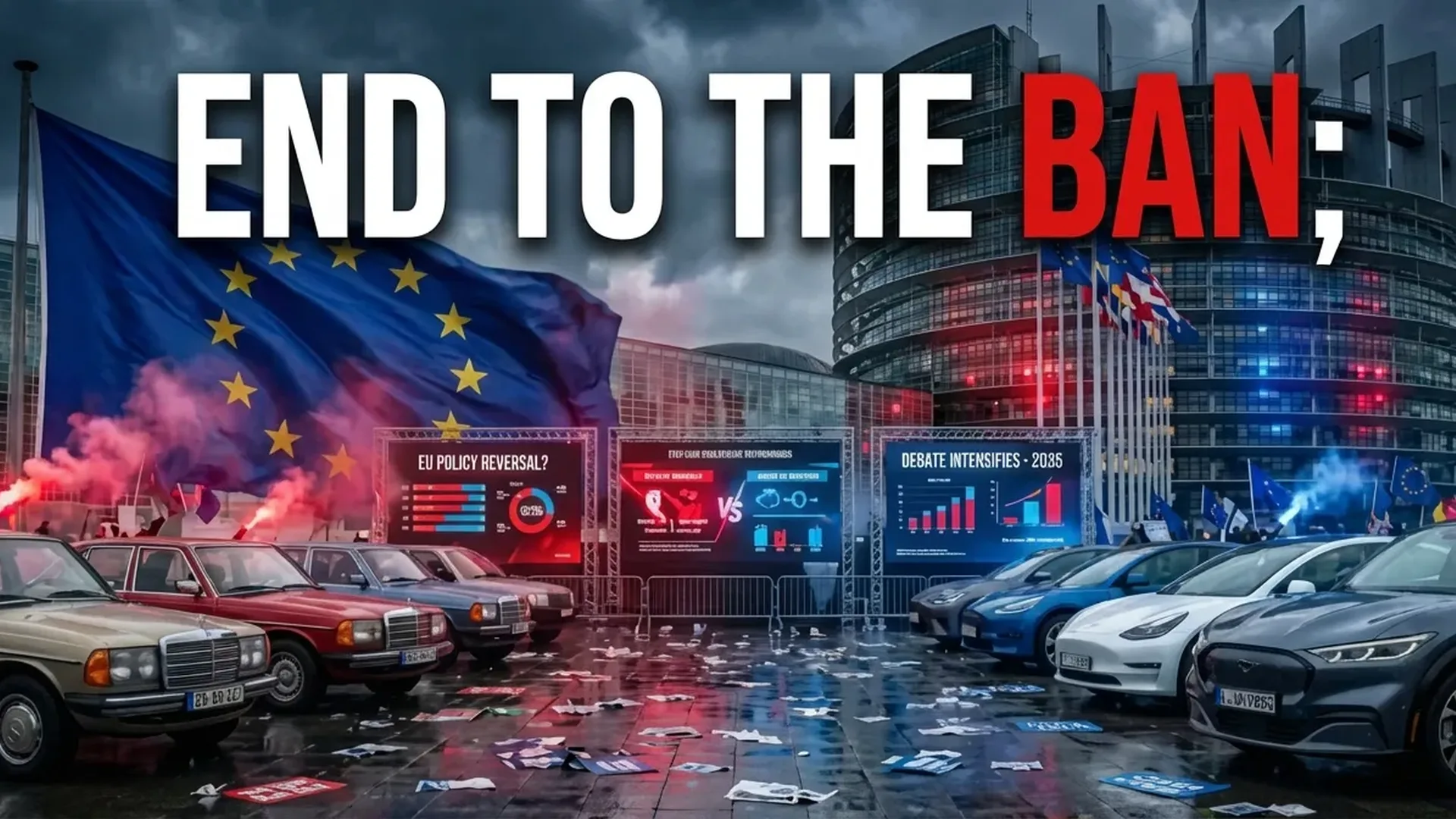
In February 2023, the European Parliament voted in favor of Regulation (EU) 2023/851, which mandates zero CO₂ emissions for all new cars and vans from 2035. What does this practically mean for European drivers, what exceptions exist, and how can you prepare?
What Exactly Does the Regulation Provide
Regulation (EU) 2023/851 is part of the "Fit for 55″ package, presented in July 2021 by the European Commission. The goal: for the EU to reduce greenhouse gas emissions by 55% by 2030 compared to 1990 levels, and to become climate-neutral by 2050.
Voting Timeline
- July 2021: The European Commission proposes 100% CO₂ reduction for new cars by 2035
- June 8, 2022: The European Parliament votes in favor
- June 29, 2022: After 16 hours of negotiations, all 27 Environment Ministers agree
- February 14, 2023: Final approval — the law for "zero CO₂ emissions from new cars and vans by 2035″ becomes reality
Important Clarification
The ban applies only to sales of new cars. Existing gasoline and diesel vehicles will continue to operate normally. You can also buy a used gasoline car after 2035.
The E-Fuels Exception
One of the most controversial points of the regulation was Germany's push for an exception in favor of e-fuels (synthetic fuels). Germany initially refused to vote in favor of the regulation, demanding that internal combustion engines running on CO₂-neutral synthetic fuels be allowed.
Frans Timmermans, then Executive Vice-President of the Commission for the European Green Deal, stated that he had an “open mind” regarding e-fuels, but emphasized that hybrids are not enough to achieve the targets.
What Is Allowed After 2035
- 🔋 Fully electric (BEV)
- ⚡ Hydrogen fuel cell (FCEV)
- ⛽ E-fuels (CO₂-neutral synthetics) — under review
What Is Banned After 2035
- 🚫 New gasoline cars
- 🚫 New diesel cars
- 🚫 New hybrids (HEV/PHEV)
- 🚫 New LPG/CNG
Member State Reactions
Although all 27 countries ultimately voted in favor, reactions have been far from unanimous:
| Country | Stance | Key Point |
|---|---|---|
| 🇩🇪 Germany | In favor, with conditions | Demanded e-fuels exception |
| 🇮🇹 Italy | Critical | Meloni condemned the “ideological madness” — demands revision |
| 🇵🇱 Poland | Opposed | Filed appeals at CJEU (August 2023) |
| 🇬🇷 Greece | In favor | Bound by the EU regulation |
| 🇳🇴 Norway | Pioneer | Already 79.6% EV market share (Q2 2023) — no official ban |
Italian Prime Minister Giorgia Meloni described the ban as a measure that would “condemn Europe to new strategic dependencies, such as Chinese electric vehicles,” stating: "Reducing polluting emissions is the path we want to follow, but with common sense."
Global Ban Landscape
The EU is not alone. Many countries have announced similar targets, and at the Glasgow Declaration (COP26, 2021) 30 countries committed to a phase-out — notably, the USA, China, Toyota, VW, Renault-Nissan, and Hyundai-Kia did not sign.
| Country/Region | Target | Notes |
|---|---|---|
| 🇪🇺 EU (27 countries) | 2035 | Regulation (EU) 2023/851 |
| 🇬🇧 United Kingdom | 2030/2035 | 2030 gasoline/diesel, 2035 hybrids |
| 🇨🇳 China | 2035 | Did not sign Glasgow — strong EV market |
| 🇨🇦 Canada | 2035 | Legislated |
| 🇯🇵 Japan | 2035 | Hybrids continue |
| 🇳🇴 Norway | ~2025 | 79.6% EV sales already — achieving it in practice |
What Automakers Are Saying
Major manufacturers are reacting differently. Some are committing to full electrification, while others (mainly Japanese) prefer a mixed strategy:
Already 100% electric — no change needed
Target 100% EV in Europe by 2030
Target 2030, with exceptions in certain markets
Target 100% EV by 2030
Target 2040 — slower transition
Target 2035 — aligned with legislation
No commitment — targeting 3.5M EVs/year by 2030
Target 2040 — slow approach
Job Losses
Between 2019–2023, the EU recorded over 853,000 job losses in manufacturing, including the auto industry. Unions warn that the Green Deal puts 11 million jobs at risk, while a study estimates a potential loss of 500,000 jobs in the auto industry alone.
What It Means for Greece
Greece, as an EU member, is fully bound by Regulation 2023/851. In practice, this means:
Current Situation
- EV market share: ~12.4% (2024), up from 5.3% (Q2 2023)
- Athens: odd/even plate system — EVs are exempt
- Zero road tax for BEVs
- Free municipal parking until 31/12/2026
- "Go Electric 3″ program with subsidies up to €8,400
By 2035
- Significant expansion of charging network
- New buildings required to have chargers
- Gradual reduction of incentives (once EVs go mainstream)
- Potential low-emission zones in urban centers
- Increase in used EVs on the market
Practical Guide: What You Should Do
Buying a car today?
Consider electric or plug-in hybrid. The resale value of gasoline cars will gradually decline.
Living in an apartment building?
Look into the legislation (Law 4710/2020) that allows charger installation without a general assembly permit.
Take advantage of subsidies
The "Go Electric 3″ program offers up to €8,400 — but funds run out quickly.
Don't rush — but plan ahead
You still have ~9 years. EV prices are dropping, models are multiplying, and the charging network is growing.
The 2026 Review
The regulation provides for a review in 2026 to assess progress. Several countries, led by Italy (the Industry Minister called for an earlier review in September 2024), are pushing for flexibility.
Possible scenarios:
Scenario 1: Stays in Effect
The regulation remains as is. Most likely if EV sales continue to rise (14.5% globally, 2023).
Scenario 2: Amendment
Official e-fuels exception, possible slight deadline extension for certain models.
Scenario 3: Repeal
Highly unlikely, but political pressures (853,000 jobs, farmer protests) cannot be ignored.
Conclusion
The 2035 ban is legally binding and applies to all member states, including Greece. It does not affect current cars — only new car sales. The transition is gradual: with EV prices falling, the charging network expanding, and subsidies still available, 2035 doesn't need to scare you. It's an opportunity.
Related Articles
EV Subsidy 2026
Detailed guide to the "Go Electric 3″ program with amounts up to €8,400
EV Road Tax 2026
Full road tax exemption for electric vehicles
Electric vs Hybrid 2026
Which is the better deal today?