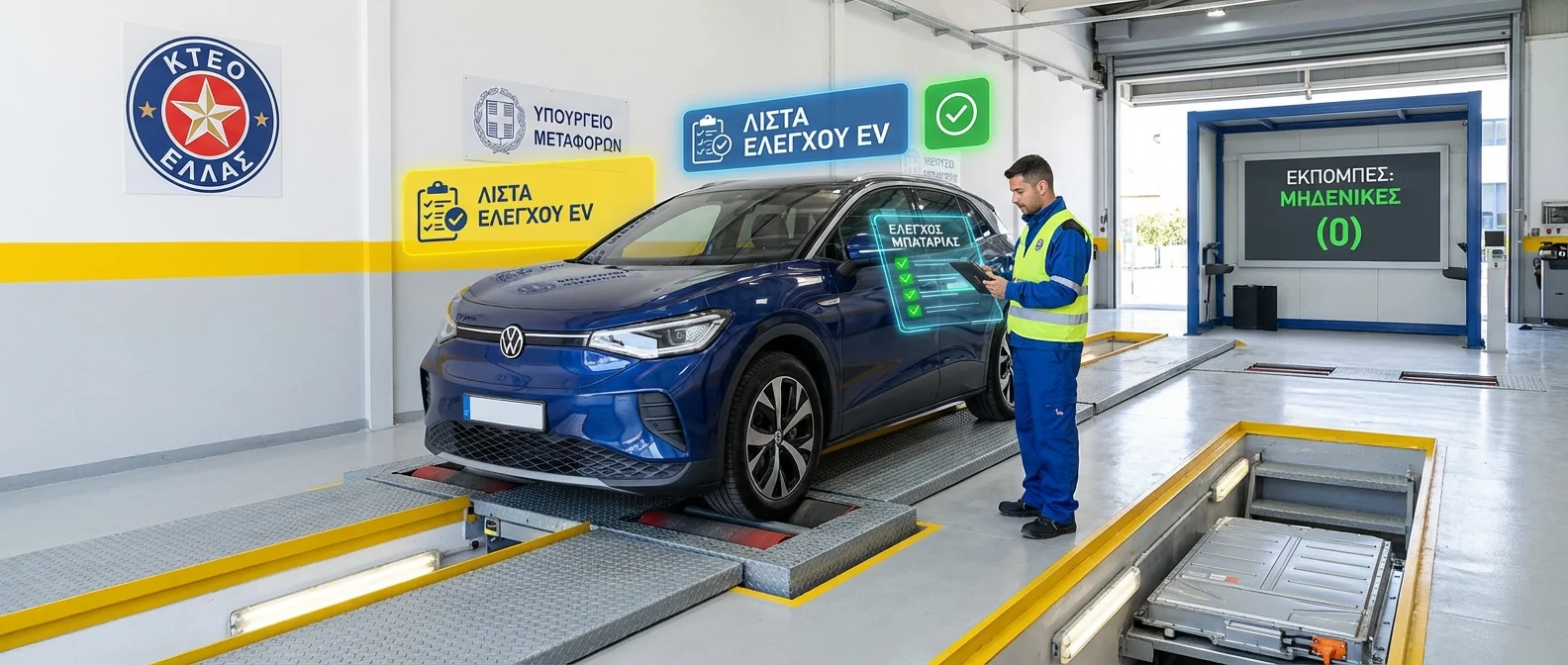
Your Tesla Model 3 just hit its fourth birthday. Time for KTEO — Greece's mandatory vehicle inspection. But here's the twist: electric cars face a completely different inspection process than gas vehicles. Some checks disappear entirely. Others get added. And the pass rates? They're dramatically higher.
📖 Read more: EVs & Flooding: Are They Safe in Water?
When Your EV Needs Inspection
Greek law follows EU Directive 2014/45/EU with zero exceptions for electric vehicles. Your EV inspection schedule matches gas cars exactly:
| Vehicle Category | First Inspection | Subsequent Inspections |
|---|---|---|
| Passenger Cars (& EVs) | 4 years after first registration | Every 2 years |
| Taxis / Rental Cars | 1 year after first registration | Annually |
| Trucks / Buses | 1 year after first registration | Annually |
| Driving School Vehicles | 1 year after first registration | Annually |
Key Point: No special EV inspection category exists in Greece. Buy a new Tesla today? Your first KTEO happens in 2030. After that, every two years — same as any passenger car.
What Gets Checked: EV vs Gas
EU Directive 2014/45/EU mandates 9 inspection categories. But electric vehicles skip several checks entirely while gaining new ones:
| Inspection Category | Gas Engine | Electric (BEV) |
|---|---|---|
| Vehicle identification (VIN) | ✅ | ✅ |
| Braking system | ✅ | ✅ |
| Steering system | ✅ | ✅ |
| Visibility (windshield, mirrors) | ✅ | ✅ |
| Lights & electrical system | ✅ | ✅ |
| Axles, wheels, tires, suspension | ✅ | ✅ |
| Chassis & bodywork | ✅ | ✅ |
| Exhaust / emissions | ✅ Emissions test | ❌ Not applicable |
| Fuel system | ✅ Tank, lines | ❌ Not applicable |
| Catalytic converter | ✅ | ❌ Not applicable |
| High-voltage electrical safety | ❌ | ✅ EV-specific check |
| Battery condition (SoH) | ❌ | ✅ EV-specific check |
| Acoustic warning system (AVAS) | ❌ | ✅ EV-specific check |
Why EVs Pass Inspections Easier
Electric vehicles dodge the most common inspection failures. Here's why your EV has better odds:
Zero Emissions
No exhaust test = no failure risk from the #1 inspection killer. Gas cars routinely fail due to worn catalytic converters or poor combustion.
Longer-Lasting Brakes
Regenerative braking reduces mechanical brake wear by 2-3x. Brake pads last 100,000+ km vs 40,000 km in gas cars — rarely fail inspection.
Simpler Mechanics
No transmission, clutch, exhaust, or timing belt. The typical mechanical failures that sink gas cars at inspection simply don't exist.
No Oil Leaks
EVs don't have engine oil or transmission fluid — common leak sources in aging gas cars that can trigger inspection failure.
📖 Read more: Nio Battery Swap: 3-Minute Battery Changes
EV-Specific Inspection Checks
While EVs skip many traditional checks, they face three new inspection categories:
High-Voltage Safety (ISO 6469)
Inspection of 400V-800V systems, insulation, wiring, and connections. Automatic disconnection in crash scenarios gets verified.
Battery Condition
State of Health (SoH) check, battery pack mounting, moisture or coolant leak inspection. 8-year/160,000 km warranty covers most issues.
AVAS (Acoustic Warning)
Since July 2021, all new EVs must emit artificial sound below 20 km/h for pedestrian safety. Proper function gets tested.
EV Inspection Costs in Greece
Electric vehicle inspection costs match gas cars exactly. No premium for EV-specific checks:
| Inspection Type | Cost | Characteristics |
|---|---|---|
| Public KTEO | €40-€55 | Government centers, lower cost, longer waits |
| Private KTEO | €55-€80 | Private centers, faster service, ISO 9001:2008 |
| Re-inspection | €15-€30 | If you fail, fix issues and return |
| Emissions card | €0 (EV) | Not required for electric! |
EV Savings: Gas cars need separate emissions testing (€15-€25) before KTEO. EVs skip this entirely. Plus, lower failure rates mean fewer repair costs before re-inspection.
Pre-Inspection Checklist for EVs
Even with better odds, check these items before your EV inspection:
🔧 Mechanical
- Tires: tread depth >1.6mm
- Brakes: pad & disc condition
- Suspension: noise, play
- Steering: free play check
💡 Lighting
- All lights functional (LED/xenon)
- Proper headlight alignment
- High beams working
- Turn signals, brake, reverse lights
📋 Documents
- Registration certificate
- Valid insurance policy
- ID / driving license
- Service book (optional)
🔋 EV-Specific
- Battery charge >20%
- AVAS system enabled
- Charging port undamaged
- No active warning lights
Common Failure Causes: EV vs Gas
| Inspection Failure Cause | Gas Engine | Electric |
|---|---|---|
| Emissions/exhaust failure | Very common | Impossible |
| Worn brake pads/discs | Common | Rare (regen braking) |
| Oil leaks | Moderate frequency | Impossible |
| Exhaust system issues | Moderate frequency | Doesn't exist |
| Worn tires | Common | Same (EVs are heavier) |
| Non-functional lights | Moderate | Same (LEDs more durable) |
| Windshield problems | Moderate | Same |
📖 Read more: Nissan Leaf 2026: The New Generation Electric
Battery Inspection Reality Check
Many EV owners worry about battery inspection. Only 2.5% of EV batteries worldwide have needed replacement — mostly under warranty recalls, not degradation.
EV Battery Warranty Standards
If your battery drops below 70% capacity within 8 years/160,000 km, the manufacturer replaces it free.
Public vs Private Inspection Centers
Public KTEO
- ✅ Lower cost (€40-55)
- ✅ Government operated
- ⚠️ Longer wait times
- ⚠️ Fewer locations
- ⚠️ May lack EV equipment
Private KTEO
- ✅ Faster service
- ✅ Modern equipment
- ✅ ISO 9001:2008 certified
- ✅ Online booking
- ⚠️ Higher cost (€55-80)
EV Owner Tip: Before booking, confirm the inspection center has EV-specific testing equipment. Most modern private centers do, but not all public centers are equipped yet.
Bottom Line
EV inspection in Greece follows identical timing (4 years + every 2 years) and costs (€40-80) as gas cars. But EVs have a massive advantage: they skip emissions testing (the #1 failure cause), have longer-lasting brakes, and lack the mechanical complexity that trips up gas cars. Only 2.5% of EV batteries need replacement, with 8-year warranties covering most issues. For EV owners, inspection day is routine — not stressful.