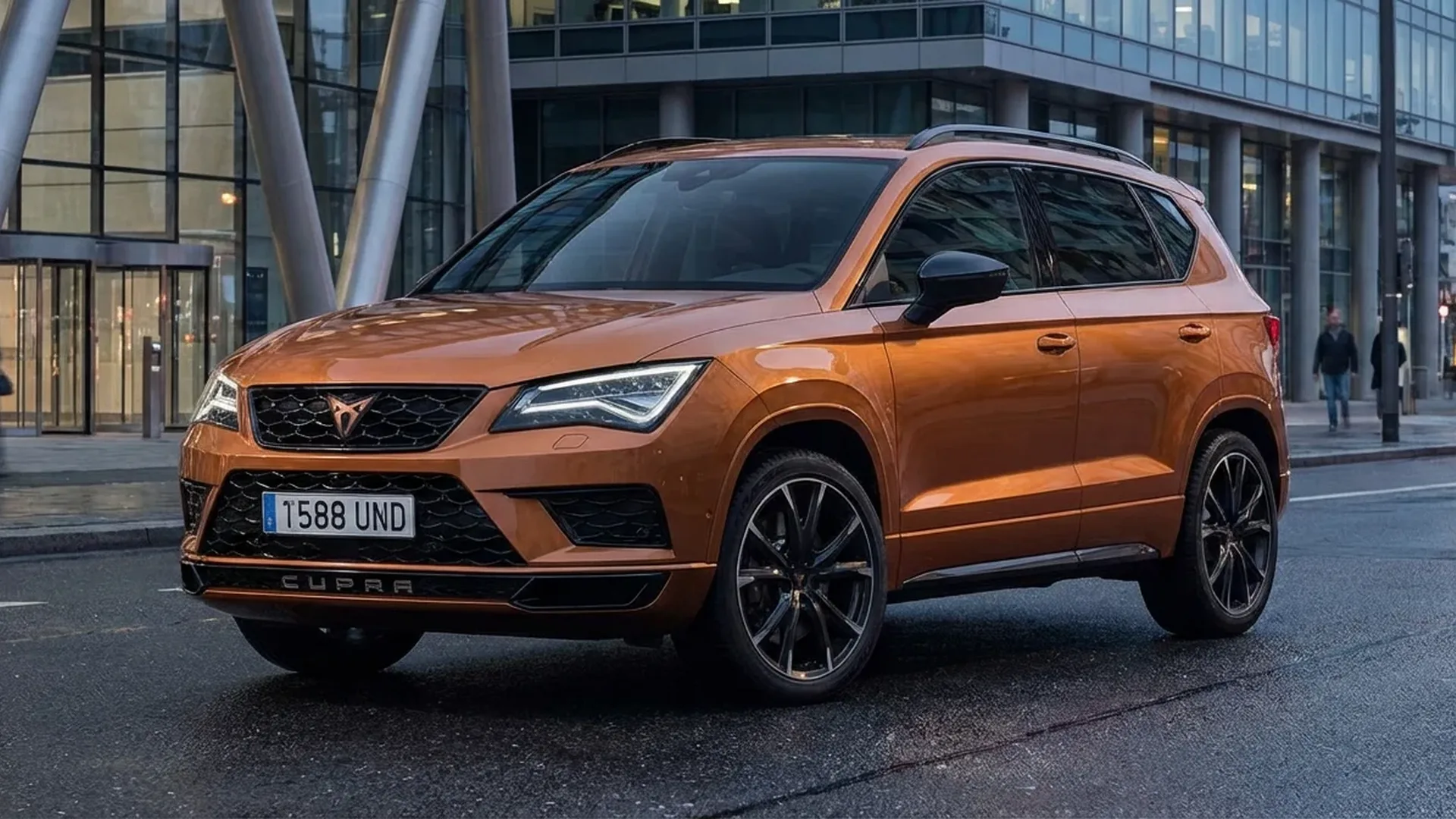
When Cupra unveiled the Tavascan as a concept in 2019, few expected the young Spanish brand to actually deliver. Yet here it is: an electric coupé-SUV that squares up against the Tesla Model Y, Kia EV6 and Polestar 2. Built on the Volkswagen Group's MEB platform — which also underpins the VW ID.4, Skoda Enyaq and Audi Q4 e-tron — the Tavascan injects something its siblings lack: sporty DNA and genuine attitude. Notably, it's the first European-market MEB car manufactured in China, at the Anhui factory.
How sporty is it really? Does it justify its premium price tag? Where does it shine, and where does it fall short? In this comprehensive review, we examine everything — from technical specifications to the everyday driving experience.
Technical Specs: V vs VZ
Both models share the same rear permanent magnet synchronous motor (PSM) — the new AP550 unit first seen in the VW ID.7 and one of the most efficient in its class. The VZ adds a 107bhp asynchronous motor on the front axle, which can freewheel when not required so it doesn't create drag.
Design: Coupé-SUV Aerodynamics
At 4,644 mm long with a coupé silhouette, the Tavascan looks remarkably close to the 2019 concept. Cupra has achieved something few MEB cousins manage: hiding the shared platform's proportions beneath genuinely dynamic lines. Particularly impressive are the three-triangle “constellation” headlights — fast becoming a Cupra design signature — along with the integrated spoiler lip in the rear light bar.
That Cd of 0.26 is excellent for an SUV of this size. There's no fake grille up front — a rarity even among EVs. The coupé roofline does mean there's no rear wiper, despite water and dirt still collecting on the rear windscreen. A minor but notable omission.
Driving Experience
This is where Cupra proves why the Born stands apart from the ID.3 despite near-identical mechanicals. The Tavascan uses rear-wheel drive as standard, which gives a naturally balanced feel through corners. The suspension is “firm but well-controlled” — according to Top Gear's testers — while the steering is quick and progressive without nervousness.
"If you can stomach the spangly, illuminated badges, it's one of the best-realised cars in the class."
— Top Gear, rating 8/10
The V (rear-wheel drive) version suffices for most: 282bhp in a solidly engineered car delivers confident motorway performance. The 0-62 mph in 6.8 seconds (tested at 6.3s by Autocar) provides plenty of push without being overwhelming. The VZ, with AWD and 335bhp, gains only 1.3 seconds but adds significant weight and cost.
Weak point: The brake pedal lacks precision. The transition between regenerative and friction braking is noticeable, and the rear drum brakes cause measurable fade after successive stops. There are only two regeneration modes (D and B) — no true one-pedal driving.
Interior: Ambitious but Flawed
From a distance, the cabin impresses. The central spine between dashboard and console, copper-coloured accents and V-shaped seat designs add character. The 15-inch touchscreen runs the latest MIB4 software — faster and less buggy than previous versions — with configurable shortcuts and a pull-down control menu.
Look closer, however, and the premium impression fades. Many visually impressive elements turn out to be hard plastic. The haptic steering wheel buttons activate accidentally — and are frustratingly difficult to activate on purpose. The electronic door handles require just the right amount of force, otherwise the mechanical release triggers. And the infotainment shortcuts occasionally reset to factory settings.
"The electronic door handles were first introduced on the VW ID.4 and urgently need retiring. Even when you squeeze them gently, they flex and feel cheap."
— Illya Verpraet, Autocar Road Tester
Space-wise, things improve. Front occupants get adequate room, and rear passengers benefit from a slightly higher seating position than rivals — though legroom trails the EV6 and Model Y. The ~540-litre boot is practical, though the coupé roofline limits tall items. There's no frunk — a significant omission shared with all MEB vehicles.
Range & Charging
WLTP range reaches 353 miles for the RWD on 19-inch wheels — an impressive figure thanks to the efficient AP550 motor and 0.26 drag coefficient. In practice, Autocar's long-term test (2,200+ miles) revealed 200-250 miles of real-world range in winter and ~300 miles in summer — competitive numbers but behind the best 800V models.
DC charging peaks at 135 kW theoretically, with a weighted average of ~113 kW in testing. The 10-80% charge completes in approximately 28 minutes. These aren't class-leading speeds (the EV6 reaches 240 kW), but consistency even in cold conditions is noteworthy — the NMC battery maintains performance at low temperatures.
Pros & Cons
Pros
- ✅ Sporty silhouette with low 0.26 Cd
- ✅ Balanced rear-wheel drive dynamics
- ✅ Efficient AP550 motor
- ✅ 353-mile WLTP range (V)
- ✅ Good MIB4 infotainment system
- ✅ Practical ~540L boot
Cons
- ❌ Heavy at 2,178 kg (RWD)
- ❌ Interior quality disappoints up close
- ❌ Haptic buttons & e-door handles
- ❌ Rear drum brakes & brake fade
- ❌ DC charging only 135 kW
- ❌ Expensive (from £47,340)
The Competition
The mid-size electric crossover segment is arguably the most competitive in today's market. The Kia EV6 (from ~£39,170) offers 800V architecture, faster charging (240 kW) and more precise controls. The Tesla Model Y (from ~£44,925) wins on Supercharger network and software. The Polestar 2 (from ~£44,950) counters with premium build quality and swift DC charging.
Within the same VW family, the Skoda Enyaq and VW ID.5 are significantly cheaper with virtually identical mechanicals. If you're not particularly fussed about the sporty appearance, these MEB siblings offer far better value for money.
Cupra is targeting buyers who want something more expressive than mainstream EVs — positioned between the practical Enyaq and premium Polestar. The question is whether stylistic boldness alone justifies the price premium.
Price & Availability
In the UK, the V1 RWD starts at £47,340, while the V2 trim jumps to £53,835. The range-topping VZ1 with AWD pushes past £60,000. For that price bracket, you're competing with serious rivals like the BMW iX1 and Polestar 2, whose interior quality and driving refinement the Tavascan can't always match. Cupra does offer competitive PCP deals that bring monthly costs in line with the Tesla Model Y and Kia EV6, which may tip the balance for some buyers.
Verdict
The Cupra Tavascan brings genuine sporty character to the electric crossover segment — but it's not without weaknesses. The driving satisfaction is real thanks to the rear-drive balance and Cupra's chassis tuning, while the 353-mile range and efficient AP550 motor impress. However, interior quality, software gremlins, slow DC charging and a high price tag raise legitimate questions. If you love the sporty look and want something different from the usual EV crowd, the Tavascan is worth a test drive. If you prioritise value for money, look at the Enyaq or EV6 first.