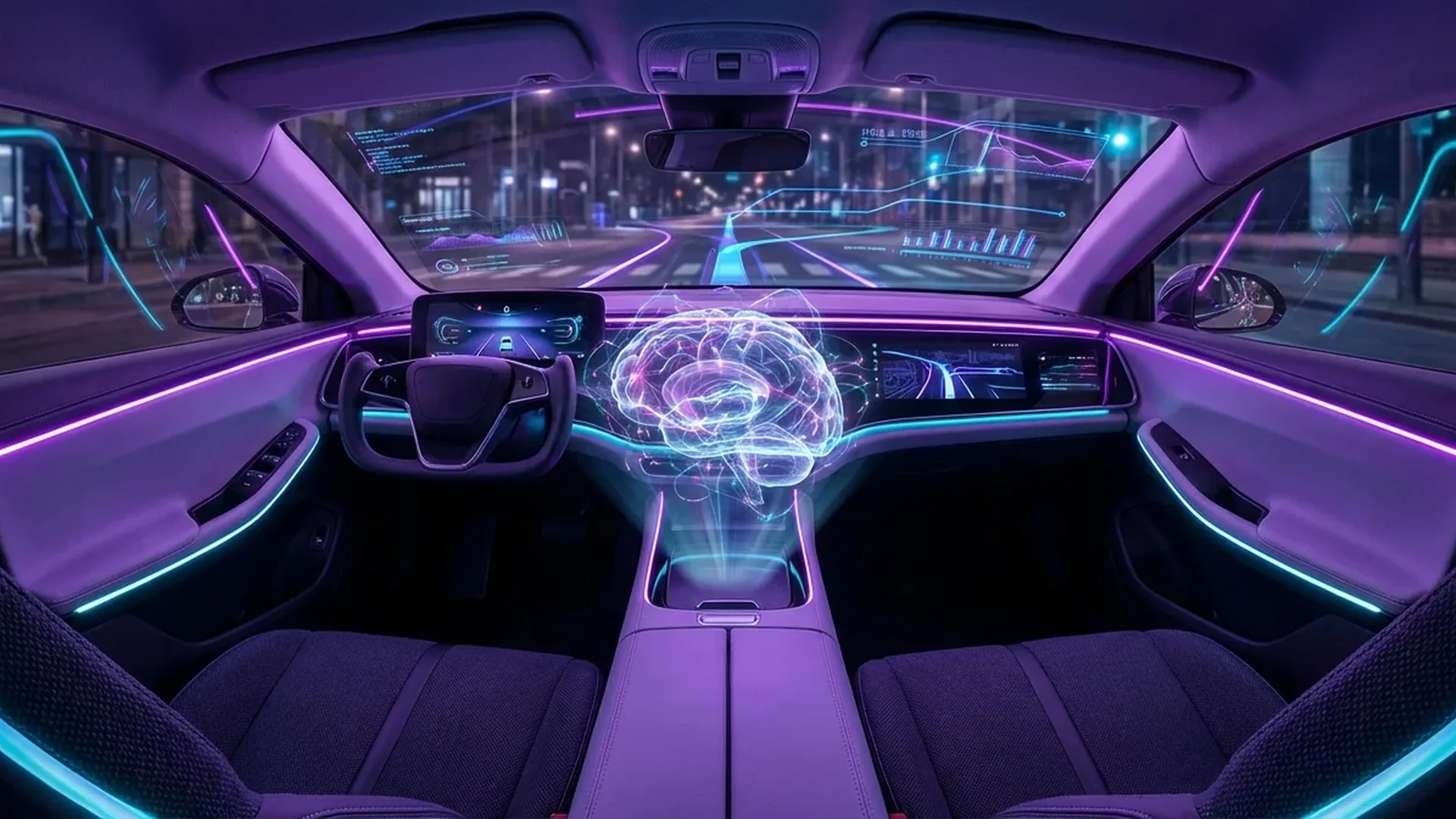
Smart Navigation & Route Planning
Navigation in modern EVs is nothing like traditional GPS. AI-powered navigation systems factor in dozens of real-time parameters: battery state of charge, ambient temperature, traffic conditions, route elevation profile, and even your personal driving habits.
Tesla Navigate on Autopilot automatically calculates Supercharger stops, charging time at each stop, and adjusts the route if conditions change mid-trip. Similarly, Mercedes EQ Route leverages data from millions of drives to optimize planning, while BMW recently launched AI routing that predicts energy consumption with ±3% accuracy.
For American drivers, this matters enormously on cross-country trips. A drive from Los Angeles to Las Vegas — or Chicago to Detroit — can have wildly different energy consumption depending on wind, temperature, speed, and elevation changes. AI systems learn these patterns and improve continuously. According to 2026 data, range prediction accuracy has improved by 40% compared to 2023, virtually eliminating range anxiety for drivers who trust the navigation.
AI Battery Management (BMS)
The Battery Management System (BMS) is the brain of every electric vehicle, and AI is turning it into a superpower. Modern AI-BMS monitors thousands of parameters per second: individual cell voltage, temperature, charge/discharge current, internal resistance, and much more.
Tesla uses neural networks for battery thermal management. The system “learns” when you're approaching a Supercharger and preheats the battery to optimal temperature, saving up to 15 minutes of charging time. BYD uses AI for real-time cell calibration, ensuring uniform degradation across the entire battery pack.
One of the most impressive features is State of Health (SoH) prediction. AI models analyze charge/discharge data from millions of vehicles and can predict battery lifespan with 97% accuracy. This means owners know exactly what their battery is worth — critical for resale value, which matters increasingly as the used EV market grows.
Did You Know...
Tesla collects battery data from over 7 million vehicles worldwide. This massive dataset feeds AI algorithms that continuously improve energy management through OTA updates. A Tesla purchased in 2024 is now 5-8% more efficient today thanks to software updates — without any hardware changes whatsoever.
Voice Assistants in EVs
EV voice assistants in 2026 bear no resemblance to the primitive voice command systems we once knew. Thanks to Large Language Models (LLMs), they can understand complex natural language commands and execute multiple actions simultaneously.
Mercedes MBUX now integrates ChatGPT, letting drivers ask “Where can I charge near Joshua Tree and grab good food?” — and receive a comprehensive answer with charging stations, restaurants, and timing. BMW Intelligent Personal Assistant learns your preferences (temperature, music, seat position) and applies them automatically based on time of day and route.
Tesla upgraded its voice assistant with natural language processing capabilities, while Chinese automaker NIO features NOMI, an AI entity with a virtual face that interacts emotionally with the driver. Amazon's Alexa is also deeply integrated into several EVs, including Rivian and certain Ford models, adding smart home control from the driver's seat.
Predictive Maintenance
AI can detect failures before they happen. Modern EVs are equipped with dozens of sensors monitoring every component, with machine learning algorithms analyzing the data in real time.
An example: AI can detect a slight increase in vibration from a wheel bearing — invisible to the driver — weeks before replacement is needed. The system alerts the owner, suggests a nearby service center, and can even schedule the appointment automatically. Tesla already does this as of February 2026, sending push notifications for issues like worn brake pads, battery coolant concerns, or a loose charging connection.
Volkswagen uses AI in the MEB+ platform to monitor tire wear on individual tires and recommend rotation or replacement. Fault prediction accuracy now reaches 94%, drastically reducing unexpected breakdowns and saving owners money on emergency repairs.
"Predictive maintenance via AI reduces repair costs by 30% and virtually eliminates unexpected breakdowns in electric vehicles."
— McKinsey Automotive Report, January 2026AI Parking & Summon
Parking is arguably the most stressful daily driving task — especially in tight urban garages and crowded parking lots. AI is solving this problem definitively. Modern EVs feature automatic parking that uses cameras, ultrasonics, and LiDAR to identify spaces and park with inch-level precision.
Tesla's Actually Smart Summon (FSD v13) lets the car come to you in a parking lot — navigating around other vehicles, pedestrians, and obstacles autonomously. BYD announced similar capability for the Seal and Han models, while Hyundai offers Remote Smart Parking Assist on the Ioniq 5 and 6.
Beyond basic parking, the most advanced systems memorize places you park frequently (home, office) and learn the optimal trajectory. Looking ahead, AI will be able to find a spot in a multi-level garage, park autonomously, and even plug in to charge — all without anyone behind the wheel.
Autonomous Driving Levels (ADAS)
Autonomous driving relies entirely on artificial intelligence, and EVs are at the cutting edge. As of February 2026, here's where autonomous driving levels stand across the market:
In the US, Level 2 and L2+ systems are available across most EVs — interstate highways like I-5, I-95, and I-10 are already handled exceptionally well by modern systems. Mercedes is the only brand with legally certified Level 3 in the US (Drive Pilot on EQS & EQE), allowing the driver to take hands off the wheel at speeds up to 40 mph on eligible highways. Tesla's FSD Supervised remains L2+ under NHTSA classification but continues to push capabilities with each update.
OTA Updates & AI Evolution
One of the biggest advantages of AI in EVs is the ability to receive Over-the-Air (OTA) updates. Unlike conventional cars that “freeze” technologically at the point of purchase, modern EVs improve continuously via software updates.
Tesla is the classic example: since 2020, a Model 3 has received over 150 OTA updates improving everything — from charging speed (+15% on certain models) to Autopilot, from entertainment graphics to the winter heat pump. The car literally appreciates in value over time — something unheard of in the ICE world.
And it's not just Tesla. BYD offers OTA updates on the Atto 3 and Seal, Hyundai on the Ioniq 5/6, BMW on the iX and i-Series, and Volkswagen through the CARIAD platform. Rivian and Ford also push regular OTA updates to their trucks and SUVs, often adding features owners didn't have at purchase. Even the price of OTA — or lack thereof — is becoming a competitive differentiator.
OTA by the Numbers (2026)
- Tesla: 150+ updates over 5 years, free
- BYD: 8-12 updates/year, free
- BMW: 4-6 updates/year, basic free / $149-$499 premium features
- Mercedes: 2-4 updates/year, $350/year for MBUX AI features
- Rivian: 6-10 updates/year, free (including major feature drops)
The Future: Full Self-Driving & Robotaxis
The ultimate vision is clear: cars that drive entirely on their own, without a steering wheel. As of February 2026, this is no longer science fiction — Waymo already operates commercial robotaxis in San Francisco, Phoenix, Los Angeles, and Austin, serving over 100,000 rides per week.
Tesla is planning its own robotaxi network based on the Cybercab, a vehicle with no steering wheel or pedals, with an estimated ride cost of $0.25/mile — cheaper than a bus. China is moving even faster: Baidu Apollo Go operates robotaxis in 10+ cities, while WeRide recently obtained a license in the UAE.
For American consumers, the timeline is one of the most aggressive globally. Waymo is expanding aggressively to new cities, Tesla plans to launch its robotaxi service in Austin and other markets, and GM-backed Cruise is working to resume operations. In 5-7 years, it's estimated that over 50% of new EVs will offer Level 3 or higher capabilities, making long highway drives significantly safer and less fatiguing.
"The transition from human to AI driving will save over 1 million lives annually worldwide. 94% of traffic accidents are caused by human error."
— WHO Road Safety Report, 2025Cost of AI Features in EVs (US Market 2026)
AI features aren't always free. Here's a breakdown of costs for the most popular AI features available to American buyers:
Conclusion: AI Is the New Engine
If the electric motor replaced the internal combustion engine, artificial intelligence is replacing the traditional way we interact with cars. EVs in 2026 aren't merely transportation — they're digital platforms on wheels that learn, evolve, and improve through AI.
For American buyers, AI makes electric cars safer (predictive maintenance, ADAS), more efficient (AI battery management, smart routing), more convenient (voice assistants, auto parking), and more economical long-term (OTA updates that increase resale value). With AI feature pricing ranging from $0 (BYD, basic Tesla Autopilot) to $8,000 (Tesla FSD), there's an option for every budget.
The next five years will bring even more dramatic changes: Level 3 in far more models, robotaxis expanding across US cities, and AI assistants that know the driver better than they know themselves. Artificial intelligence isn't just changing cars — it's redefining the entire concept of mobility.