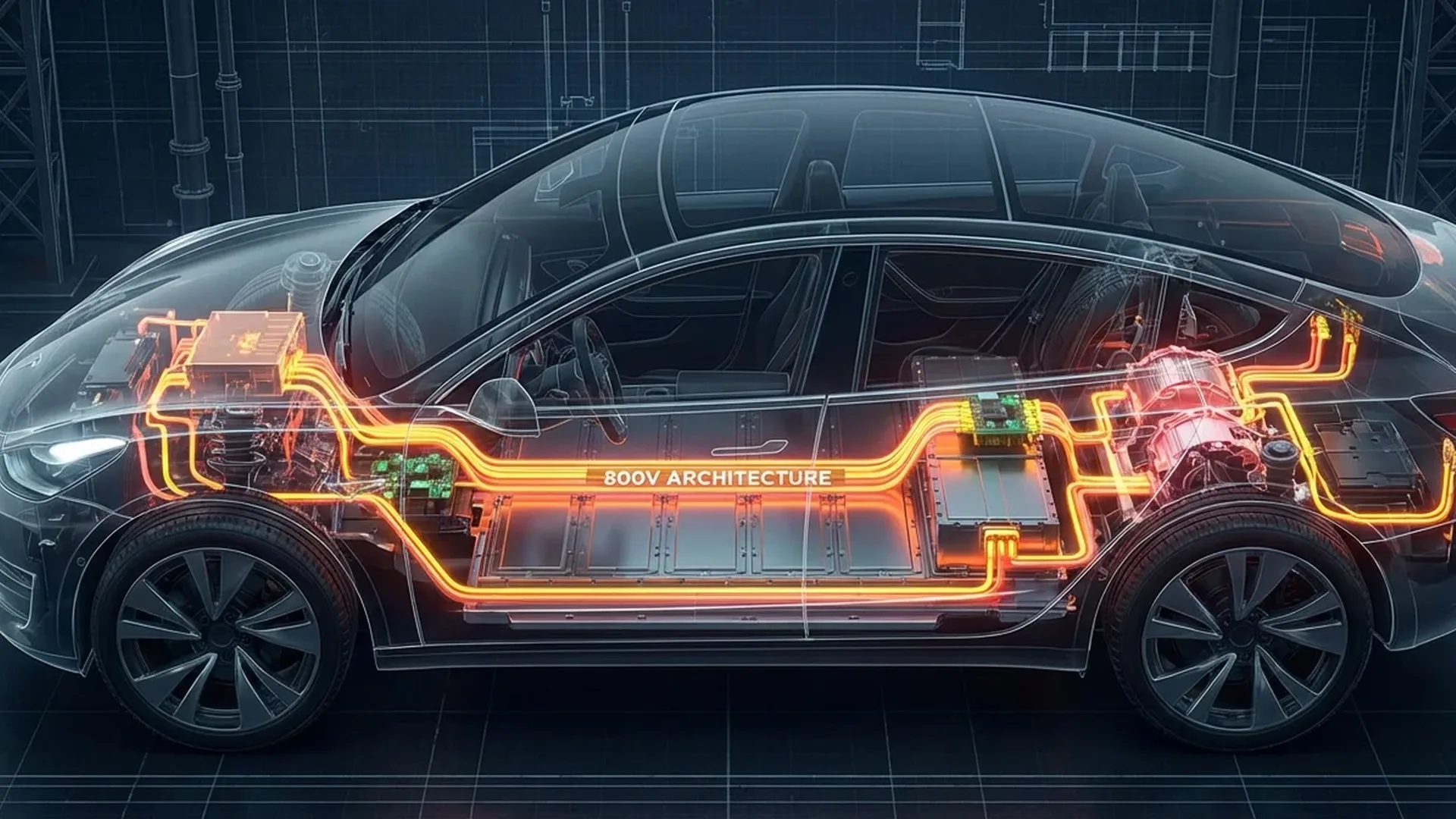
⚡ What Is 800V Architecture?
In an electric vehicle, the voltage of the electrical system determines how much energy can be transferred per second without excessive current. Think of it like a water pipe: voltage is the pressure, current (Amperes) is the amount of water flowing through, and power (Watts) is the work being done. By increasing voltage, we can transfer the same power with less current.
Most electric vehicles today use 400V architecture — a legacy from the first mass-market EVs. The transition to 800V doubles the voltage, bringing multiple advantages in charging, efficiency, and weight.
🔌 Why Does Higher Voltage Mean Faster Charging?
The basic physics is simple: Power (W) = Voltage (V) × Current (A). To charge at 350 kW on a 400V system, you need 875 Amperes — a massive current requiring thick cables, large coolers, and generating serious heat. At 800V, the same power requires just 437.5 Amperes — half as much.
This means:
Faster DC Charging
With half the current for the same power, the battery heats up less. This means the charger can sustain high power for longer, instead of throttling due to overheating.
Lighter Cables
Lower current means thinner, lighter cables throughout the car. This reduces weight by 10-15 kg — significant in an EV where every kilogram counts.
More Efficient Motors
Electric motors operate more efficiently at higher voltage. Less energy lost as heat means greater range from the same battery.
Less Heat
Thermal losses in cables and connectors are proportional to the square of the current (I²R). Reducing current by 50% = reducing heat by 75%!
🏎️ Porsche Taycan: The Pioneer
Porsche was the first major automaker to adopt 800V architecture in a production car, with the Taycan in 2019. The J1 platform uses a battery with an operating voltage of 610-835V (nominal 723V) and supports DC charging up to 320 kW after the 2024 refresh.
A distinctive feature that makes the Taycan stand out is its reverse conversion capability: a built-in step-up converter transforms 400V to 800V, allowing charging at any CCS 400V charger up to 150 kW — critical in the early years when 800V chargers were rare.
After the 2025 refresh, the Taycan Turbo S delivers 700 kW (939 hp) and charges from 5% to 80% in 22.5 minutes under ideal conditions. The Taycan Turbo GT reaches 760 kW (1,019 hp) — making it the most powerful production Porsche ever.
"The 800-volt system wasn't just a technical choice — it was the only choice if we wanted to build an electric Porsche that makes you smile every time you hit the accelerator."
— Michael Steiner, Board Member Porsche AG, R&D🚗 Hyundai E-GMP: 800V for Everyone
If Porsche showed the way, Hyundai Motor Group democratized it. The E-GMP (Electric Global Modular Platform) launched in 2021 and brings 800V architecture to vehicles across every segment — from the Hyundai Ioniq 5 to the Kia EV9 and the new Hyundai Ioniq 9.
The E-GMP supports 200 kW DC charging, bringing the 77.4 kWh battery from 10% to 80% in 18 minutes. A quick 5-minute stop adds 100 km of range on a 350 kW/800V charger. The platform uses Silicon Carbide (SiC) semiconductors in the rear motor inverter, with thermal conductivity nearly 10 times greater than conventional silicon.
An innovative E-GMP feature is bidirectional V2L (Vehicle-to-Load) charging: you can power electrical appliances or even another EV directly from your car, delivering up to 3.7 kW (230V). It also supports V2G (Vehicle-to-Grid) — sending energy back to the electrical grid.
Hyundai/Kia/Genesis Vehicles on E-GMP 800V
🔬 Silicon Carbide: The Unsung Hero
The 800V architecture wouldn't be practical without Silicon Carbide (SiC) semiconductors. Compared to conventional silicon (Si) semiconductors, SiC offers:
- 10x better thermal conductivity: 1,490 W/m-K versus 150 W/m-K — meaning vastly superior heat dissipation
- Higher voltage operation: SiC handles 800V+ without issues, while Si requires complex arrangements
- Lower conversion losses: The inverter converts DC to AC more efficiently, boosting range by 5-8%
- Smaller size: The same inverter fits in a smaller housing, saving space and weight
Hyundai announced in 2022 that it would replace Si semiconductors with SiC in the front motor as well (initially only the rear had SiC), improving range by an additional 5%. Today, virtually every new 800V EV uses SiC inverters — the technology has gone mainstream.
⚔️ 400V vs 800V: Practical Comparison
400V vs 800V Architecture
🌍 Who Else Uses 800V?
The 800V architecture is no longer limited to Porsche and Hyundai. Increasingly, more manufacturers are adopting this technology:
- Lucid Air: 924V architecture — the highest in any production car. 300 kW DC charging, over 800 km WLTP range
- Mercedes-Benz EQS/EQE: EVA2 platform with 400V, but the new MMA (CLA 2026) will use 800V
- Audi e-tron GT: Shares the J1 platform with the Taycan, 270 kW DC charging
- BYD: New 800V platforms for premium models, 5-minute charging for 200+ km
- Xiaomi SU7: 800V architecture, SiC inverter, 15-minute 10-80% charging
- Lotus Eletre: 800V, 350 kW DC, 0-80% in 20 minutes
💡 What About Tesla?
Tesla still uses 400V architecture in the Model 3 and Model Y — but compensates with exceptionally efficient battery management and an extensive Supercharger network. The Cybertruck and Semi use 800V. With the next-generation platform (expected after 2026), Tesla will likely transition fully to 800V+.
🇪🇺 What Does 800V Mean for European Drivers?
Across Europe, the charging infrastructure is expanding rapidly. Networks like IONITY, Fastned, and Tesla Superchargers are installing 150-350 kW chargers along motorways and in urban centers. For owners of an 800V vehicle, this means:
- London → Edinburgh: A single ~15-minute stop is enough to complete the journey comfortably
- Daily use: Even without a home charger, a stop at a public fast charger once a week is sufficient
- Road trips: The installation of 150+ kW chargers along major routes makes EVs viable for long-distance touring
🔮 The Future: 900V, 1,000V and Beyond
The 800V level isn't the final destination. Lucid Motors already uses 924V in the Air, while the Mercedes Vision EQXX used 900V for its record-breaking 1,202 km range. In motorsport, Formula E uses 900V+ architecture.
The question is no longer whether 800V will become standard — but when. It's estimated that by 2028, over 70% of new EVs will use 800V+ architecture. SiC technology will become cheaper, charging networks will be upgraded, and charging an EV will be as quick as a brief coffee break.
🏁 Conclusion
The 800V architecture isn't just a number on a spec sheet — it's the technological shift that transforms EVs from “cars where you need to plan your charging” to “cars you charge while grabbing your coffee.” Porsche showed the way, Hyundai democratized it, and by 2028 it will be the norm. If you're buying an EV today, 800V architecture isn't a luxury — it's the right investment for the future.