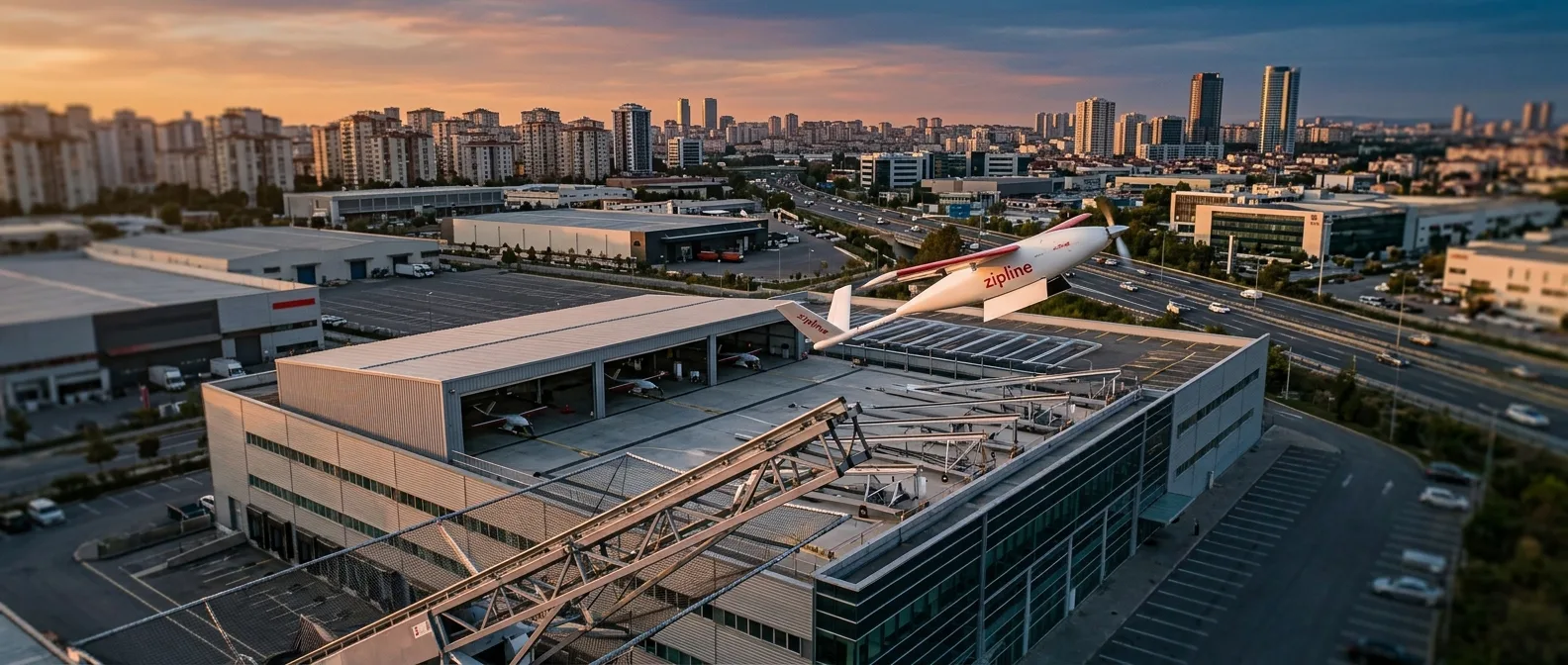
Who expected 2026 to bring 20% shopping cart growth in three weeks? Zipline just announced an additional $200 million in funding for drone delivery, pushing their total fundraising to $800 million. The autonomous drone delivery startup isn't just growing — it's doubling the brands on its platform in the next 30 days.
When CEO Keller Cliffton shared the news via video on X, his phrase was telling: "Things are moving a little faster than we expected." Twelve years after launching with blood deliveries in Rwanda, the company that started with life-saving missions is now changing how Americans order lunch.
🚀 The New Phase of US Expansion
Zipline's Series H round started in January with $600 million from Fidelity, Baillie Gifford, Valor Equity Partners, and Tiger Global. The valuation hit $7.6 billion — roughly $7 billion euros. March brought another $200 million, with participation from crypto investment fund Paradigm.
But the interesting details hide in how they're spending the money. The company targets expansion into at least four states this year, having already announced Houston, Phoenix, and Seattle. The city selection isn't random — these locations have infrastructure and regulatory frameworks that support commercial drone operations.
The home delivery service that launched last year in the US exceeded projections in both January and February. Customers aren't using drones once a week — they're ordering breakfast, lunch, and dinner. What are the technical specs that make this possible?
⚡ Platform 2: The Tech Behind the Deliveries
Zipline operates two drone categories. Platform 1 was designed for long distances — up to 120 miles round trip — serving businesses and governments. Platform 2 is the workhorse of home deliveries.
This second generation carries up to eight pounds (about 3.6 kilos) within a 10-mile radius. Sounds limited? Not really. Eight pounds covers a meal for three people or plenty of medications. Delivery speed reaches one mile per minute — meaning a 5-mile order arrives in five minutes plus prep time.
How the Delivery Drone Works
Platform 2 drones don't land. They hover at 100-300 feet and lower products with a specialized system. This explains why the company can deliver to precise locations — even balconies or backyards. The process takes seconds, not minutes.
The drones are fully electric and autonomous. No pilot required. Zipline's software platform handles airspace management, route optimization, and obstacle avoidance. But what about weather conditions?
Extreme Weather Resistance
Zipline emphasized that its drones continued operating during winter storms across the US — even in hail, snow, and freezing rain. This reliability provides a significant competitive advantage over traditional delivery services.
📊 Partnerships and US Expansion
Platform 2 launched in Pea Ridge, Arkansas, and the Dallas-Fort Worth area with Walmart. Now the company partners with more than twelve restaurant brands. Chipotle was among the first adopters, followed by other restaurant chains.
The expansion strategy isn't random. Zipline selects cities with high population density, easy access to restaurants and pharmacies, and regulatory environments that permit commercial drone operations. Houston, Phoenix, and Seattle meet these criteria.
What changes with the current investment? The company promises to double platform brands in the next 30 days. New software enables onboarding new restaurants in less than 24 hours — an impressive improvement from previous processes that took weeks.
The Growth Numbers
The statistics are impressive: delivery volumes exceeded projections for the first two months of 2026. Customers order multiple times daily, and average cart size increased by over 20% in three weeks. This shows the technology isn't just a novelty — it's becoming part of daily life.
🌍 International Presence and Rwanda
Despite focusing on American expansion, Zipline isn't abandoning international markets. They just closed a new national-scale contract in Rwanda to deploy Platform 2 in major cities. This means the country that was the company's first testbed will now try the most advanced technology.
The third distribution center in Rwanda will serve all hospitals and health facilities in the country. A recent study showed Zipline's services reduce missed malaria treatment opportunities by 60%. These results prove the real-world impact of the technology.
Global Coverage
Operations in five African countries, multiple US cities, and Japan. Over 100 million flight miles and more than one million deliveries completed.
Sustainability
Fully electric drones with zero emissions. Reduces traffic congestion and carbon footprint of traditional delivery services.
What's behind the African success? Zipline started with blood deliveries to remote hospitals — a problem traditional logistics couldn't solve efficiently. The company offered a solution to a real problem, not just technological novelty.
🧬 The Future of Drone Deliveries
The funding increase to $800 million isn't just a number. It reflects market timing — regulatory frameworks are stabilizing, technology is maturing, and consumers are beginning to accept drone deliveries as everyday reality.
The company doesn't just compete with other drone delivery startups. It competes with Amazon Prime, DoorDash, Uber Eats, and traditional shipping companies. Its advantage? Speed and access to areas difficult for trucks or delivery drivers.
Challenges and Opportunities
The biggest obstacles remain regulatory. The FAA in the US still restricts commercial drone operations, especially in densely populated areas. Zipline works closely with regulatory authorities to expand the operational envelope.
But opportunities exist. Increasing demand for fast deliveries, growing environmental consciousness, and improvements in battery technology create a favorable environment for industry development.
"When we're inside the house, we don't even hear it. When we're playing in the yard, the kids enjoy watching it... it's a fun event for everyone."
Zipline Customer
The customer response shows drones integrate smoothly into daily routines without disruption. Kids get excited, parents appreciate the speed and reliability.
💰 Investment Ecosystem and Valuation
The $7.6 billion valuation places Zipline among the largest logistics startups globally. Paradigm's participation — a crypto-focused fund — indicates interest from new investor categories who see autonomous systems as the future of the economy.
Fidelity and Baillie Gifford are traditional institutional investors who invest in mature companies with proven business models. Their participation shows Zipline is no longer an experimental startup — it's a company with sustainable revenue and a clear path to profitability.
What does this mean for the industry? With Zipline attracting so much capital, other companies will struggle to compete. This could lead to consolidation — with smaller startups being acquired or exiting the market.
🎯 Frequently Asked Questions
How much does a Zipline drone delivery cost?
The company doesn't reveal specific prices, but according to partnerships with Walmart and restaurant chains, the cost is competitive with traditional delivery services. Speed and reliability offset any additional costs.
Can drones fly in bad weather?
Yes, Platform 2 drones operate in snow, rain, and even hail. The company emphasizes reliability as a significant competitive advantage over traditional delivery services that cancel deliveries in bad weather.
When will we see drone deliveries in Europe?
Zipline hasn't announced plans for Europe. EU regulatory requirements differ from the US, and cooperation with local authorities is required. Similar companies like Wing (Google) are testing services in other European countries.
With $800 million raised and customers ordering multiple times daily, Zipline has moved drone delivery from experiment to business reality. The company now faces the challenge of scaling operations fast enough to meet surging demand.