📖 Read more: Drone Topographic Surveys: Complete Guide 2026
🌊 What Are Underwater Drones — ROV vs AUV
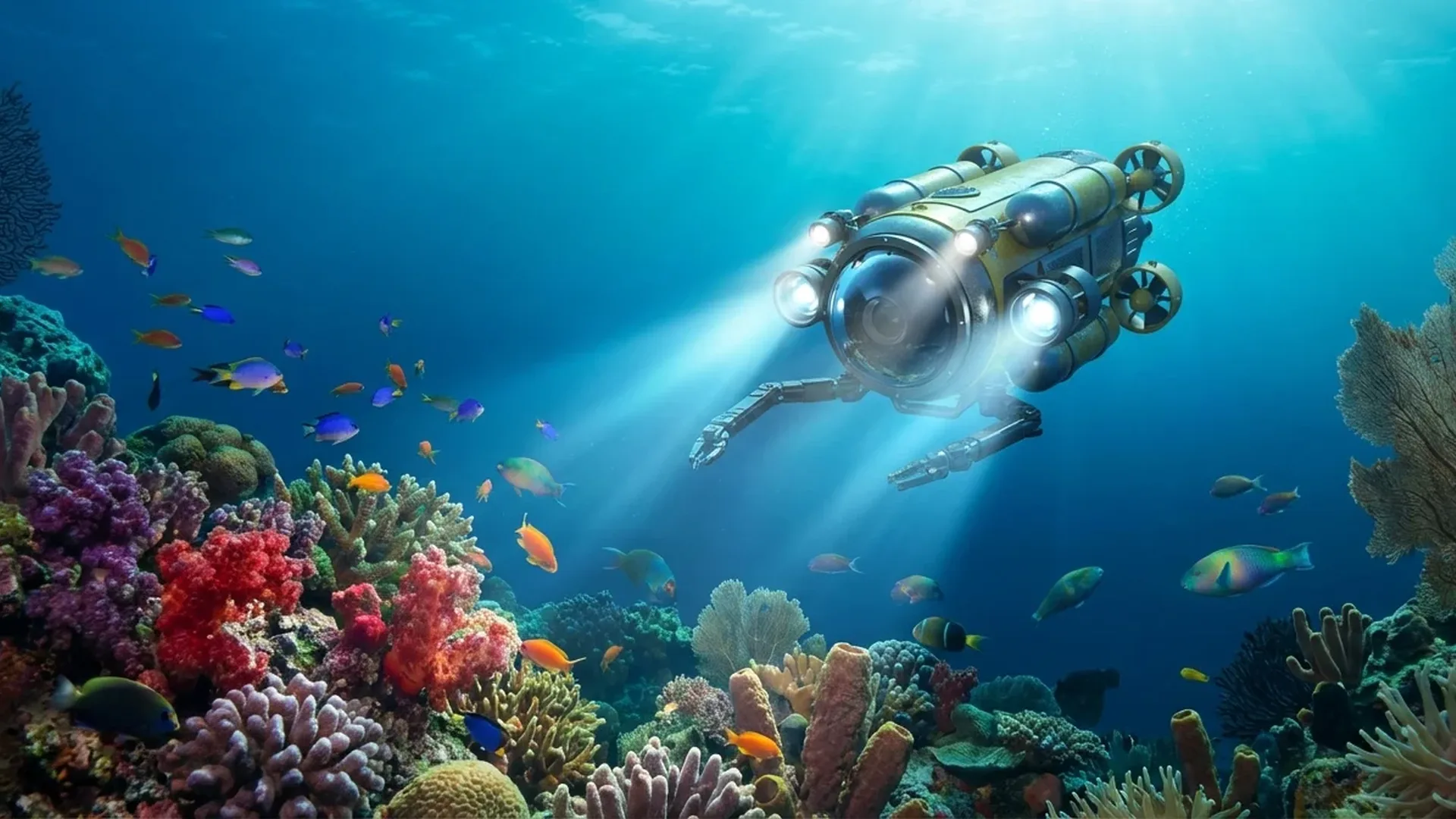
The term “underwater drone” is a broad label covering two fundamentally different categories of vehicles. The first and most widespread are ROVs (Remotely Operated Vehicles) — tethered submersibles controlled by a human operator through a physical cable (tether or umbilical). This cable carries electrical power, video, and data signals, ensuring reliable operation even at extreme depths. The second category consists of AUVs (Autonomous Underwater Vehicles) — fully autonomous underwater robots that operate without any human pilot, following pre-programmed mission plans.
The fundamental challenge of underwater technology is communication. Unlike in air, water rapidly absorbs radio waves, making wireless communication over long distances effectively impossible underwater. That's why ROVs rely on physical tethers — a dependable but range-limiting solution. AUVs, meanwhile, use acoustic modems for basic communication, though acoustic transmission suffers from 1–2 second delays and severely limited bandwidth (around 80 BPS under the NATO JANUS standard, ratified in 2017).
ROV Categories by Size & Power
The Marine Technology Society classifies ROVs into several categories. Micro-class units weigh under 3 kg and are used in confined spaces — sewers, pipelines, small cavities — where a diver simply cannot fit. Mini-class ROVs (around 15 kg) can be transported and deployed by a single person from a small boat. Inspection-class vehicles are rugged industrial machines equipped with live-feed video, imaging sonar, and ultrasonic thickness gauges. Heavy Workclass ROVs, generating up to 220 horsepower, carry hydraulic manipulator arms and operate at depths up to 3,500 meters. Finally, Trenching & Burial ROVs exceed 200 horsepower and work at depths of up to 6,000 meters laying subsea cables.
📜 Historical Milestones — From 1957 to the Ocean Depths
The history of underwater drones goes back further than most people realize. In 1957, the Applied Physics Laboratory at the University of Washington created SPURV (Self-Propelled Underwater Research Vehicle), the world's first autonomous underwater vehicle. Weighing 484 kg, capable of diving to 3,650 meters, and operating autonomously for up to 5.5 hours, it was designed to study acoustic transmission and oceanographic data in Arctic waters.
In the 1960s, the U.S. Navy funded the development of CURV (Cable-Controlled Underwater Recovery Vehicle), laying the groundwork for modern ROVs. Its practical value was demonstrated dramatically in 1966, when a CURV-type ROV recovered a nuclear bomb lost in the Mediterranean Sea after a B-52 crashed near Palomares, Spain — an incident that established ROV technology as essential for deep-water recovery missions.
The 1980s proved pivotal. As offshore oil extraction moved into deeper waters — beyond the limits of human diving — ROVs became indispensable. In 1983, ISE Ltd created ARCS (Autonomous and Remote Controlled Submarine), a hybrid system featuring a Motorola 32-bit processor. But the moment that captivated the world came in 1985, when Dr. Robert Ballard used ROVs from the Woods Hole Oceanographic Institution (WHOI) to locate the wreck of the Titanic at 3,800 meters depth in the North Atlantic. That discovery turned underwater robots into front-page news worldwide.
🏛️ Milestone: The Mariana Trench. In 1993, Japan's Kaikō (JAMSTEC) became the first ROV to reach the deepest point on Earth — nearly 11,000 meters. It operated until 2003 when it was lost on a mission. WHOI's Nereus, a hybrid ROV/AUV, repeated the feat in 2009 before also being lost in 2014. Then in 2021, researchers published in Nature the creation of a self-powered soft robot inspired by a deep-sea snailfish that operated at 10,900 meters in the Mariana Trench.
The past decade has seen a dramatic acceleration. In July 2024, a Titanic expedition used ROVs equipped with magnetometers to recover artifacts for the first time in an archaeological retrieval mission. The technology has spread far beyond research — into combat, documentary filmmaking, pollution monitoring, and public safety.
🔬 Scientific & Industrial Applications
The oil and gas industry remains the largest user of ROVs worldwide. These vehicles perform seafloor mapping ahead of infrastructure installation, pipeline inspection, flexible flowline connections, component replacement on platforms, and even valve operations using hydraulic manipulator arms at depths no human diver could reach. Chevron reports that mini ROVs have dramatically reduced costs in shallower environments thanks to their compact size and rapid deployment times.
📖 Read more: Drones for Kids: Safe Choices 2026
Marine Scientific Research
The world's leading oceanographic institutions rely on specialized ROVs for groundbreaking discoveries. MBARI (Monterey Bay Aquarium Research Institute) in California operates ROV Ventana (since 1988) and ROV Doc Ricketts (since 2009) — the former has logged over 16,000 hours of subsea operations. WHOI uses the Jason system (operational since 1988) for missions across the globe. In Europe, France's IFREMER runs the Victor 6000 (since 1999), while Germany's MARUM operates the QUEST and SQUID systems.
AUVs have delivered equally important breakthroughs. The jellyfish Stellamedusa ventana was discovered via ROV, while research AUVs study Arctic sea ice, measuring thickness, salinity, temperature, and light transmittance. In Australia, COTSBot — an AUV developed by Queensland University of Technology — uses neural networks to identify crown-of-thorns starfish that devastate the Great Barrier Reef, then neutralizes them by injecting bile salts. A robot that autonomously saves coral reefs.
Filmmaking & Archaeology
The film industry quickly embraced ROVs. National Geographic, BBC, and other networks use ROVs equipped with 4K cameras (such as the BlueROV2) to capture footage in deep, dangerous, and confined underwater environments. Series like “The Dark Secrets of the Lusitania” and BBC Wildlife Special “Spy in the Huddle” are prime examples. In underwater archaeology, ROVs conduct shipwreck excavations — a notable case being the Mardi Gras Shipwreck Project in the Gulf of Mexico, where in 2007 the deepest scientific archaeological excavation ever attempted at the time was carried out at 1,200 meters depth.
⚓ Military Applications & New Geopolitics
The military sector is one of the oldest users of underwater drones. Navies of multiple countries — the U.S., UK, France, India, Russia, and China — employ UUVs primarily for mine countermeasures. The REMUS AUV, roughly 90 centimeters long, can neutralize mines across one square mile within 16 hours — a task that would take a team of human divers 21 days. It was deployed by the U.S. Navy during the Iraq War in the 2010s to clear mines around the port of Umm Qasr.
The U.S. Navy's AN/SLQ-48 Mine Neutralization Vehicle can venture 910 meters from its host ship via cable and reach depths of 610 meters, carrying three mission packages: a cable cutter for surfacing moored mines, a 34 kg PBXN-103 explosive charge for neutralizing bottom mines, and a moored-mine cable gripper with float-and-charge combination.
Large Autonomous Submarines — A New Era
The latest generation of underwater drones dramatically scales up both size and capability. Boeing's Orca, ordered by the U.S. Navy in 2019 (five units), represents an extra-large AUV with combat capabilities — the first unmanned submarine acquired by the fleet for actual warfighting missions. In May 2024, Northrop Grumman unveiled the Manta Ray for DARPA — a UUV inspired by the manta ray, designed for extended autonomous missions with minimal human oversight and capable of harvesting energy from the ocean. It completed full-scale at-sea trials off Southern California in February–March 2024.
In April 2025, Anduril Industries announced the Copperhead family — a series of autonomous UUVs that includes a loitering munition variant. The trend is unmistakable: underwater drones are no longer just observation tools — they're becoming weapon platforms.
Ukraine — The World's First Underwater Drone Attack
The conflict in the Black Sea has written history in undersea warfare. Beginning in early 2023, Ukraine deployed the Toloka TLK-150 — a small robotic submarine measuring 2.5 meters long with twin thrusters mounted on wing-like stabilizers. Compared to the surface maritime drones (USVs) Ukraine has successfully employed since October 2022, the TLK-150 is smaller and slower — but far stealthier and more survivable.
The advanced variant boasts a range of 2,000 kilometers and a warhead capacity approaching 5,000 kg of explosives. And in December 2025, Ukraine announced what the New York Times, Wall Street Journal, and CNN characterized as the "world's first underwater drone attack on a submarine": a strike on a Russian submarine at the heavily fortified port of Novorossiysk. The SBU (Security Service of Ukraine) stated the operation was the first of its kind globally — a military first that fundamentally changes the calculus of naval warfare.
📖 Read more: Drones in Agriculture: Applications & Benefits 2026
🎮 Consumer & Hobbyist Underwater Drones
Technology that once cost millions is now accessible to anyone. The consumer underwater drone market has exploded in recent years, with companies like Chasing, QYSEA, PowerVision, and Blue Robotics offering models priced from a few hundred to several thousand euros.
The most popular consumer models include:
- Chasing Dory — The most affordable entry point, weighing under 1 kg with a 1080p camera and a maximum depth of 15 meters. Price: approximately €450–€550 (~$490–$600).
- Chasing Gladius Mini S — 4K camera, depth rating up to 100 meters, EIS stabilization. Ideal for recreational underwater photography. Price: approximately €600–€800 (~$650–$870).
- QYSEA Fifish V6 — 6-axis movement (full 360° freedom), 4K UHD camera, depth up to 100 meters. Price: approximately €1,200–€1,800 (~$1,300–$1,960).
- Chasing M2 — Professional-grade, 100 m depth rating, 8 thrusters, swappable battery, optional robotic claw. Price: approximately €2,500–€3,500 (~$2,700–$3,800).
- BlueROV2 — Open-source, highly modular, 100 m depth (upgradeable), preferred by researchers and universities. Price: approximately €4,500–€6,000 (~$4,900–$6,500).
Hobbyist ROVs, while unable to compete with commercial models on depth or durability, can typically reach 15–30 meters and offer an excellent exploration experience in lakes, rivers, and shallow coastal waters. Several ROV competitions exist — the most notable being MATE (Marine Advanced Technology Education), NURC (National Underwater Robotics Challenge), and RoboSub — where students design, build, and compete with their own underwater robots.
🔮 The Future & Remaining Challenges
Despite impressive advances, underwater drones still face significant technical hurdles. Communication remains the primary limitation — acoustic transmissions underwater suffer from reflection, refraction, and signal absorption, while data transfer speeds are a fraction of what we enjoy in air. Research labs are exploring alternatives including optical, inductive, and RF-based techniques, alongside multi-modal solutions that combine multiple approaches.
Battery endurance is the second critical bottleneck. Most AUVs today run on rechargeable lithium batteries (Li-ion or Li-polymer), while some use primary cells that deliver roughly double the endurance — at considerably higher cost per mission. Underwater gliders tackle the problem by changing buoyancy rather than using thrusters, achieving endurance measured in months and transoceanic ranges. Newer MIT experiments explore lithium-seawater batteries theoretically capable of delivering 8,530 Wh/kg — energy harvested directly from the surrounding ocean.
Biomimetic design is also gaining ground. Festo developed the AquaJelly (inspired by jellyfish), EvoLogics created the BOSS Manta Ray, and a Chinese university built a manta ray–shaped UUV for data collection near the Paracel Islands in September 2021 — the design aids both hydrodynamic efficiency and camouflage among real marine life.
In public safety, law enforcement agencies and search-and-rescue teams are increasingly adopting ROVs for evidence retrieval, victim recovery, dam inspection, and flood response. The Maricopa County Sheriff's Office has established a dedicated ROV Unit (ROV-U) to meet rising demand. Using ROVs as a “pre-dive check” ensures safe conditions before sending a human diver underwater.
The trajectory is clear: underwater drones will become more autonomous, more resilient, and more affordable. With artificial intelligence being integrated into onboard decision-making systems, oceanography, naval security, and underwater exploration are entering an era where unmanned vehicles will do the work — autonomously, silently, and deeper than we ever imagined possible.