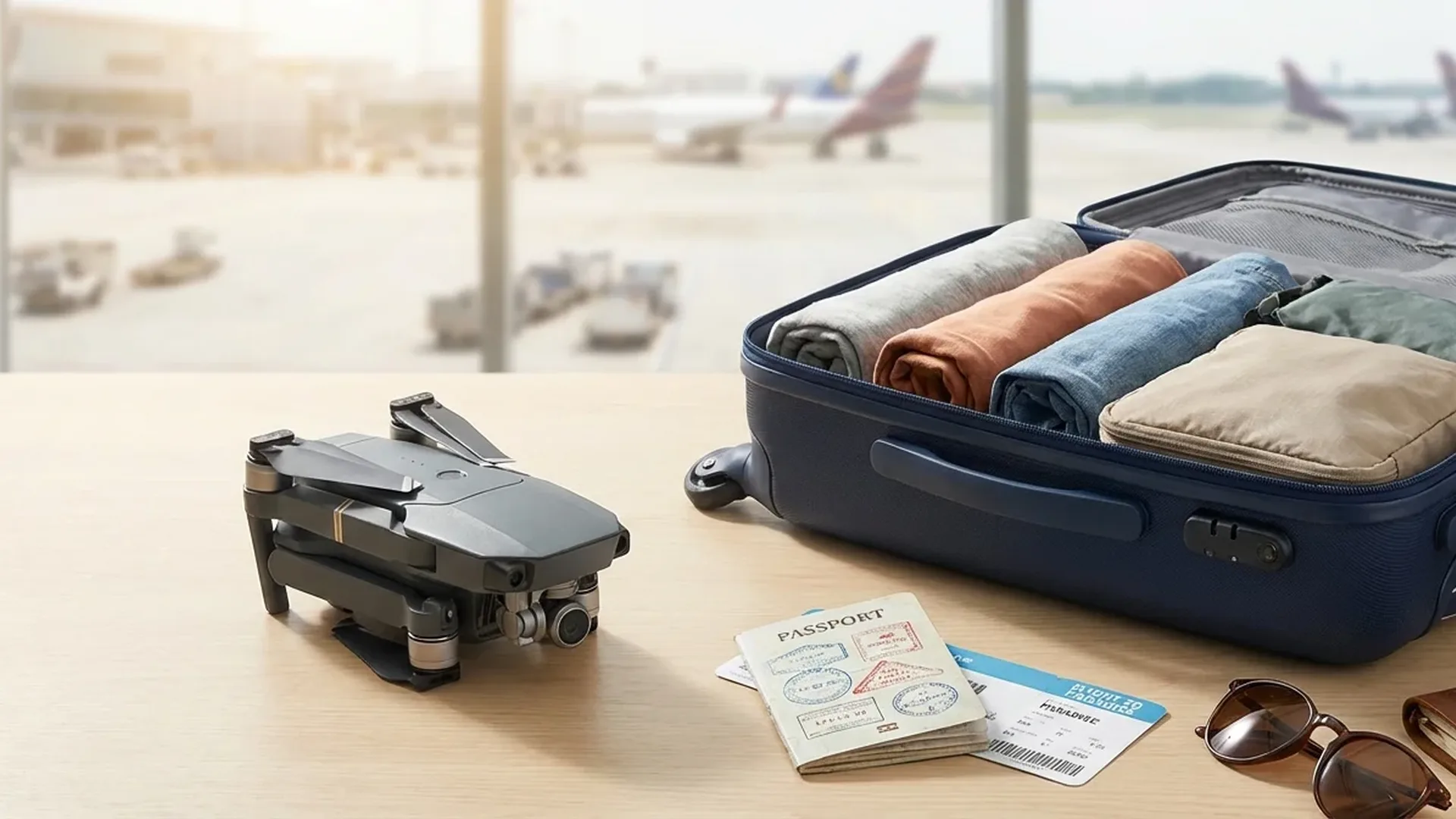
Batteries & Airlines: The IATA Rules
The most critical factor isn't the drone itself — it's the lithium batteries. According to IATA (International Air Transport Association) regulations followed by all airlines, there are strict rules you must follow:
Carry-On ONLY
Lithium batteries MUST be carried in the cabin (carry-on), NEVER in checked luggage. If your carry-on gets gate-checked, remove all batteries first.
100 Wh Limit
Batteries under 100 Wh are allowed without airline approval. The Mini 4 Pro battery is just 18.96 Wh — far below the limit. Batteries between 100-160 Wh require specific airline approval.
Terminal Protection
Loose batteries must be in their original packaging or have terminals covered with tape to prevent short circuits. Alternatively, use a battery case or protective pouch.
Devices = Carry-On
According to IATA, all lithium-battery devices (phones, laptops, drones, cameras) should be transported in the cabin, not in the cargo hold.
How many batteries can I bring?
There's no universal rule for the exact number of batteries, but here's what applies:
- Under 100 Wh: No numerical limit (but “reasonable quantity” — IATA says “pack light”)
- 100-160 Wh: Maximum 2 per passenger, airline approval required
- Over 160 Wh: Completely prohibited on passenger flights
With the Mini 4 Pro battery at 18.96 Wh, you can easily bring 3-4 batteries with zero issues. Even the Fly More Combo with 3 batteries and the Charging Hub fits comfortably in a carry-on — priced at around €1,010 (~$1,099) with the RC 2 controller.
EU Regulations: EASA Framework
The European Union follows a unified regulatory framework for drones through EASA (European Union Aviation Safety Agency). Under Regulation (EU) 2019/947, the “Open” category is the primary reference for recreational flights.
EASA Open Category: Subcategories
| Category | Class | Weight | Flying Near People | Training |
|---|---|---|---|---|
| A1 | C0, C1 | <900 g | Over people (C0) | Basic online |
| A2 | C2 | <4 kg | Close (30 m distance) | Online + practical |
| A3 | C3, C4 | <25 kg | Far from people | Online |
The DJI Mini 4 Pro carries a C0 class identification label (under 250 g), which means:
- Subcategory A1 — you can fly over people (but not over crowds/assemblies)
- Maximum altitude: 120 meters (400 feet)
- VLOS (Visual Line of Sight) — always maintain visual contact
- In most EU countries, operator registration isn't required for C0 drones
- Basic online training required (free through local aviation authority/EASA)
Important: Operator Registration
While C0 drones under 250 g are often exempt from mandatory registration, EASA recommends checking local regulations in each country before traveling. Some countries (e.g., Italy, France) require registration even for <250 g drones. If you're based in Greece, registration is done through the HCAA (Hellenic Civil Aviation Authority).
📖 Read more: Cinematic Drone Shots: 10 Essential Moves
Popular Destinations & Drone Rules
DJI provides flight guidelines for 20+ countries through DJI Fly Safe. Here are the most popular travel destinations:
Greece
✔ AllowedC0 <250g OK, HCAA registration, NOTAM check
Italy
⚠ ENAC RegistrationMandatory registration, no-fly zones at landmarks
Spain
✔ AllowedAESA regulation, <250g no registration
France
⚠ AlphaTangoAlphaTango registration, strict Paris rules
United States
⚠ FAA TRUSTRecreational: TRUST test, B4UFLY app, <250g OK
United Kingdom
✔ AllowedCAA regulation, <250g no registration
Thailand
⚠ CAAT RegistrationCAAT registration required, insurance mandatory
Japan
⚠ MLIT RegistrationMandatory registration, no-fly near airports
Countries with Drone BANS
Some countries completely ban drones or require special government permits. Before traveling, ALWAYS check if your destination country allows drones. Countries with strict or complete bans include: Morocco, Egypt, Cuba, North Korea, Iraq, Iran. In these countries, your drone may be confiscated at the airport.
Packing: How to Pack Your Drone
The DJI Mini 4 Pro is the ideal travel drone thanks to its tiny dimensions (148×94×64 mm folded) and 249 g weight. But proper packing makes a huge difference:
Carry-On (MANDATORY)
- Drone body (ideally in DJI carrying case)
- ALL batteries (no exceptions!)
- Controller (RC 2 or RC-N2)
- Charging Hub
- USB-C cables & 30W charger
- MicroSD cards
Checked Luggage (Optional)
- Propeller Guards (~€15-20 / ~$16-22)
- Landing Pad (~€10-15 / ~$11-16)
- ND Filters (in protective case)
- Hard shell carrying case
- Tripod / selfie stick
- Spare propellers
Documents (Essential!)
- Operator registration number
- Drone insurance (if required)
- DJI Care Refresh details
- Screenshot of destination country rules
- Drone serial number & purchase receipt
- Online training certificate ID
Airport Security Tips
- Prep your carry-on before the checkpoint: Place the drone in a separate bin, just like you do with a laptop
- Batteries in a ziplock bag: Keep batteries in a separate clear bag — speeds up the security check
- Discharge batteries to ~50%: Some airlines recommend discharging below 50% for transport — reduces risk of thermal runaway
- Don't open the DJI Fly app on the plane: Keep your phone in airplane mode throughout the flight
📖 Read more: DJI Mini 4 Pro vs Mini 5 Pro: Full Comparison
Flight Tips on Vacation
You've arrived, unpacked — now how do you make the most of your drone?
Golden/Blue Hour
The best times for aerial footage are 30 minutes before/after sunset (golden hour) and 20 minutes after (blue hour). Use apps like Sun Surveyor or PhotoPills to plan your shots.
Pre-Plan Your Flights
Use Google Earth Pro to scout impressive locations before you go. Mark GPS waypoints and plan quick flights — it saves battery life and maximizes your shooting time.
Quickshots & MasterShots
The Mini 4 Pro's automated modes (Dronie, Helix, Rocket, Circle, Boomerang) deliver cinematic footage in seconds — perfect when you're short on time.
Storage & Backup
Bring 2+ microSD cards (128-256 GB) and back up to a laptop or portable SSD every evening. Don't risk losing irreplaceable footage.
Pre-Trip Checklist
24 Hours Before Departure
| Action | Status | Notes |
|---|---|---|
| Firmware update | Do it before you leave! | Hotel WiFi may be too slow/unreliable |
| Charge batteries to ~40-50% | Ideal for travel | Safest charge level for transport |
| Format microSD | Clean card | Back up old footage first |
| Check destination regulations | MANDATORY | DJI Fly Safe, local authorities |
| Operator registration | Varies by country | HCAA (GR), ENAC (IT), DGAC (FR), FAA (US) |
| Download offline maps | DJI Fly & Google Maps | Essential without mobile data abroad |
| DJI Care Refresh insurance | Recommended | ~€45-55 (~$49-60)/year, replacement in 2 days |
Why the Mini 4 Pro Is the Ultimate Travel Drone
Weighing just 249 g and measuring 148×94×64 mm when folded, the DJI Mini 4 Pro is arguably the best travel drone on the market. It literally fits in a large jacket pocket. With the Fly More Combo (3 batteries, ~€1,010 / ~$1,099 with RC 2), you get over 100 minutes of total flight time — enough for a full day of stunning aerial footage.
The 249 g weight ensures C0 class in the EU (lightest regulations), legal flying without exams in most countries, and no special air transport requirements. At the same time, you don't sacrifice quality: 4K/60fps, 48MP photos, omnidirectional obstacle sensing, O4 video transmission — capabilities that just a few years ago required drones three times the weight.
Conclusion
Traveling with a drone doesn't have to be stressful. With proper preparation — batteries in your carry-on, regulation checks, smart packing — you can fly almost anywhere in the world. The keys: respect local laws, plan your transport carefully, and always check before you fly. Safe flights — and happy travels!