📖 Read more: How to Fly a Drone: Step-by-Step Tutorial
🌡️ Thermal Inspection of Solar Panels: What It Is and How It Works
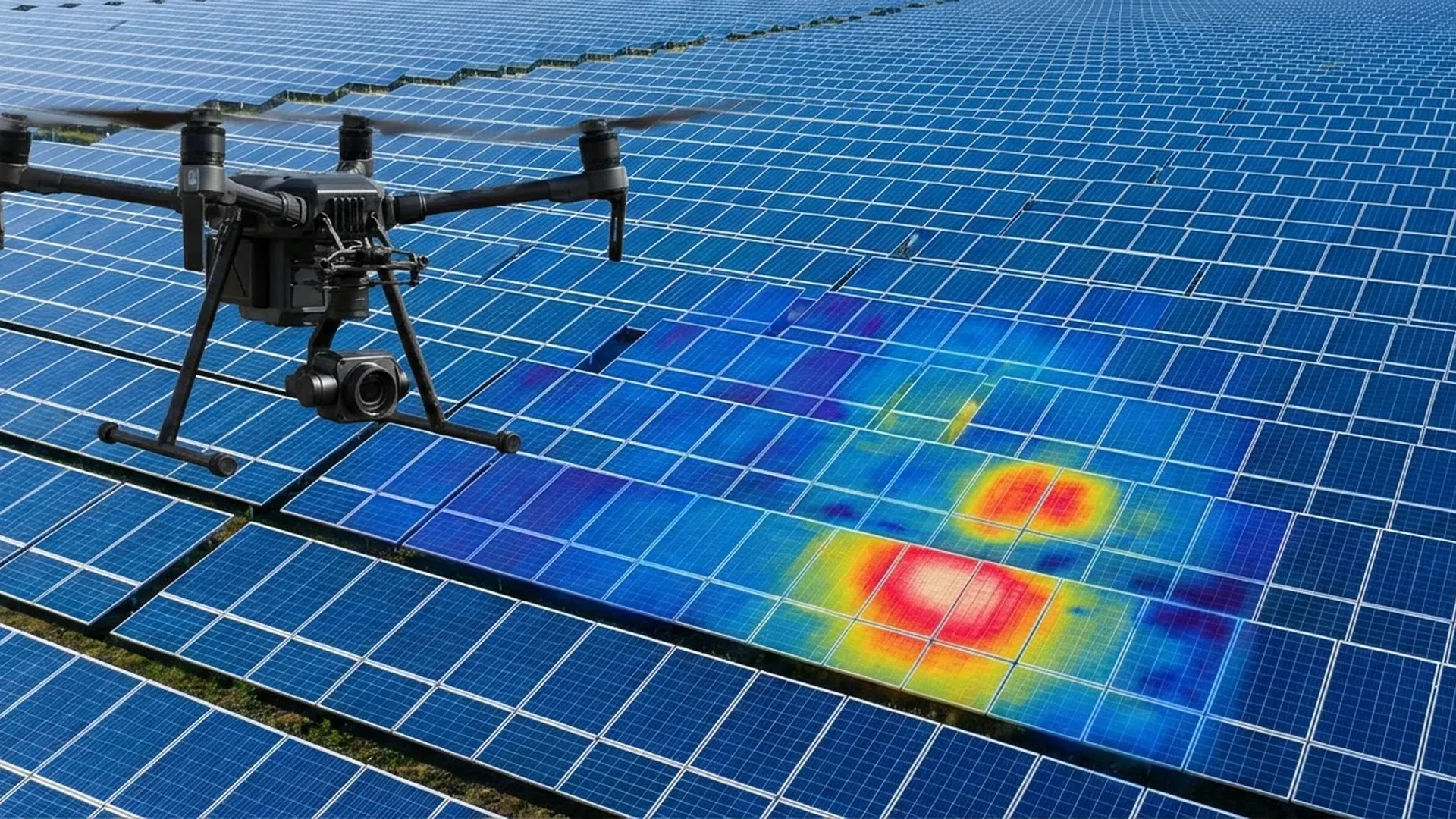
Thermal inspection (infrared thermography) is a non-destructive testing (NDT) technique based on imaging the temperature field of a surface. According to literature from the IEA PVPS Task 13, every photovoltaic module during operation exhibits normal temperature variations of 3-5 K due to convective heat transfer. Hot spots, however, show local temperature deviations of many tens of degrees (10+ K) — a clear sign of damage.
The steady-state thermography method is performed while the PV module is in normal operation, under steady-state conditions. According to Wikipedia (Photovoltaic module analysis techniques), the ideal measurement conditions include:
- Irradiance: at least 700 W/m² (clear sky)
- Ambient temperature: low, for greater thermal contrast
- Wind: low intensity, so thermal signals are not masked
- Capture angle: between 60° and 90° relative to the module plane
- Shading: no shadows on the module (clouds, buildings, operator, camera)
This technique can be applied to individual modules, groups of modules, or even entire sections of large PV parks, using unmanned aerial vehicles (drones) — and this fundamentally changes the game.
📊 Key Industry Figures
According to a study published in the scientific journal Joule (2019), annual revenue losses due to soiling (panel surface contamination) were estimated between €5 (~$5.4) and €7 billion (~$7.6 billion) globally. Regular inspection — and especially thermal imaging via drones — helps identify problems early, before they escalate into significant financial losses.
🚁 Drones in Inspection: The New Era
Unmanned aerial vehicles (UAVs/drones) have transformed how PV installations are inspected. Traditionally, thermal inspection required technicians to walk between rows of panels or use handheld thermal cameras from the ground — a slow, laborious process with limited coverage. Today, a drone equipped with a thermal camera can scan a park of tens of MW in just a few hours, covering every single square meter.
DJI Matrice 350 RTK: The King of Aerial Inspections
The DJI Matrice 350 RTK is the top drone platform for professional inspections. According to official DJI specifications, it offers a maximum flight time of 55 minutes, IP55 protection (waterproof and dustproof), a payload capacity of up to 2.7 kg, and wind resistance up to 12 m/s. With an operating temperature range of -20° to 50°C, it performs reliably even in extreme conditions.
The DJI O3 Enterprise Transmission supports triple simultaneous 1080p HD live feeds with a maximum range of 20 km. Additionally, optional 4G Enhanced Transmission ensures uninterrupted connectivity in urban environments with obstacles.
For thermal inspection, the Matrice 350 RTK pairs with the Zenmuse H30 sensor suite — a multi-sensor payload integrating a wide-angle camera, zoom camera, infrared thermal camera, laser rangefinder and NIR auxiliary light. Alternatively, the Zenmuse H20 Series combines a zoom camera, wide-angle, thermal and laser rangefinder into a unified quad-sensor system.
🔑 Key advantage: Through the Live Mission Recording feature, the Matrice 350 RTK stores flight path files that can be reused, automating repetitive inspections. The AI Spot-Check function supports automatic focusing and subject adjustment, improving the accuracy of repeated captures.
🔍 Types of Defects Detected by Thermal Cameras
According to the IEA PVPS Task 13 assessment of PV module failures in the field, thermal imaging can detect a wide range of defects:
Hot Spots
Localized overheating of cells due to high resistance. This can affect part of a cell (in broken cells) or entire cells (in current mismatches).
PID (Potential-Induced Degradation)
Typically appears in cells near the module frame. Causes power loss of up to 30%, accelerated by high voltages, temperatures and humidity. First described in 2010 by S. Pingel.
Cell Cracks
Micro-cracks in crystalline silicon — invisible to the eye but visible in thermal images as zones of uneven temperature within a single cell.
Soiling & Shading
Dust, bird droppings, tree shadows or nearby building shade reduce performance. Annual energy loss from soiling is estimated at 3-4% worldwide, per a 2019 Joule study.
Beyond thermography, there are complementary analysis techniques: electroluminescence (EL) uses an external forward current to “illuminate” silicon cells, revealing cracks, mismatches and PID. Photoluminescence (PL) uses an external light source instead of current, without requiring electrical connection to the module. These techniques can be combined with drones for a comprehensive picture.
📖 Read more: Drone Racing: Complete Guide 2026
⚔️ Drone vs Manual Inspection
✅ Drone Inspection
- Covers a park of tens of MW in just hours
- Uniform capture angle (60-90°) on every panel
- No risk to technicians (falls, electrocution)
- Automated flight paths — full repeatability
- Detailed thermal data per individual cell
❌ Manual Inspection
- Slow: days or weeks for large parks
- Inconsistent angles — unreliable results
- Risk of worker injury
- Limited coverage — not all modules checked
- Higher labour cost per MW
💰 Equipment & Investment Costs
The entry cost for aerial thermal inspection depends on the size of installations to be serviced and the required precision:
Professional Equipment
- DJI Matrice 350 RTK: approximately €11,000-€18,400 (~$12,000-$20,000) depending on payload configuration, 55-minute max flight time, IP55 rating, 2.7 kg max payload
- Zenmuse H30 Series: multi-sensor payload with thermal camera, zoom camera, wide-angle, laser rangefinder and NIR — sold separately
- DJI Mavic 3 Enterprise (Thermal): approximately €4,600 (~$5,000), a lighter alternative with integrated thermal camera for smaller installations
Analysis Software
After data collection, specialized software is needed for thermal image analysis. DJI offers DJI Terra for creating orthomosaic maps and 3D models, while third-party platforms (Raptor Maps, Above Surveying, and others) specialize in automated defect detection through AI algorithms.
“In a 10 MW solar farm, the savings from early defect detection via drone can exceed tens of thousands of euros annually, considering that global revenue losses from soiling alone are estimated at €5-7 billion (~$5.4-$7.6 billion) per year.”
⚙️ How an Inspection Flight Is Carried Out
A typical thermal inspection mission with a drone follows specific steps:
- Mission planning: Defining the area in a flight application (e.g. DJI Pilot 2), setting altitude, speed and image overlap
- Condition check: Verifying solar irradiance ≥700 W/m², low wind, absence of clouds
- Automated flight: The drone follows predefined flight lines (waypoints), simultaneously capturing thermal and RGB images
- Data analysis: Creating an orthomosaic map, identifying thermal anomalies, classifying defects
- Reporting: Documented report with georeferenced defect locations, fault type and repair priority
With the DJI Matrice 350 RTK’s Live Mission Recording feature, the initial flight can be saved and automatically replayed for future inspections, ensuring full repeatability.
🇬🇷 Solar Panels in Greece: A Sun-Drenched Future
Greece, thanks to its exceptional sunshine (1,500-2,000+ kWh/m²/year), offers an ideal environment for photovoltaic installations. In recent years, installed capacity has grown significantly, with new parks of tens and hundreds of MW being licensed across the country.
This rapid expansion creates enormous demand for inspection services. Thermal drone inspection is perfectly suited to the Greek climate: many sunny days with irradiance well above 700 W/m², low cloud cover, and naturally the need to combat panel soiling from dust — particularly in southern Greece.
At the same time, Greek legislation requires PV park operators to maintain an operation & maintenance (O&M) programme, creating opportunities for specialized drone inspection companies.
🛡️ Regulatory Framework & Certifications
To legally carry out an aerial PV inspection in Greece, the operator must hold:
- A2 or STS Certificate: Depending on the drone’s weight category and proximity to people, appropriate EASA certification is required (A2 exam cost: ~€50-100 / ~$55-110, STS training: ~€300-800 / ~$330-870)
- Operator registration: Mandatory with the Greek CAA (HCAA), free of charge
- Insurance: At least €1,000,000 (~$1,090,000) third-party liability for commercial use (~€150-500 / ~$165-545 per year)
- IEC 62446-3: The international standard for thermal inspection of photovoltaic systems, which defines the methodology and evaluation criteria
📈 ROI: The Inspection That Pays for Itself
Investing in drone-based thermal inspection delivers rapid returns. Considering that a 1 MW solar farm generates annual revenues of tens of thousands of euros, a 5-10% loss due to detectable defects translates to thousands of euros in lost revenue per year. Thermal drone inspection — costing just a few hundred euros per MW — can identify these problems before they escalate.
Detecting PID is particularly critical, given that according to a Fraunhofer CSP study, in 2013 only 4 out of 23 major module manufacturers were considered unaffected by the phenomenon. Early detection through thermography enables the installation of Anti-PID boxes (PID reversal devices) that can recover a significant portion of lost power output.
📌 Conclusion: Thermal inspection of solar panels by drone is not a luxury — it is a necessity for every modern PV park. With equipment like the DJI Matrice 350 RTK (55-minute flight time, IP55 rating, Zenmuse thermal camera) and adherence to international standards, every park owner can maximize the return on their investment and prevent hidden losses worth thousands of euros.