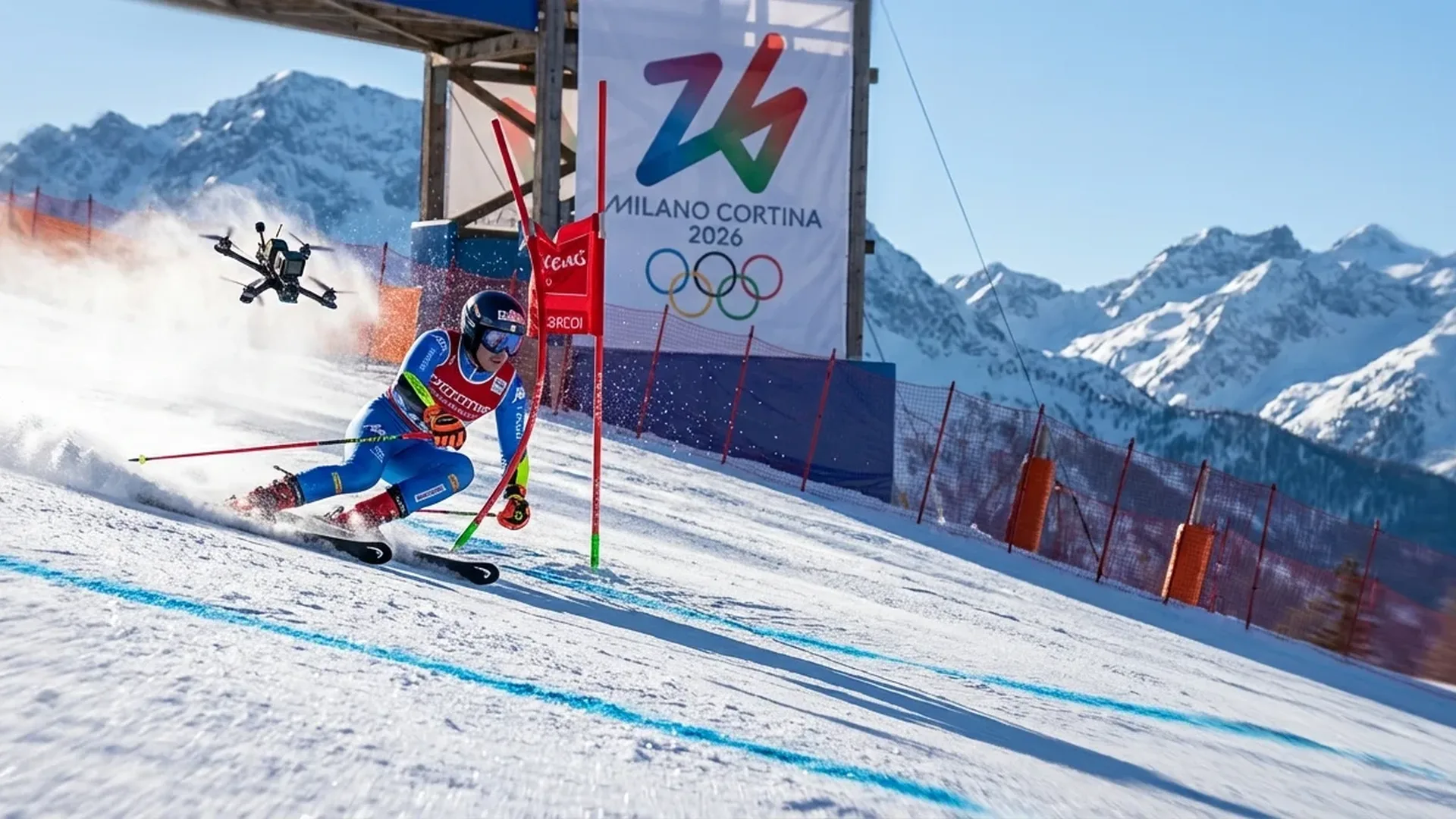
The Milano-Cortina 2026 Olympics
The XXV Winter Olympic Games took place from February 6 to 22, 2026, with events spread across multiple venues in Lombardy and Northeast Italy. Milan hosted the ice events (hockey, figure skating, speed skating), while Cortina d'Ampezzo, Livigno, and the Fiemme Valley hosted snow events — alpine skiing, cross-country skiing, snowboard, freestyle skiing, ski mountaineering (debuting as an Olympic sport), and sliding sports (bobsleigh, luge, skeleton).
The opening ceremony at the legendary Stadio San Siro in Milan featured performances by Mariah Carey, Laura Pausini, and Andrea Bocelli. The official mascots were Tina and Milo — two stoats inspired by Italian nature. Norway dominated the medal table (17 golds), while host nation Italy earned 27 medals (9 golds).
Beyond the athletic results, these Olympics marked a technological revolution: the Olympic Broadcasting Services (OBS) systematically integrated FPV drones into live broadcasts, offering viewers camera angles that feel like a video game — following athletes just meters behind as they hurtle down slopes at over 140 km/h (87 mph).
Why FPV Drones at the Olympics?
Traditional filming methods at the Winter Olympics — cable cams, fixed slope cameras, helicopters — provide stable coverage but from a distance. FPV (First Person View) drones fundamentally change the equation: the pilot sees in real time exactly what the drone sees through FPV goggles, enabling extremely precise flying. This means they can follow a skier within a few meters, fly between slalom gates, or dive into an icy luge half-pipe.
What makes FPV drones unique? Unlike regular camera drones (e.g., DJI Mavic) that fly slowly and hover, FPV drones are extremely fast (180+ km/h / 112+ mph for 5-inch builds), highly agile, and flown using first-person-view goggles. The pilot sees everything in real time, as if they were flying themselves.
Benefits of FPV in sports broadcasting
- Speed and immersion: The footage gives viewers a “video game” feel — as if they're right behind the athlete
- Impossible angles: Camera angles that cable cams, helicopters, and fixed cameras can't achieve — inside narrow luge channels, between trees, close to the snow
- Flexibility: An FPV drone can change angle, altitude, and speed in fractions of a second
- Low cost vs helicopters: A complete FPV drone costs under €370 (~$400) in parts (excluding professional broadcast equipment)
Downsides and challenges
- Noise: FPV drones are quite loud — annoying for on-site spectators and making live audio capture more difficult
- Potential athlete distraction: Some athletes reported that the buzzing drone distracted them
- No mechanical stabilization: FPV drone cameras are rigidly mounted to the frame without a gimbal, which can result in shaky footage
- Motion sickness: The fast, dynamic footage may cause discomfort for viewers sensitive to motion
The 3 Types of FPV Drones at the Olympics
According to FPV expert Oscar Liang, approximately 25 drones were used at the Milano-Cortina 2026 Olympics. These fall into 3 main categories of custom-built drones — nothing particularly exotic, most components are available online to any hobbyist. What makes them special is the pilots' skill and the professional broadcast equipment.
Sub-250g Micro FPV
Weight: 243 grams
Speed: Up to 140 km/h (87 mph)
Battery: 4S LiPo
Use: Luge, skeleton — inside narrow icy tracks
5-Inch FPV Drone
Weight: 600-800 grams
Speed: 180+ km/h (112+ mph)
FPV Goggles: DJI Goggles 3
Use: Chasing skiers and snowboarders on open slopes
Cinewhoop
Camera: Blackmagic Micro Studio Camera G2
Feature: Prop guards for safety
FPV Goggles: DJI FPV V1/V2
Use: Safe flight near people, indoor venues
Sub-250g Micro: The Luge and Skeleton hero
The most impressive drone was the one that followed athletes through the narrow icy tubes of luge and skeleton at the brand-new Cortina Sliding Centre. Weighing just 243 grams, it fits into tight spaces where larger drones cannot. According to the pilot, these reach speeds up to 140 km/h (87 mph) — enough to keep up with luge sleds.
Components identified from photographs:
- FPV system: DJI O4 Air Unit Lite — DJI's lightest digital HD FPV system
- Motors: RCINPOWER GTS V2 1207 6000KV Titanium Red
- Props: 2.5-inch tri-blade
- Battery: 4S LiPo
- Radio link: 900MHz (Crossfire or ExpressLRS) — lower frequency for better signal penetration in mountainous terrain
- Broadcast setup: Proton Camera + Domo PicoTXR COFDM transmitter for live TV broadcast
Interesting detail: The frame is used upside down (pusher configuration) — motors spin inverted. This frees up space on top for broadcast equipment and keeps propellers out of the camera's field of view. Takeoff and landing become more challenging, but the advantages are worth it.
Drone parts cost: approximately €370 (~$400). However, the professional broadcast equipment (Proton camera + COFDM transmitter) costs many times that amount.
5-Inch Drone: The mountain chaser
5-inch FPV drones were used for outdoor events — chasing skiers and snowboarders at Stelvio Ski Centre (men's alpine skiing) and Livigno Snow Park (snowboard, freestyle skiing). Weighing 600-800 grams (including battery) and easily exceeding 180 km/h (112 mph), these drones follow even world-class athletes without any problem. They're also used for chasing race cars.
Pilots were photographed wearing DJI Goggles 3 and holding a RadioMaster Boxer Max (Gold edition). Two antennas were visible on the back of the radio — likely an ExpressLRS Gemini-X module like the Nomad for dual antenna and improved coverage. In some cases, a fiber optic cable was observed running from the radio to an external antenna/repeater — a technique ensuring reliable connection in difficult mountainous terrain.
Cinewhoops: Safe flight near people
Cinewhoops — FPV drones with prop guards — were used in locations where safety was paramount: near spectators, indoor ceremony venues, and close-contact athletic events. In a photo published by the Olympic Broadcasting Services (OBS), a cinewhoop is visible carrying a Blackmagic Micro Studio Camera G2 (approximately €920 / ~$995) — a camera that delivers exceptional image quality in a compact size. The pilot was using first or second-generation DJI FPV goggles.
How Live Broadcasting Works
Each drone at the Olympics carried two cameras with completely separate purposes — and this is key to understanding how the entire system works.
Pilot camera (DJI Air Unit)
The DJI camera is used exclusively by the pilot to see where they're flying. DJI FPV goggles receive this signal. This system is never broadcast on television.
Broadcast camera + COFDM transmitter
A second, professional camera (e.g., Proton or Blackmagic) along with a COFDM transmitter sends footage directly to the broadcast network. This is what viewers see at home — via Eurosport, RAI, and other networks.
DJI FPV systems were used exclusively across all drones — logical given their reliability and low latency. The broadcast transmission uses a completely separate COFDM transmitter, ensuring professional image quality on television independent of the pilot's FPV system.
Pilot Equipment
FPV Goggles
Three DJI goggle models were identified at the Olympics:
- DJI Goggles 3 (approximately €460 / ~$499) — used with 5-inch drones. Support DJI O4, offer Full HD resolution, and latency under 30ms
- DJI FPV Goggles V2 — used with cinewhoops. Older generation but fully reliable
- DJI Goggles with O4 Lite — for sub-250g micro drones
Radio controllers
The RadioMaster Boxer Max Gold edition (approximately €130 / ~$140) was the primary choice. It's a compact radio with high-precision Hall gimbals. In some photos it's visible connected via fiber optic to an external antenna — likely some repeater system for improved coverage across demanding mountain locations.
Flight controllers and motors
While no official parts lists exist, typical components for a custom-built 5-inch FPV drone include:
- Flight controller stack: e.g., SpeedyBee F405 V4 (approximately €65 / ~$70) — FC + ESC in a unified package
- Motors: e.g., T-Motor Velox 2207 (approximately €14 / ~$15 per motor) or similar racing motors
- Frame: Specialized carbon fiber 5-inch frame, often custom designed
- VTX: DJI O4 Pro Air Unit (approximately €200 / ~$220) for 5-inch builds
Events Covered by FPV Drones
Luge & Skeleton
Sub-250g micro drones followed athletes through the icy tubes of the Cortina Sliding Centre. The track was brand new — built specifically for the Games after multiple delays and controversies.
Alpine Skiing
5-inch drones chased skiers at Stelvio Ski Centre (Bormio) for men's events and Tofane Alpine Skiing Centre (Cortina) for women's — descent speeds exceeding 140 km/h (87 mph).
Snowboard & Freestyle Skiing
At Livigno Snow Park, 5-inch and cinewhoop drones captured halfpipe, slopestyle, and moguls — with dynamic shots between obstacles and mid-air.
Cross-Country Skiing
At Tesero Cross-Country Stadium (Val di Fiemme), drones followed athletes across long distances — Sweden achieved a podium sweep in the women's sprint.
Safety Rules and No-Fly Zones
The use of FPV drones at the Olympics was strictly controlled. Unlike spectators — who had no right to fly any drone over competition venues — FPV pilots operated under special authorization from OBS (Olympic Broadcasting Services) in coordination with Italian authorities.
As Wikipedia notes about the Games: “No-fly zones are strictly enforced over all venues” — flight exclusion zones were rigorously applied over all competition areas, primarily due to security concerns and cyberattack risks. Within this framework, the authorized FPV drones operated as the sole exception.
Important: Flying a drone without special authorization over Olympic venues was strictly prohibited. FPV drones operated only under OBS control, with specific safety protocols, in coordination with security forces — Italian as well as international, given the heightened security presence at the Games.
Equipment Costs
One of the most surprising facts is that the drones themselves aren't expensive — they're made of components any hobbyist can buy online. The cost, however, rises dramatically when professional broadcast equipment is added.
The cost of a complete 5-inch FPV drone (frame, motors, FC, ESC, props, battery, DJI Air Unit) ranges from €500-700 (~$540-760). Add goggles (€460 / ~$499) and a radio (€130 / ~$140) for a basic setup. Professional broadcast equipment (COFDM camera transmitter, ground station, fiber repeater) can cost thousands of euros — but that's not relevant for the average hobbyist.
FPV Drones vs Traditional Filming Methods
FPV Drones
- ✅ Speed 140-180+ km/h (87-112+ mph)
- ✅ Extremely close athlete tracking
- ✅ Angles impossible for cable cams
- ✅ Low cost (~€370-700 / ~$400-760 drone)
- ✅ Light, agile, rapid deployment
- ✅ Immersive “video game” footage
Cable Cams / Helicopters
- ✅ Excellent image stabilization
- ✅ Longer flight endurance
- ✅ Don't disturb athletes/spectators
- ❌ Very high installation cost
- ❌ Fixed paths (cable cam)
- ❌ Limited camera angles
A Brief History of FPV in Sports
The use of FPV drones in major sporting events didn't start in Milan. The technology has evolved gradually over recent years:
- 2018-2019: First FPV drone tests at Formula 1 events and rallies — chasing cars on track
- 2020-2021: The film Red Notice (Netflix, 2021) became the first major cinematic production to use FPV drones extensively, with 8 pilots on set and a RED Komodo camera mounted on an FPV drone
- 2022-2023: Increased use at Super Bowl, Champions League, Tour de France
- 2024: Paris Olympics — first significant FPV use at Olympic Games
- 2026: Milano-Cortina — full integration of ~25 FPV drones in Winter Olympics broadcasting
The Pilots Behind the Footage
Flying an FPV drone at an Olympic-level sporting event requires exceptional skill. Pilots must follow athletes at speeds exceeding 140 km/h (87 mph), through tight spaces, with stable footage — and without any crashes. These are people with thousands of hours of flight time, many of whom are known from the film industry.
In the world of cinema FPV, names like Johnny Schaer (Johnny FPV), Jay Christensen (Jay Byrd), Nurk FPV, and Gabriel Kocher (Gab707) have flown for films like Jurassic World Dominion, The Batman, FIFA World Cups, and Super Bowls. While the specific pilots at the 2026 Olympics weren't officially announced, they were certainly professionals of comparable caliber.
The Future of the Technology
After the Milano-Cortina 2026 Olympics, FPV drones are expected to become standard equipment in sports broadcasting. The evolution will bring:
- Smaller, lighter drones: Weight reduction will continue — drones under 200 grams with HD broadcast aren't far off
- AI-assisted tracking: Artificial intelligence helping pilots “lock on” to athletes, reducing errors
- Improved stabilization: Electronic image stabilization (EIS) comparable to GoPro or DJI — with RockSteady 3.0+, DJI is already showing the way
- 5G/6G broadcast: Instead of COFDM, transmission via mobile networks for even greater flexibility
- 2030 Olympics (French Alps): Expected even greater FPV drone use, possibly with autonomous flight capabilities
Frequently Asked Questions (FAQ)
Can I fly a drone at the Olympics as a spectator?
No. Drone flight over Olympic venues was strictly prohibited for the public. No-fly zones were rigorously enforced over all competition areas.
How many FPV drones were used?
Approximately 25 drones of three types: sub-250g micro (for luge/skeleton), 5-inch (for skiing/snowboard), and cinewhoops (for close/indoor filming).
Which FPV system was used?
Exclusively DJI FPV — DJI O4 Air Unit Lite (micro), DJI O4 Pro (5-inch), DJI FPV V1/V2 (cinewhoops). The TV broadcast used a separate COFDM transmitter.
How much does such a drone cost?
Drone parts cost approximately €370-700 (~$400-760) depending on size. Goggles (~€460 / ~$499) and radio (~€130 / ~$140) are separate. Broadcast equipment costs multiples of that.
Can I build a similar drone?
Yes! Most components are available online. A comparable 5-inch FPV drone can be built for approximately €500-700 (~$540-760) (without goggles/radio). For cinewhoops, try solutions like the GEPRC Cinelog30 V3 (approximately €290-320 / ~$310-350) or BetaFPV Pavo20 Pro (approximately €230-260 / ~$250-280), ideal as RTF or BNF entry points.