📖 Read more: FPV Drone for Beginners: How to Get Started
What Is Drone Racing?
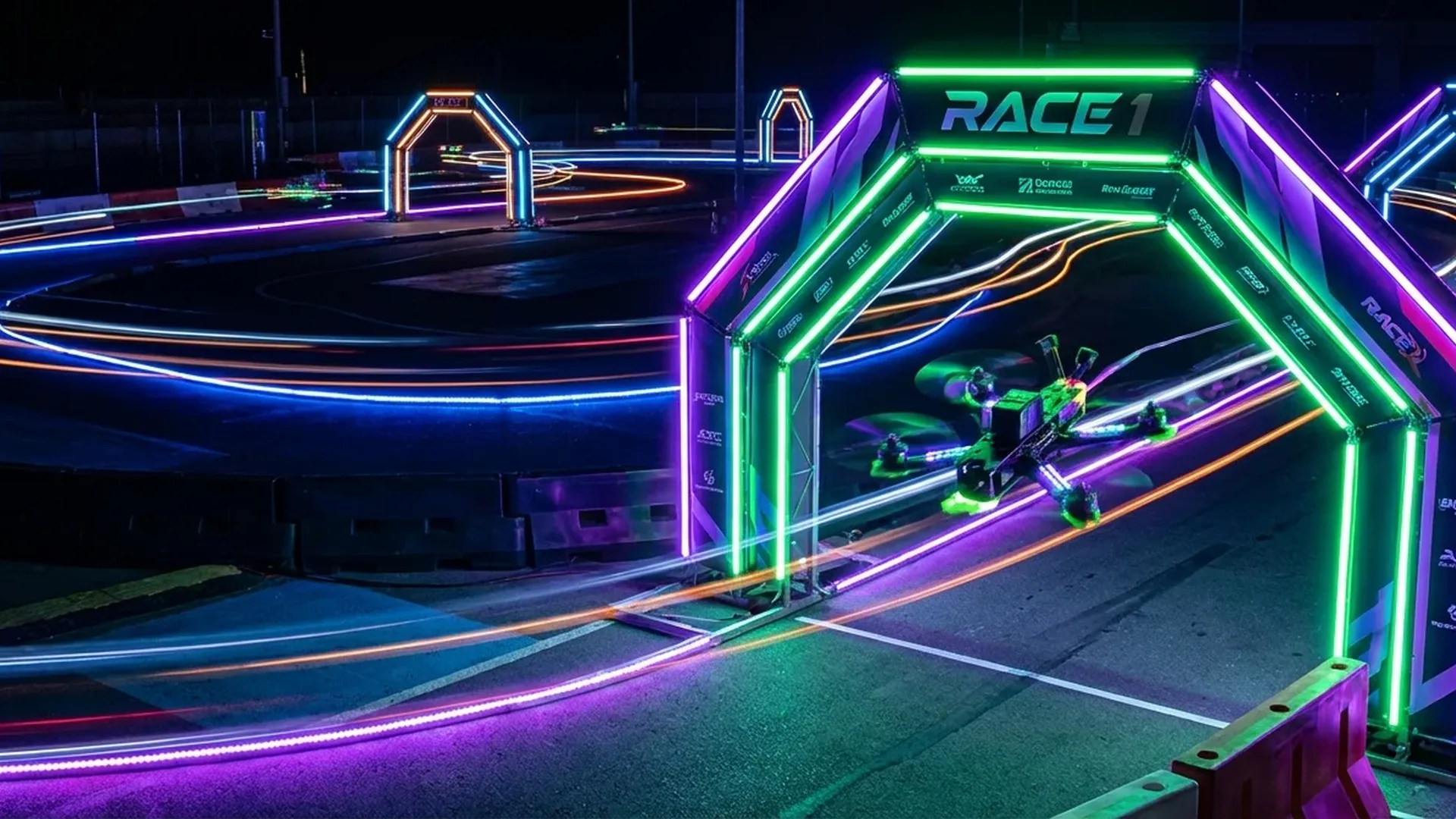
Drone racing is a motorsport in which participants fly remote-controlled FPV drones (typically quadcopters) equipped with a camera. The pilot wears FPV goggles that display a real-time feed from the drone's camera, navigating through courses with gates, flags, and obstacles. The goal? Complete the lap in the shortest time without hitting an obstacle or missing a gate.
The first recorded FPV race took place in Australia in 2011, in Karlsruhe. Since then, the sport has evolved rapidly: today there are professional championships, sponsors like BMW, Allianz, and DHL, television broadcasts on ESPN and Sky Sports, and pilots earning hundreds of thousands of dollars. The Fédération Aéronautique Internationale (FAI) — the world governing body for air sports, recognized by the IOC — organizes the annual FAI Drone Racing World Championship.
History & Key Events
The Major Organizations
The drone racing world is divided among three major types of organizations:
FAI (Fédération Aéronautique Internationale)
The world governing body for air sports, recognized by the International Olympic Committee. Organizes the FAI Drone Racing World Cup and the FAI World Drone Racing Championship. The highest level of recognition in the sport.
MultiGP
The world's largest community drone racing league. Over 30,000 registered pilots, 500+ chapters worldwide. Defines the race class specifications used by most events. Completely free to join.
DRL (Drone Racing League)
The professional for-profit league. Invite-only — pilots fly identical drones (Racer 4) built by DRL. Sponsorships exceeding $30M (Allianz, BMW, US Air Force). Broadcast on ESPN, Sky Sports, Fox Sports Asia.
Beyond these, there's the Drone Champions League (DCL) in Europe, and local organizations in many countries. In Greece, the drone racing scene is still in its early stages, but is gradually growing through local meetups and the FPV community.
Race Classes
Races are divided into classes based on drone size, motors, battery, and weight. MultiGP's class specifications are the most widely used worldwide:
Open Class
Maximum: 305mm (diagonal), 800g AUW. No restrictions on motors/props/electronics. The most unrestricted class.
PRO Spec (7″)
7″ propellers. Motors ≤2808 stator. 6S 2200mAh max. 1200g AUW. Betaflight KAACK firmware. Mandatory LEDs. The "Formula 1″ of drone racing.
Freedom Spec (5″)
5″ propellers. 2207 motors. 6S max. 533g minimum weight. Betaflight with 18,000 RPM limit. The most popular freestyle/racing class.
Tiny Whoop
65mm ducted. 1S battery. 31mm props max. Brushed or brushless motors. Ideal for indoor flying. Very low barrier to entry.
Micro Class (3.1″)
3.1″ propellers. 1404 motors (4500-4600 KV). 3S max. Great for smaller outdoor/indoor spaces. Low cost, lots of fun.
Simulator
Virtual races in Velocidrone (official MultiGP simulator). No restrictions. Ideal for practice and online competitions.
Why do classes exist? For three reasons: (1) They level the playing field — skill wins, NOT equipment. (2) Pilots can build their setup with confidence it'll be accepted at events. (3) They ensure radio equipment doesn't create interference between pilots.
Equipment You Need
Drone racing equipment falls into three main categories:
1. The Racing Drone
Racing drones differ fundamentally from GPS camera drones. They're designed for speed and agility, NOT stable hovering:
- Frame: Usually H-pattern (instead of X-pattern), directing thrust forward.
- Motors: High-KV brushless (e.g., 2207 2400KV for 5″), with massive torque. Price: €10-30 (~$10-29) per motor.
- Propellers: 3-blade or 4-blade (instead of 2-blade), smaller diameter but faster acceleration. Price: €3-8 (~$3-8) per set (consumables!).
- ESC (Electronic Speed Controller): 4-in-1 board. Firmware: BLHeli_32 or AM32.
- Flight Controller: Runs Betaflight. STM32 F7 or H7 processor.
- Camera: Front-facing, low-latency. NO gimbal — fixed-mounted at an angle (~25-35°).
- VTX (Video Transmitter): 5.8 GHz, 25mW during races (to avoid interference), 400-800mW for freestyle.
- Battery: LiPo 4S or 6S, 1300-1500mAh for 5″. Flight time: ~3-5 minutes during a race.
2. FPV Goggles
Goggles display the live feed from the drone's camera. They range from €40 (~$39) for analog entry-level to €800+ (~$780+) for digital HD. The main categories:
- Analog: Affordable, lighter, lower image quality but minimal latency. Ideal for beginners. (Eachine EV800DM ~€50 (~$49), Skyzone SKY04X ~€300 (~$293))
- Digital HD (DJI O4 / HDZero): Excellent image, higher cost. DJI Goggles 3 €349 (~$341), Goggles Integra €349 (~$341), HDZero Goggles ~€300 (~$293).
3. Transmitter (TX)
Drone racing transmitters look somewhat like game controllers but are far more precise:
- RadioMaster Boxer: ~€100-130 (~$98-127) — excellent entry-level, built-in ExpressLRS.
- RadioMaster TX16S MK2: ~€180-250 (~$176-244) — OpenTX/EdgeTX, multi-protocol.
- TBS Tango 2: ~€200 (~$195) — compact gamepad style, popular among racers.
How Much Does It Cost to Start?
Drone racing is NOT a cheap hobby, but there are options for every budget:
Budget Entry (~€150-300 / ~$147-293)
- 🎮 Tiny Whoop Kit (BetaFPV Cetus Pro): ~€150-180 (~$147-176)
- 🥽 Includes: drone + goggles + TX
- 🏠 Ideal for indoor flying
- 📈 Simulator (Velocidrone): ~€18 (~$18)
- ✅ Low risk, instant fun
Serious Setup (~€500-900 / ~$489-879)
- 🏎️ 5″ BNF Race Drone: €150-300 (~$147-293)
- 🥽 Goggles (analog/digital): €50-350 (~$49-342)
- 🎮 TX (RadioMaster Boxer): ~€100-130 (~$98-127)
- 🔋 Batteries + charger: €100-150 (~$98-147)
- 🔧 Spare parts, props, tools: €50-100 (~$49-98)
For comparison, a ready-to-fly kit like the Emax Speed Standard costs €762 (~$745) and includes drone + goggles + TX. And DJI's Avata 2 FMC (€874 / ~$854) offers an all-in-one FPV experience, though it's not a “racing” drone — it's cinematic FPV.
How Are Courses Designed?
Drone racing courses range from small indoor spaces (Tiny Whoop tents) to massive outdoor tracks at airports, stadiums, and architectural landmarks.
- Gates: Pilots must fly through the gates. MultiGP Open Class gates: 5'×5' (1.52m × 1.52m). PRO Spec 7″ gates: 7'×6'. Mega Class: 12'×12'.
- LED Lighting: LED badges on drones and gates — for spectator experience and safety.
- Flags & Cones: Mark turns, slalom sections, and obstacles.
- DRL Courses: 3D racecourses designed like sci-fi — ~1.6 km long, inside BMW museums, warehouses, and stadiums.
Simulators: Your First Course
Every serious racer starts with a simulator. Velocidrone is the official MultiGP simulator, but there are others:
Velocidrone
Official MultiGP simulator. ~€18 (~$18). Realistic physics. Custom tracks. Online multiplayer. The best choice for racing practice.
Liftoff
Available on Steam. Realistic graphics. Community tracks. ~€20 (~$20). A great alternative for freestyle + racing.
DRL Simulator
Free (Steam). Virtual DRL courses. Top simulator pilots can earn a spot in the actual DRL!
"If you can't clear a course in the simulator, DON'T try it in the real world. The simulator doesn't cost $200 in props and motors."
How to Get Started — Step by Step
- Download a Simulator: Velocidrone (~€18 / ~$18) or DRL Simulator (free). You can use an Xbox/PlayStation controller to start.
- Learn Acro Mode: At least 10-20 hours on a simulator before flying a real drone. Learn throttle management, racing lines, and gate timing.
- Get an Entry-Level Kit: BetaFPV Cetus Pro (~€150-180 / ~$147-176) for indoor, or a custom 5″ BNF + RadioMaster Boxer + budget goggles (~€400-500 / ~$391-489).
- Find a Community: Sign up on MultiGP (free) — find the nearest chapter. If there isn't one nearby, search for local FPV Facebook groups or Discord servers.
- Start in Open Fields: Lawns, parks, fields. Fly freestyle first — learn to control the drone before entering a race.
- Enter a Local Race: MultiGP events accept pilots of ALL skill levels. You don't need to be a pro — just go to learn.
- Improve & Upgrade: After your first few races, you'll know what you need: better goggles, a faster drone, or simply more practice.
Regulations & Legislation (Europe)
In Europe, racing drones fall under the EASA Open Category regulations:
- Weight: Most racing drones (5″ class) weigh 400-800g → category A1 (C1) or A2 (if over 900g).
- Visual Observer: Mandatory during FPV flight — a second person watches with the naked eye.
- Registration: Required with the local aviation authority (e.g., HCAA in Greece) if the drone has a camera or weighs over 250g.
- Flying at Events: At organized races, the organizer is responsible for flight permits and securing the area.
- VTX Power: In the EU, 25mW is the standard during races. Higher power (200-600mW) may require a special license.
Top Pilots & Heroes
The drone racing world has its own "stars":
- MCK (Minchan Kim): South Korean pilot, 2× MultiGP Champion (2022-2023). One of the fastest pilots on the planet.
- Killian Rousseau: French pilot, winner of the 2024 MultiGP World Cup. Dominates the European scene.
- Rudi Browning: Australian, first FAI Drone Racing World Champion (2018) at age 17.
- Luke Bannister: British pilot, won $250,000 at the 2016 World Drone Prix in Dubai — at age 15.
- MinJae Kim: South Korean, winner of the 2022 FAI Drone Racing World Cup at age 14.
- Leviathann (Levi Johnson): Winner of the 2024 Sharjah Drone Racing Champions (7″ PRO Spec).
Strange trend: The top drone racing pilots are often TEENAGERS. Fast reflexes and the ability to learn new skills quickly make young people natural talents in this sport. MinJae Kim won a world title at just 14!
Final Thoughts
Drone racing is one of the fastest-growing sports in the world — and it's worth your time. If speed, adrenaline, technology, and community appeal to you, this hobby will captivate you. Start with a simulator, pick up an affordable Tiny Whoop, find a local chapter, and enter your first race. Even the very best started exactly the same way.
Frequently Asked Questions (FAQ)
Do I need a license for drone racing?
Yes. In Europe, you need to register with your local aviation authority (if camera or >250g), pass the A1/A3 online exams, and have a visual observer during FPV flight. At organized races, the organizer handles special permits.
How fast do racing drones go?
Competitive 5″ racing drones reach 150-200 km/h (93-124 mph). The speed record exceeds 300 km/h (186 mph) on special builds. In EU mode (C1), the limit is ~70 km/h (43 mph).
Can I use a DJI Avata 2 in a race?
Technically, no — not in an official MultiGP or FAI race, as it doesn't fit any standard race class. You can use it at casual events or for practice, but for competitive racing you need a dedicated racing drone.
How long does a battery last during a race?
3-5 minutes at full throttle racing. That's why pilots carry 5-10 batteries to each event. Each race heat lasts 2-3 minutes (2-4 laps around the course).
Are there drone racing events in Greece?
The scene in Greece is still in its early stages. There are local meetups and casual races (mostly through Facebook groups). If you want organized events, you can start a MultiGP chapter (free) to bring local events to your area.