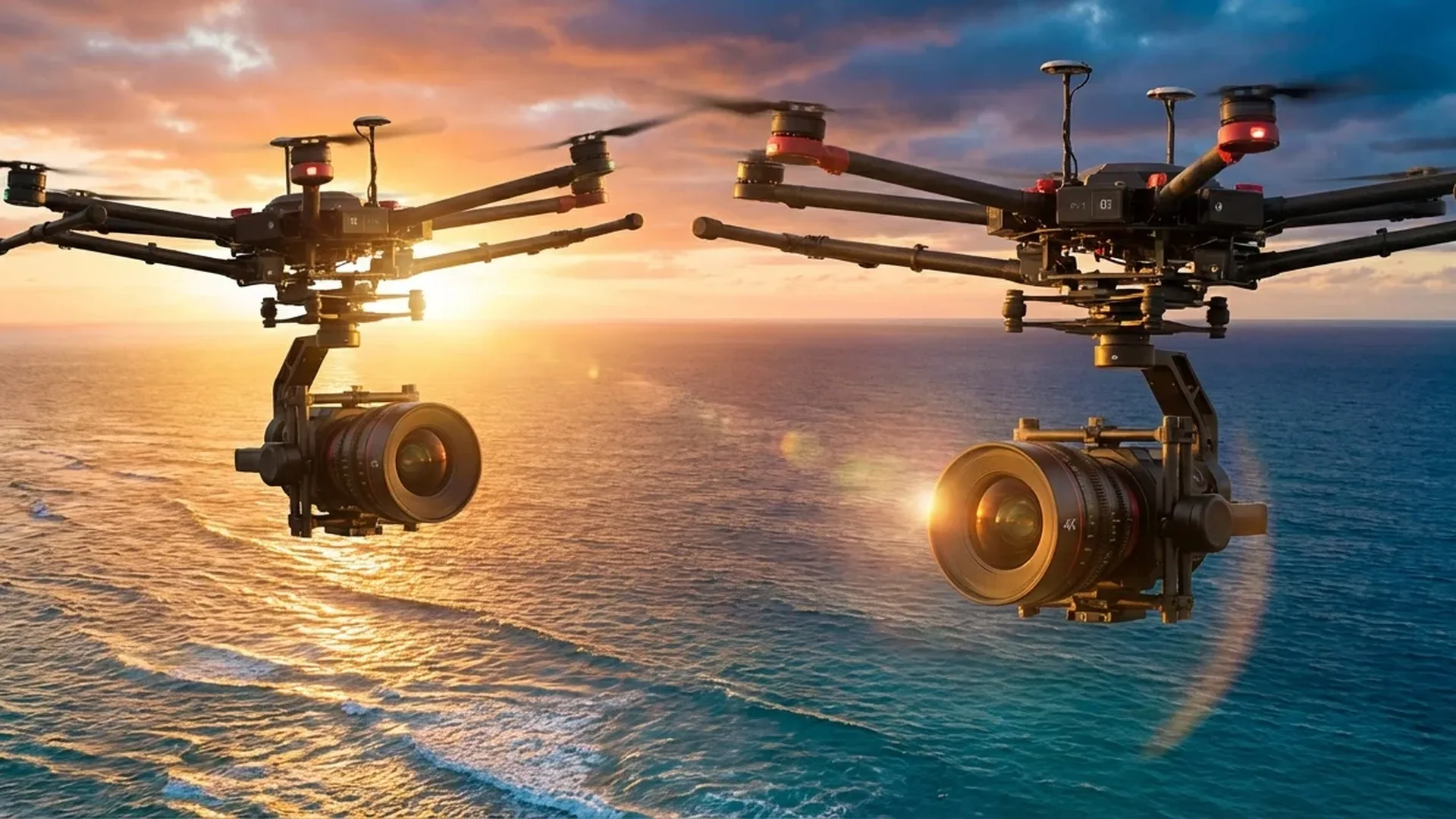
A drone's ability to shoot quality 4K video comes down to far more than resolution alone. Sensor size, bitrate, frame rate, gimbal stabilization, and color profiles all determine whether your footage looks like a cinematic production or a phone recording. In this head-to-head comparison, we line up the top drones of 2026 and break down which one truly delivers the best 4K.
Why “4K” Doesn't Always Mean the Same Quality
The “4K” label gets slapped on just about every drone these days — even models costing €30 (~$33). What genuinely separates them comes down to five critical factors: the sensor (how much light it gathers), bitrate (how much image data gets saved per second), fps (for slow-motion or smooth 60fps), stabilization (digital EIS vs. 3-axis mechanical gimbal), and color profiles (D-Log M, HLG, 10-bit). A drone with a 1-inch sensor and 130 Mbps bitrate produces a completely different result from one with a 1/2.3″ sensor at 40 Mbps — even though both technically say “4K” on the box.
The 6 Drones We're Comparing
We selected six models spanning every budget — from €245 (~$267) to €2,109 (~$2,293) — and examined their video capabilities exclusively. All prices reflect real retail pricing in Greece via Skroutz.gr (February 2026).
1. DJI Neo 2 — The Compact that Surprises
from €245 (~$267) — Drone OnlyThe DJI Neo 2 is a palm-sized drone weighing just 192 grams, yet it packs a 1/1.3-inch sensor — the same size found in the considerably more expensive Flip. For video, it records 4K/30fps with respectable detail and color, though without a mechanical 3-axis gimbal. Instead, it relies on EIS (Electronic Image Stabilization), which works remarkably well for its size. The difference becomes noticeable during fast maneuvers and in low light, where rolling shutter makes its presence felt.
With omnidirectional obstacle avoidance and O4 transmission reaching 13 km, it's an excellent pick for casual videographers who want something pocket-sized. The Motion Fly More Combo (€589 / ~$640) adds a motion controller for full hands-free operation without a smartphone.
2. DJI Flip — Cinematic at Sub-250g
from €378 (~$411) — StandardThis is where serious videography begins. The DJI Flip, with its 1/1.3-inch sensor and f/1.7 lens, records 4K up to 100fps — perfect for stunning slow-motion. The bitrate peaks at 150 Mbps (higher even than the Air 3S!) and supports D-Log M in 10-bit, giving you enormous latitude for color grading in post-production.
The 3-axis mechanical gimbal makes all the difference compared to the Neo 2: butter-smooth footage even in strong winds. The built-in prop guards make it safer for indoor flying, while the C0 classification means license-free flight across the entire EU. The weakness? Single camera with no telephoto, and obstacle avoidance is limited to front (3D Infrared) and downward only — no rear or side sensors.
Also available in RC2 Combo (€556 / ~$604) or Fly More Combo (€676 / ~$735) with three batteries.
3. DJI Mini 5 Pro — The Mini Evolution
from €752 (~$818)The DJI Mini 5 Pro extends the sub-250g formula with omnidirectional obstacle avoidance (front, rear, side, top, bottom) — something the Flip lacks entirely. This means you can use ActiveTrack in complex environments without worrying about collisions.
On the video front, 4K/60fps HDR delivers smooth cinematic footage with exceptional dynamic range. The 1/1.3-inch sensor matches the Flip in size, but DJI's latest-generation image processing algorithms provide even better noise management in low light. It supports D-Log M and HLG in 10-bit.
The premium price tag (€752 vs. €378 for the Flip) is mainly justified by the omnidirectional sensors and advanced tracking. If you don't need those features, the Flip delivers 90% of the video quality at half the cost.
4. DJI Air 3S — The Sweet Spot for Videographers
from €1,129 (~$1,099) — RC-N3If video is your primary focus, the DJI Air 3S offers unquestionably the best quality-to-price ratio on the market right now. The 1-inch sensor on the primary camera (24mm, f/1.8) delivers 14 stops of dynamic range — enough to retain detail in both shadows and highlights, even during challenging sunset conditions.
The dual-camera system is a game-changer: alongside the 24mm wide-angle, there's a 70mm telephoto (1/1.3″, 48MP, f/2.8) with perfectly matched colors and video specs. This means you can switch between close-up and panoramic framing mid-shot without cutting — something that requires two separate lenses in traditional filmmaking.
The 4K/120fps slow-motion capability is stunning for action sequences (waves, sports, traffic), while 10-bit D-Log M recording with H.265 encoding provides tremendous flexibility in color grading. The 45-minute flight time is the longest in any consumer drone — fewer battery swaps per shoot. And the front-facing LiDAR literally saves you at night: nightscape omnidirectional obstacle sensing.
The only downside? At 724 grams, it falls under C1 classification, meaning operator registration and certain flight restrictions in urban areas. Fly More Combo Lite with RC 2: €1,599 (~$1,738).
5. DJI Mavic 4 Pro — The Cinematic Powerhouse
from €2,109 (~$2,293) — StandardThe crown jewel of the consumer lineup. The DJI Mavic 4 Pro goes beyond 4K entirely with a Hasselblad camera recording 6K at 60fps HDR — a resolution that provides enormous headroom for cropping and reframing in the edit suite. Hasselblad's Natural Colour Solution (HNCS) delivers noticeably superior accuracy in skin tones and natural landscapes.
Rated 5.0/5 on Skroutz (5 reviews), it features a triple camera system for focal length versatility and ProRes video support. The Creator Combo (approximately €3,639 / ~$3,955) adds high-speed SSD storage. Clearly aimed at professionals or semi-pro creators who need competitive image quality without the weight penalty of an Inspire.
6. Potensic Atom 2 — The Budget Alternative
from €370 (~$402) — Standard KitIf you're looking for the sole worthwhile non-DJI alternative in today's market, the Potensic Atom 2 deserves a look. For €370 (~$402), you get a 1/1.3-inch sensor with a 3-axis gimbal — specs that mirror DJI Mini models costing two to three times more. The 4K/30fps HDR output is sufficient for cinematic landscape footage, though the lack of 60fps or slow-motion limits its versatility for fast-paced scenes.
Where does it fall short? Obstacle avoidance is basic (front and downward only), the transmission system doesn't match DJI's O4 in reliability, and the intelligent flight modes are more limited. But as a pure video tool for beginners, the specs-to-price ratio is outstanding.
Video Specs Comparison Table
| Model | Sensor | Max Video | Bitrate | Gimbal | D-Log | Price (EU) |
|---|---|---|---|---|---|---|
| DJI Neo 2 | 1/1.3″ | 4K/30fps | — | EIS | — | €245 (~$267) |
| Potensic Atom 2 | 1/1.3″ | 4K/30fps HDR | — | 3-axis | — | €370 (~$402) |
| DJI Flip | 1/1.3″ | 4K/100fps | 150 Mbps | 3-axis | ✅ 10-bit | €378 (~$411) |
| DJI Mini 5 Pro | 1/1.3″ | 4K/60fps HDR | ~150 Mbps | 3-axis | ✅ 10-bit | €752 (~$818) |
| DJI Air 3S | 1" + 1/1.3″ | 4K/120fps | 130 Mbps | 3-axis | ✅ 10-bit | €1,129 (~$1,099) |
| DJI Mavic 4 Pro | Hasselblad | 6K/60fps HDR | — | 3-axis | ✅ 10-bit | €2,109 (~$2,293) |
What Actually Makes the Difference in 4K Video
Sensor Size: The King of Low-Light
In a drone, a 1-inch sensor (Air 3S) gathers roughly 70% more light than a 1/1.3-inch sensor (Flip, Mini 5 Pro, Neo 2). This doesn't just mean better nighttime footage: it translates to less noise in shadows, smoother tonal gradients, and wider dynamic range. If you're shooting during golden hour or in challenging lighting conditions, the difference shows up in every single frame.
Bitrate: More Data Means More Detail
Bitrate determines how many megabits of information are recorded per second. The Flip's 150 Mbps means it can preserve finer texture in complex scenes (tree foliage, waves, stone surfaces) without compression artifacts. Similarly, the Air 3S's 130 Mbps in H.265 is equally efficient thanks to the more advanced codec. Budget drones typically record at 30-50 Mbps — and it shows.
Frame Rate: The Magic Number
24fps gives a cinematic look, 30fps provides smooth motion, 60fps delivers butter-smooth pans and tilts. Above 60fps, we enter slow-motion territory: the Flip's 100fps yields 4× slow-mo on a 25fps timeline, while the Air 3S's 120fps produces even slower motion — ideal for waves, birds in flight, or extreme sports. If you plan on using slow-motion regularly, this is a make-or-break criterion.
"The difference between a €250 (~$272) drone video and a €1,100 (~$1,196) one isn't the resolution — it's what you do afterward, in the edit. D-Log M in 10-bit gives you the power to 'rescue' shots that would be lost in standard color."
D-Log M & 10-bit: For Serious Color Grading
If you edit after shooting (and if you don't, you should!), D-Log M color profiles retain a flat image that stores maximum tonal information. Combined with 10-bit color depth (1 billion shades vs. 16.7 million in 8-bit), you avoid “banding” artifacts in sky gradients and sunsets. The DJI Flip, Mini 5 Pro, Air 3S, and Mavic 4 Pro all support D-Log M in 10-bit. The Neo 2 and Potensic Atom 2 don't — and it shows in post-production.
Which One Suits You?
Travel & Social Media
Go with the DJI Flip (€378 / ~$411). Lightweight, sub-250g, 4K/100fps, D-Log M, prop guards. Your videos will impress on Instagram and YouTube without breaking the bank. For even more portability, the DJI Neo 2 (€245 / ~$267) fits in your pocket.
Serious Filmmaking & Freelance
The DJI Air 3S (€1,129 / ~$1,099) is the ultimate value pick. Dual camera, 4K/120fps, 1-inch sensor, 45-minute flight time, LiDAR. Nothing in its class comes close. If you do paid shoots (real estate, events, tourism), it pays for itself in 2-3 jobs.
Maximum Quality, No Compromises
The DJI Mavic 4 Pro (€2,109 / ~$2,293) leaves no doubt. 6K Hasselblad, ProRes, museum-grade color accuracy. For corporate documentaries, tourism promotion, or cinematic projects demanding theater-quality results.
5 Tips for Better 4K Drone Video
- Always shoot in D-Log M when available: The flat image provides flexibility in editing. If you don't do post-production, use HLG for HDR color straight out of the box.
- ND filters are mandatory: Keep shutter speed at double your frame rate (1/50 for 25fps, 1/120 for 60fps) to achieve cinematic motion blur.
- Fly with wind at your back: Wind assists smooth movement instead of making the gimbal shake. Shoot facing the wind at half speed for steadier footage.
- Avoid digital zoom: Every 4K drone loses quality with digital zoom. Stick to optical only (Air 3S 70mm telephoto) or physically fly closer.
- Format to exFAT before every shoot: A clean card means zero risk of file corruption. Use a V30/UHS-I U3 card at minimum.
Note: Prices refer to the base package (Drone Only or Standard) unless otherwise stated. For Fly More Combo pricing, check each model's page on Skroutz. Prices as of February 2026 — subject to change.
The Final Verdict
If you asked me “which drone shoots the best 4K video?” with no budget constraints, the answer is the DJI Air 3S. The combination of a 1-inch sensor, dual camera, 4K/120fps, 14 stops of dynamic range, 45-minute battery life, and nighttime LiDAR navigation is unmatched at €1,129 (~$1,099).
But if you want what we'd call the “sweet spot” — the best video quality relative to price — then the DJI Flip at €378 (~$411) delivers genuinely impressive results: 4K/100fps, 150 Mbps, D-Log M, 3-axis gimbal, sub-250g. Two years ago, these specs would have cost three times as much.
The drone market for video has never been this strong across every price tier. Whatever you choose, make sure it matches how you actually shoot — because the best camera is the one you take with you.