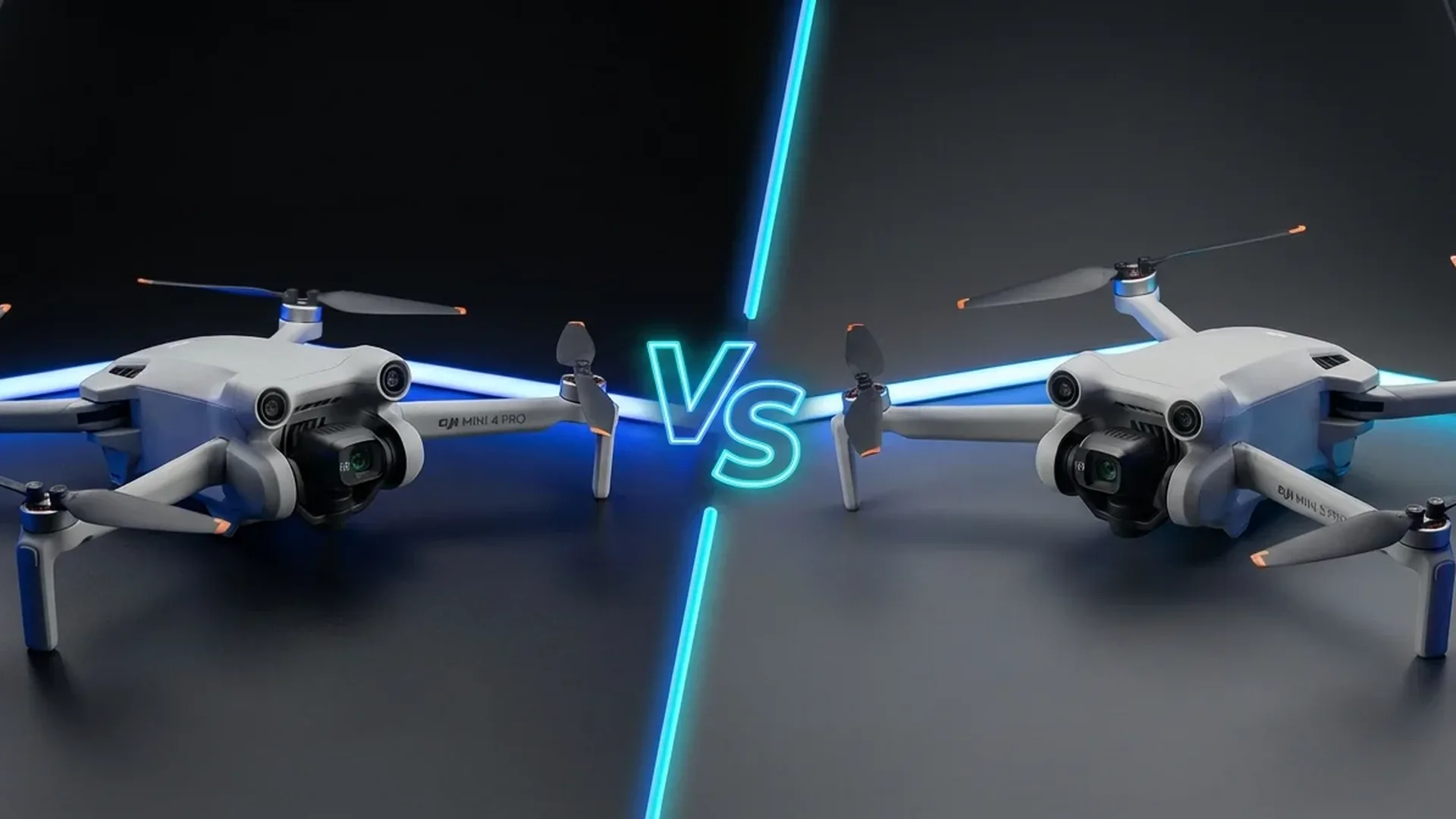
Quick Overview: The Numbers at a Glance
Before diving into details, let's see the key numbers side by side. This quick overview highlights the most significant differences between the two drones, giving you a first impression before we analyze each area separately.
| Feature | Mini 4 Pro | Mini 5 Pro |
|---|---|---|
| Camera Sensor | 1/1.3″ CMOS | 1″ CMOS |
| Photo Resolution | 48MP | 50MP |
| Aperture | f/1.7 | f/1.8 |
| Slow Motion | 4K/100fps | 4K/120fps |
| Gimbal | Max tilt 60° | 225° rotation |
| Obstacle Avoidance | Omnidirectional Optical | LiDAR + Optical 360° |
| Video Transmission | O4 | O4+ |
| Flight Time | 34 minutes | 36 minutes |
| Plus Battery | ~40 minutes | 52 minutes |
| Battery | 2,590 mAh | 2,788 mAh |
| Internal Storage | 2GB | 42GB |
| Weight | <249g | <250g |
| EU Category | C0 | C0 |
| Standard Price (Skroutz) | from €614 (~$670) | from €752 (~$820) |
The numbers clearly show Mini 5 Pro superiority in nearly every category. However, the real story lies in the details — and the ~€138 (~$150) price gap separating them. Let's analyze each area.
Camera & Image Quality
The biggest upgrade on the Mini 5 Pro is the camera sensor. From the Mini 4 Pro's 1/1.3″ sensor, DJI jumped to a 1″ CMOS — the same sensor size that was previously reserved for much larger, more expensive drones. A bigger sensor means more light, lower noise, and better dynamic range.
Photography
The Mini 4 Pro offers 48MP RAW photos, while the Mini 5 Pro reaches 50MP. The megapixel difference isn't dramatic, but the real gap shows in dynamic range — especially in high-contrast lighting scenes. The Mini 5 Pro's 1″ sensor delivers 12.8 stops of dynamic range, resulting in more detail in both shadows and highlights.
It's worth noting that the Mini 4 Pro has a slightly wider aperture (f/1.7 vs f/1.8), but this doesn't compensate for the sensor size difference. In practice, the Mini 5 Pro performs noticeably better in low-light conditions.
— magla, Skroutz (5★, 15/10/2025)
Video
Both drones record in 4K/60fps HDR, but the Mini 5 Pro adds 4K/120fps slow-motion — a significant upgrade if you're into creative shots. The Mini 4 Pro maxes out at 4K/100fps, which is respectable, but the difference is mainly in HDR: the Mini 5 Pro produces more “vivid” colors thanks to the larger sensor and 150Mbps bitrate.
Both models support 10-bit D-Log M and HLG color modes, giving you great flexibility in color grading. However, the Mini 5 Pro's 1″ sensor means the raw footage carries more shadow detail — ideal for post-production work.
Gimbal: The Major Upgrade
One of the most significant differences: the Mini 4 Pro has a gimbal with maximum 60° tilt, while the Mini 5 Pro offers 225° rotation. This means far more creative possibilities — tilt shots, vertical panoramas, and angles that were impossible with the older model. True Vertical Shooting exists on both, but the Mini 5 Pro's 225° rotation delivers an entirely different level of freedom.
Obstacle Avoidance & Safety
This is perhaps the area with the biggest practical difference in everyday use.
The Mini 4 Pro features omnidirectional optical sensors — four wide-angle sensors and a downward-facing pair. It works reasonably well during the day, but at night reliability drops dramatically. As one Skroutz user notes: “Be very careful at night because the sensors don't work in the dark.”
The Mini 5 Pro introduces a front-facing LiDAR sensor combined with 360° optical sensors. This is a game changer: obstacle avoidance works reliably even in complete darkness, something that was a major weakness for mini drones until now. If you fly near trees, buildings, or in urban areas, this upgrade is massive.
— _George_L_, Skroutz (5★, 17/02/2026)
Additionally, the Mini 5 Pro has an improved ActiveTrack 360° that automatically recognizes sport scenes (cycling, etc.) and automatically selects the appropriate tracking mode. On the Mini 4 Pro, ActiveTrack 360° exists but without this AI scene detection.
Flight & Battery Life
Flight time is always a critical factor with any drone. Here are the numbers:
The 2-minute difference on standard batteries doesn't dramatically change things. But with the Plus Battery, the gap becomes enormous: 52 minutes vs ~40 minutes — that's 12 extra minutes of flight time, a massive advantage for extended shooting sessions.
In practice, of course, real flight times are always lower. Mini 4 Pro users report 25-28 minutes of actual flight, while Mini 5 Pro users report 20-30 minutes depending on conditions. Wind, temperature, and usage patterns play a huge role.
Video Transmission
The Mini 4 Pro uses DJI O4, while the Mini 5 Pro upgrades to O4+. Both claim 20km range (in FCC mode), but in practice within Europe (CE mode) the range is much shorter. Mini 4 Pro users report stable signal up to 1.5-3.5km in urban areas, while in open locations it can reach 5km. The Mini 5 Pro's O4+ offers more stable connectivity and smoother real-time video feed.
Wind Resistance
The Mini 4 Pro handles up to 10.7 m/s wind. Both drones, due to their sub-250g weight, aren't ideal for strong winds. Mini 5 Pro users note: "Don't expect miracles in strong wind — it's all plastic to keep the weight under 250g." If flying in strong wind is a requirement, consider the DJI Air 3S or Mavic 4 Pro instead.
Storage & Other Features
Internal Storage: The Hidden Upgrade
This is an upgrade many people underestimate. The Mini 4 Pro has only 2GB of internal storage — essentially enough for just a few minutes of video or photos. If you forget your microSD card, you'll barely capture anything meaningful.
The Mini 5 Pro, on the other hand, has 42GB of internal storage. This means you can fly and record without an SD card — enough for many dozens of minutes of 4K video. A genuine safety net for every pilot.
Controller
The Mini 4 Pro comes with the DJI RC-N2, while the Mini 5 Pro includes the DJI RC-N3 (in the Standard Kit). The Mini 5 Pro's Fly More Combo offers the DJI RC 2 with a built-in 5.5″ FHD screen. Both standard controllers require a smartphone, but the RC-N3 offers ergonomic improvements.
Weight & EU Classification
Both drones fall under the EU's C0 category, meaning fewer flight restrictions. The Mini 4 Pro weighs under 249g, while the Mini 5 Pro marginally exceeds 250g — but EU regulations allow a small gram tolerance, so it remains in the C0 category.
Pricing in Europe (Skroutz, February 2026)
Let's look at real prices available in the European market via Skroutz (Greece):
| Edition | Mini 4 Pro | Mini 5 Pro |
|---|---|---|
| Standard | from €614 (~$670) | from €752 (~$820) |
| Fly More Combo (RC 2) | — | from €1,150 (~$1,255) |
| Skroutz Rating | 4.9/5 (88 reviews) | 5.0/5 (27 reviews) |
| Used (Skoop) | from €550 (~$600) | — |
The price difference between Standard editions is approximately €138 (~$150) — an amount many would say is worth it given the upgrades. However, if you're looking for value, the Mini 4 Pro in used condition on Skoop starts from €550 (~$600) — an excellent deal.
The Mini 5 Pro Fly More Combo (with RC 2, 3 batteries, ND filters, bag, charging hub) costs from €1,150 (~$1,255) on Skroutz — a significant investment, but the most complete package if you want to fly without battery limitations.
What Users Say on Skroutz
Mini 4 Pro Reviews (4.9/5 — 88 reviews)
— tselios9162 (5★, 25/12/2024)
— George Bozouris (4★, 25/02/2025)
— Skroutz User (5★)
Mini 5 Pro Reviews (5.0/5 — 27 reviews)
— FoBo (5★, 30/09/2025)
— yannis.pap (4★, 22/09/2025)
— Mitch_Dask (5★, 31/12/2025)
Who Should Buy Which
Get the Mini 4 Pro if:
- You want excellent image quality at a lower price
- You're a beginner looking for a reliable first drone
- You don't fly often in dark conditions
- You're looking for value (especially used from €550 / ~$600)
- You don't need 4K/120fps slow-motion
- Internal storage doesn't matter (you always use SD)
Get the Mini 5 Pro if:
- You want the best image quality in a mini drone
- You fly in urban areas or at night (LiDAR)
- You need 4K/120fps slow-motion
- You want maximum battery life (52 min with Plus)
- 42GB internal storage gives you peace of mind
- You create social media content (225° gimbal)
Is the Upgrade Worth It?
If you already own a Mini 4 Pro, the answer depends on how you use your drone:
Yes, it's worth it if: you frequently fly in low-light conditions or at night (LiDAR is a massive game changer), you need 4K/120fps slow-motion, or you're tired of the 2GB internal storage. The upgrade to the 1″ sensor delivers visible improvement in night photography.
Probably not worth it if: you mainly fly during the day, don't use slow-motion, and are satisfied with the Mini 4 Pro's image quality (which is indeed excellent). The 2-minute flight time difference alone doesn't justify buying a new drone.
If you're starting fresh: with only ~€138 (~$150) separating the Standard editions, the Mini 5 Pro is the smarter choice. You get a bigger sensor, LiDAR, more battery, 42GB storage, and 4K/120fps — upgrades you'll appreciate throughout the drone's entire lifespan.
Final Verdict
The DJI Mini 5 Pro is clearly superior in nearly every category. However, the Mini 4 Pro remains an excellent drone — especially now that its price has dropped. If you find a Mini 4 Pro at a good price (new or used), you won't be disappointed. But if you're buying new, the extra €138 (~$150) for the Mini 5 Pro Standard is the most logical investment.
Frequently Asked Questions (FAQ)
Which drone is better for beginners?
Both are excellent for beginners, with automation features that forgive mistakes. The Mini 5 Pro offers greater safety thanks to LiDAR, but the Mini 4 Pro is a more affordable entry into drones.
Do I need a special license for these drones in Europe?
Both fall under the C0 category (<250g). No registration or license is required, only basic remote pilot training. Make sure you follow your local civil aviation authority's regulations.
Which Fly More Combo offers better value?
The Mini 5 Pro Fly More Combo (from €1,150 / ~$1,255 on Skroutz) includes 3 batteries, ND filters (ND8/32/128), charging hub, shoulder bag, and RC 2 with screen. If you plan to fly regularly, it's much more cost-effective long-term than buying extra batteries separately.
How much real flight time do I get?
Real flight times are lower than advertised. Mini 4 Pro: 25-28 minutes of practical use. Mini 5 Pro: 20-30 minutes depending on conditions. Temperature, wind, and whether you're recording video all have significant impact.
Can I fly above 120 meters?
European regulations limit flight altitude to 120 meters for C0 category drones. Both drones respect this limit through geofencing. This is not a DJI restriction but a European directive.