📖 Read more: Drone for Video: Which Shoots the Best 4K?
📅 Release History
The first rumors about the Mavic 4 Pro surfaced in December 2024. Leakers like OsitaLV and Jasper Ellens published leaked specs and product photos from internal store listings, revealing a drone far more ambitious than its predecessor, the Mavic 3 Pro. Igor Bogdanov shared the first leaked product photos in April 2025, confirming the triple camera system and the rotating gimbal.
In May 2025, DJI posted a teaser video featuring a “spinning triple-camera system” with a presentation date of May 13, 2025 at 12:00 GMT. The unveiling was impressive — but the biggest news wasn't the features, it was something else entirely: DJI announced it would not sell the Mavic 4 Pro in the United States.
According to DroneDJ (May 2025), the decision was due to trade tariffs and US-China tensions during the Trump administration. DJI stated it would not provide warranty or support for units purchased outside the US. Some Americans managed to buy units from DJI's physical stores in New York and through Adorama, but the situation remained unclear.
In Europe, the launch came immediately — on May 13, 2025 — with EASA C2 certification, which allows flight near people under the A2 (Open) category. In Greece, the Mavic 4 Pro was readily available through authorized retailers and platforms like Skroutz.
📸 Triple Hasselblad Camera System
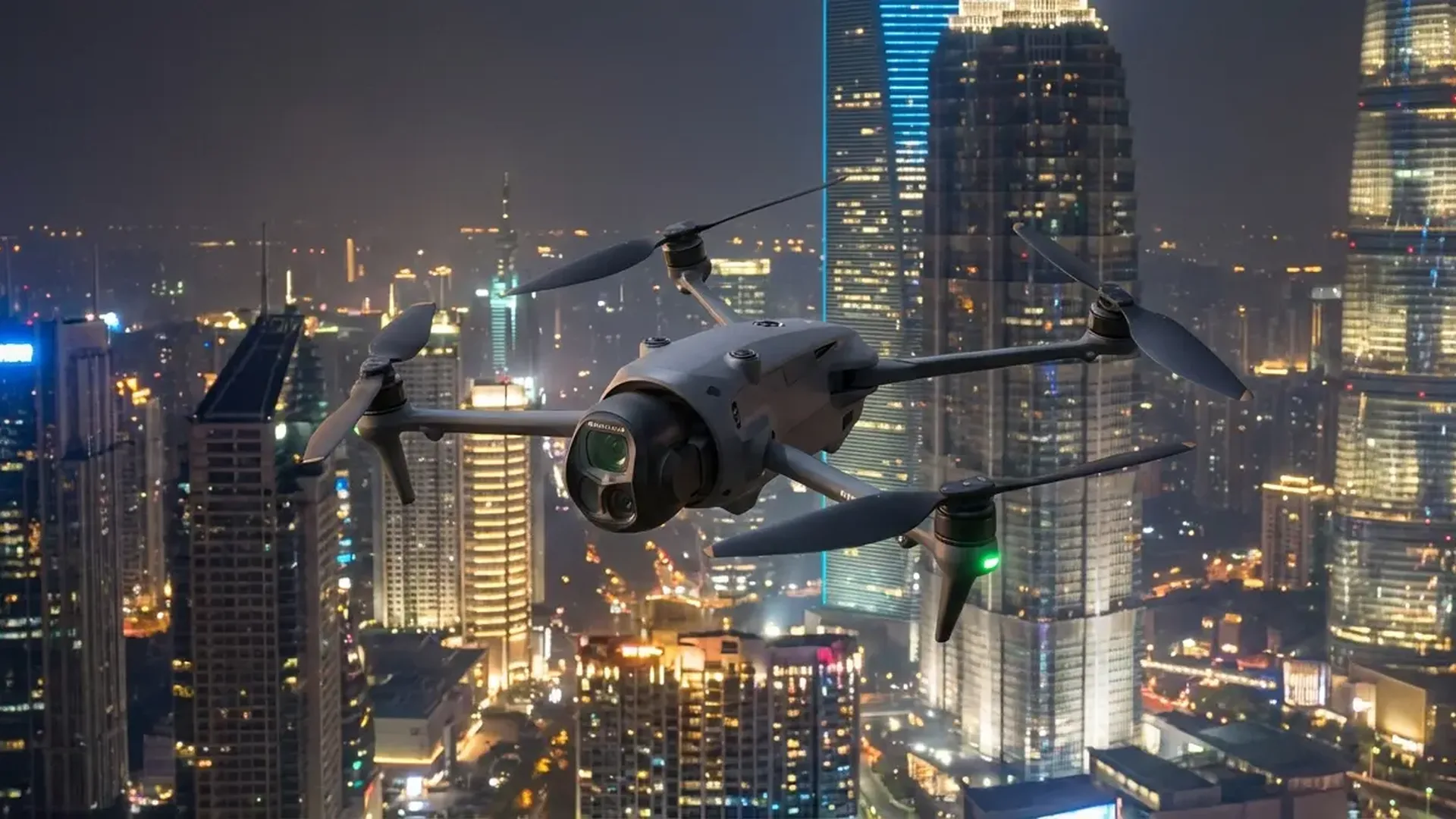
The heart of the Mavic 4 Pro is its triple lens system — the evolution of what the Mavic 3 Pro introduced, but taken to an entirely different level.
Main Camera: 4/3 CMOS Hasselblad, 100MP
The main camera uses a “next-generation” Micro Four Thirds CMOS sensor (according to Jasper Ellens' leaked specs on DroneDJ), capable of shooting 100-megapixel photos. In video, it records 6K at 60fps in HDR or 4K at 120fps. The variable aperture ranges from f/2.0 to f/11, providing full depth-of-field control. Perhaps the most impressive detail: 16 stops of dynamic range — cinema-grade output from a foldable drone.
Medium Telephoto: 70mm, 1/1.3″ CMOS, 48MP
The second lens at 70mm equivalent (1/1.3-inch CMOS, 48MP) shoots 4K HDR at 60fps or 4K at 120fps. It's the ideal lens for landscape portraits, architectural details, and mid-range shots without sacrificing resolution.
Telephoto: 168mm, 1/1.5″ CMOS, 50MP
The third lens — the longest reach — hits 168mm equivalent with a 1/1.5-inch sensor at 50MP. It shoots 4K HDR at 60fps or 4K at 100fps. According to DroneDJ, “this isn't just a zoom gimmick — it's a serious secondary camera” with its wide f/2.8 aperture and large sensor. The 168mm focal length was a topic of debate before launch — some leakers expected ~145mm — but DJI kept the longer range.
Worth noting: there is no Mavic 4 Cine — according to OsitaLV, DJI has no plans for a Cinema-specific variant. Also, Apple ProRes is not supported. Instead, the drone uses a codec similar to Sony XAVC-I High Profile 4:2:2 — good enough for professional workflows, but still debated among colorists.
🎛️ Infinity Gimbal: The Breakthrough Innovation
The most impressive feature — the one that sets the Mavic 4 Pro apart from every other consumer drone — is the Infinity Gimbal. This is a gimbal that rotates a full 360° (payload rotation), enabling shots at every angle: top-down, bottom-up, Dutch tilt, angular shots that were previously impossible on consumer models.
DJI states it supports 70° upward shooting — something unheard of in a drone. On the Mavic 3 Pro, stabilization was excellent but without this kind of freedom of movement. The 360° gimbal opens new doors for real estate photography, documentary work, urban exploration, and cinematic content production.
🔋 Flight, Battery & Performance
With a 6,654mAh battery, the maximum flight time reaches 51 minutes — the longest of any DJI consumer drone. For comparison, the Mavic 3 Pro offered 43 minutes. In practice, under real-world conditions (wind, 4K recording, active obstacle avoidance), expect 35-43 minutes — more than enough for extended shoots without anxiety.
Charging time is 90 minutes with the DJI 100W USB-C Power Adapter. With the Fly More Combo, which includes 3 batteries, a Parallel Charging Hub, carrying bag, and spare propellers, total air time exceeds 100 minutes — roughly 1 hour 45 minutes in practice.
As for speed, the Mavic 4 Pro tops out at 25 m/s in Sport mode (18 m/s in Normal) and handles winds up to 12 m/s. A notable spec: the maximum takeoff altitude is 6,000 meters — a figure DJI leveraged spectacularly in July 2025 when a Mavic 4 Pro filmed the entire Everest climbing route in one uninterrupted take, from 6,500m to 8,800m near the summit.
🛡️ Flight Safety: LiDAR & Night Vision
One of the biggest upgrades over the predecessor is obstacle avoidance. The Mavic 4 Pro integrates a forward-facing LiDAR sensor alongside 8 wide-angle fisheye sensors positioned omnidirectionally (top, bottom, left, right, rear). The major innovation is called “0.1 Lux Nightscape” — night vision that allows the drone to detect obstacles even in near-total darkness, with only street or city lighting.
In practice, this means you can fly night shots over dams, archaeological sites, or beaches without fearing a collision with trees or buildings. According to Skroutz user reviews, “the fisheye sensors and dual processors ensure obstacle avoidance at speed.”
Additionally, Return to Home (RTH) now functions without satellite signal. In good lighting conditions, the drone memorizes its flight path and can return to base even if it loses GPS — a feature DJI calls “Satellite-free Smart Return to Home.”
📡 DJI O4+ Transmission
The new O4+ transmission generation replaces the O3+ from the Mavic 3 Pro and practically doubles the usable range. Transmission range hits 30km (FCC) or 15km (CE/Europe) with a live 10-bit HDR video feed. The live feed quality is impressive — users report sharper imagery, less interference, and a more stable signal compared to any previous DJI consumer drone.
It's worth noting that DJI had planned a cellular dongle for the Mavic 4 Pro (according to DroneDJ, August 2025), though it wouldn't have been available in the US. In Europe, the cellular function can be utilized as an alternative transmission channel, particularly in urban environments.
🎮 Controllers & Bundles
The Mavic 4 Pro is available in three editions in Europe:
- Standard — €2,109 (~$2,200): Drone + DJI RC 2 (built-in screen, foldable) + 1 battery + spare propellers + storage cover + USB-C cables
- Fly More Combo — €2,767 (~$2,890): Everything in Standard + 2 extra batteries (3 total) + 3 extra propeller pairs + Parallel Charging Hub + Shoulder Bag + 100W Power Adapter
- Creator Combo: DJI Mavic 4 Pro 512GB + DJI RC Pro 2 (7″ foldable screen, premium controller) + 240W Power Adapter + High-Speed Data Cable + 3 batteries + Shoulder Bag
The RC Pro 2 is noteworthy: it features a 7-inch foldable high-brightness screen — almost a tablet — that folds behind the controls. According to DroneDJ, the design recalls the old Phantom 4 Pro controllers — but in premium materials. Worth noting that the RC Pro 2 now supports the DJI Air 3, Air 3S, and Mini 4 Pro (firmware update May 2025), so the investment carries across multiple drones.
🌍 What Users Are Saying — Skroutz, February 2026
As of February 20, 2026, the Mavic 4 Pro holds a 5.0/5 rating from 5 verified reviews on Skroutz — all five perfect scores. The ratings for “Handling,” “Flight Stability,” “Range,” “Battery Life,” and “Build Quality” are all 5/5. The only category where some users mark slightly lower — still at 5 — is “Value for Money.” Nobody denies it's expensive; but nobody says it's not worth it.
Worth noting: used Mavic 4 Pro units are already appearing on Skoop (Skroutz's second-hand platform) from €1,900 (~$1,980) — a sign that demand is high even in the secondary market.
⚔️ Mavic 4 Pro vs Mavic 3 Pro: What Changed?
Comparing against the predecessor helps understand the scale of the upgrade. Main camera: from 20MP to 100MP, from 5.1K to 6K/60fps. Dynamic range: from 12.8 stops (estimated) to 16 stops. Telephoto: from 1/1.3″ without notable resolution to 1/1.5″ at 50MP with f/2.8. Gimbal: from fixed 3-axis to 360° Infinity Gimbal. Transmission: from O3+ (15km) to O4+ (30km). Flight time: from 43 to 51 minutes. Obstacle avoidance: added LiDAR + 0.1 Lux night vision.
The only “loss” — if you can call it that — is the absence of Apple ProRes. If you work in a ProRes workflow, the Mavic 3 Cine or Inspire 3 remain the only options.
🇪🇺 Availability in Europe
In Greece, the Mavic 4 Pro is fully available from 15 authorized retailers via Skroutz, starting at €2,109 (~$2,200) for the Standard edition. It carries EASA C2 certification, meaning it can be used in the A2 (Open) category — flight near people, provided the pilot holds the relevant certification.
A clarification worth making: despite the "C2″ label, the drone weighs 1,063 grams, meaning it doesn't fall into the A1 (Open) category. You need pilot certification, but that requirement applies anyway for a drone of this size class.
Note for US buyers: as of February 2026, DJI has not reversed its decision to withhold the Mavic 4 Pro from the US market. The drone is not officially sold, warranted, or supported in the United States due to trade restrictions. Some units have been obtained through third-party channels, but DJI explicitly states no US warranty coverage.
💡 Firmware Updates: Post-Launch Evolution
DJI doesn't leave its drones stagnant. Since May 2025, the Mavic 4 Pro has received at least 3 significant firmware updates: one at launch (May 2025), one in late September 2025 that “made the drone even more attractive for creators” according to DroneDJ, and another in January 2026 that improved “smoother flight control” — enhancements to gimbal stabilization, smoother controller response, and battery optimization.
This policy of ongoing support significantly increases the purchase value — you're not just buying hardware, but continuous software improvements.
🏆 Verdict: Who Is It For?
The DJI Mavic 4 Pro is not a beginner's drone — neither in price (€2,109 / ~$2,200 Standard) nor in size (1,063g, C2). It's aimed at serious content creators, small production teams, solo cinematographers, real estate photographers, and travel content creators who want something capable of broadcast-quality output.
If you own a Mavic 3 Pro: the upgrade is worth it only if you need the 100MP sensor, the 360° gimbal, or the LiDAR. If you don't need any of those, the Mavic 3 Pro remains excellent.
If you don't own a drone in this category: if you're entering the world of professional aerial content, this is now the reference point. At this moment, no competing drone offers this combination of camera quality, gimbal flexibility, flight safety, and endurance — in a foldable format.
📌 Quick Numbers: 100MP Hasselblad | 6K/60fps HDR | 3 cameras (24mm + 70mm + 168mm) | 51 min flight | 30km O4+ transmission | LiDAR + 0.1 Lux Nightscape | 1,063g | C2 EU | €2,109 (~$2,200) Standard | €2,767 (~$2,890) FMC | 5.0/5 Skroutz (5 reviews)