🎯 The DJI Flip Price Drop That Changes Everything
From €389 to €278 in two weeks — this isn't just a "sale," it's DJI admitting they misjudged the initial pricing. The controller-free Flip bundle, now circulating in Europe for roughly €278, puts the Chinese drone in a position nobody expected: below the Neo's launch price when that hit the market.
How did we get here? The Flip has no controller in the base version. It flies exclusively from your phone via the DJI Fly app and the experience becomes so different you feel like you're using a "smart gadget" instead of drone equipment.
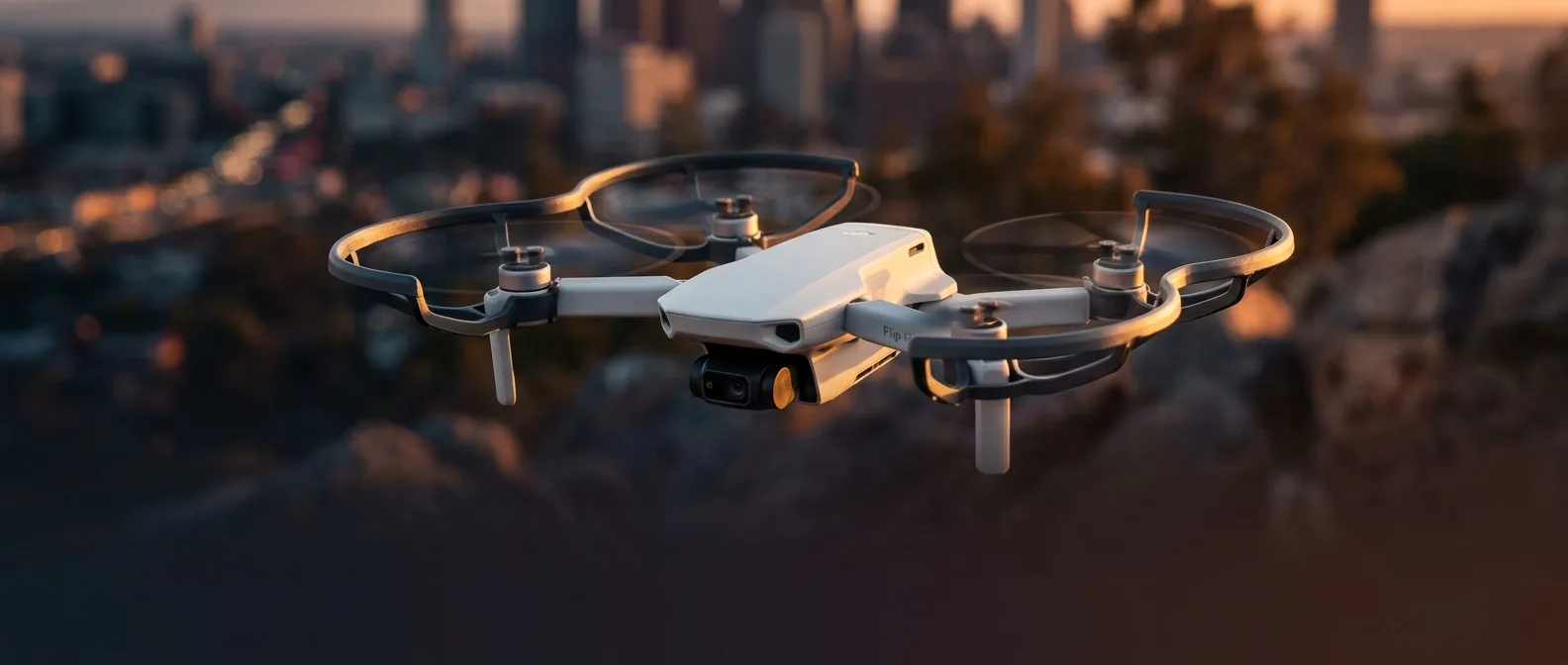
First impressions deceive. It doesn't look like a drone when you unbox it. The propeller guards — a first for a foldable DJI model — make it resemble a professional action camera more than a flying machine. That's no accident.
The simplicity is striking. Unfold the wings, it powers on automatically. Press a button on the side, it takes off from your palm. Your phone becomes the viewfinder, tap to shoot, swipe to select modes. Done.
🔬 DJI Flip Technical Specs That Actually Matter
Beneath the friendly design lies hardware that rivals the Mini 4K. A 1/1.3-inch sensor, f/1.7 lens and 48MP photo capability. Video reaches 4K/60fps HDR and supports 10-bit D-Log M for post-production.
The 3D infrared sensing system works even at night. It stops automatically when it detects obstacles within one meter — though if you're flying faster than 3 m/s, physics beats technology and it might still crash.
What's Missing from the Picture
No FPV headset support. If you want first-person flight, you need something else. The protected propellers generate more noise than other DJI models. And when using only the app, you're limited to 30m altitude and 50m distance — for obvious safety reasons.
⚡ Why the DJI Flip Price Dropped So Dramatically
Truth? €389 was overpricing. DJI was testing how much the market would pay for a "new" concept. It didn't pay enough.
"This sales pace doesn't reflect the demand we expected for this product category"
Unofficial DJI executive comment
Meanwhile, availability of other drones in this price range has increased significantly in 2026. The Mini 4K often drops below €400, the Neo sits at €209, and the Autel Nano+ offers similar features at €320.
The reduction to €278 is a tactical move. It puts the Flip in a pricing bracket that doesn't just compete with other drones, but with action cameras, smartphone gimbals, even compact cameras. This completely changes the target audience.
The New Pricing Matrix
Controller-Free Bundle
€278 (from €389) — Smartphone control only, two batteries
RC-N3 Bundle
€349 (from €439) — Traditional controller with phone mount
RC 2 Bundle
€509 (from €639) — Controller with built-in screen
At €278, the Flip is no longer a "drone purchase" — it's an impulse buy for anyone seeking better shots for social media or family trips.
📊 Who's Buying at the New DJI Flip Price
Analytics from European retailers show a shift in buyer profile. Before the price drop, 70% of buyers were men aged 25-45 with previous drone experience. Now, 45% are women aged 20-35 buying for travel content or family documentation.
This happens because the price crossed a psychological threshold. Below €300, the Flip gets treated as a "tech accessory" instead of "specialized equipment". The difference in marketing psychology is massive.
The timing is perfect too. Summer 2026 is coming and many are looking for ways to upgrade their travel content. A drone that takes off from your hand, needs no setup and costs as much as a good smartphone gimbal? Easy choice.
Social Media Factor
The Flip's automated modes — Dronie, Rocket, Helix, Boomerang — are designed specifically for short-form content. In an era where TikTok and Instagram Reels make aerial shots mainstream, the Flip becomes a content creation tool instead of a hobby drone.
And the DollyZoom effect? Looks professional on social media. In reality it's an automated mode that runs with one tap. But who's going to know?
🧬 What This Means for the Drone Market
DJI's move creates a domino effect. Other companies are forced to reconsider their pricing. The Autel Nano+ that sold for €350 now appears at €290. The Skydio 2+ that was €450 dropped to €380.
But the change isn't just in prices. It's in how we perceive drones. They're transitioning from "enthusiast gadgets" to "mainstream accessories".
This has regulatory implications too. More beginners in the sky means more incidents. The European Union is already examining stricter procedures for sub-250g drones — even if they don't require registration.
On the flip side, increased volume allows DJI to reduce production costs and bring new innovations faster. Win-win, but at the cost of the exclusivity the hobby had until recently.
Competition from Other Categories
At €278, the Flip competes with the DJI Osmo Mobile 8 (€139), iPhone 15 Pro with tripod (€1000+ total), even action cameras like the GoPro Hero12 (€400+). The comparison becomes less "drone vs drone" and more "content creation solution vs alternatives".
This is a major shift. Before, you bought a drone because you wanted to fly. Now, you buy the Flip because you want better shots — and it happens to fly.
🎯 Frequently Asked Questions
Is the upgrade from Neo to Flip worth it?
If you already have the Neo, the upgrade at the new price starts making sense. You gain a larger sensor, better video quality and more flight time. But you lose the Neo's extreme portability. Depends on how you use your drone.
Do I need a controller or is smartphone enough?
For occasional use and social media content, the smartphone suffices. If you plan frequent use or long distances, get a bundle with controller. The experience difference is significant.
Is it legal to fly everywhere in Greece?
Under 250g, no registration needed. But all other restrictions apply — no near airports, no over people, no above 120m. Learn the rules before you fly.
At €278, the DJI Flip is no longer the "innovation that costs." It's the choice you make when you want to go one step beyond your phone, without diving into rabbit holes with controllers, licenses and manual setups. If 2025 was the year drones went mainstream, 2026 is the year they became impulse purchases. And that changes everything.