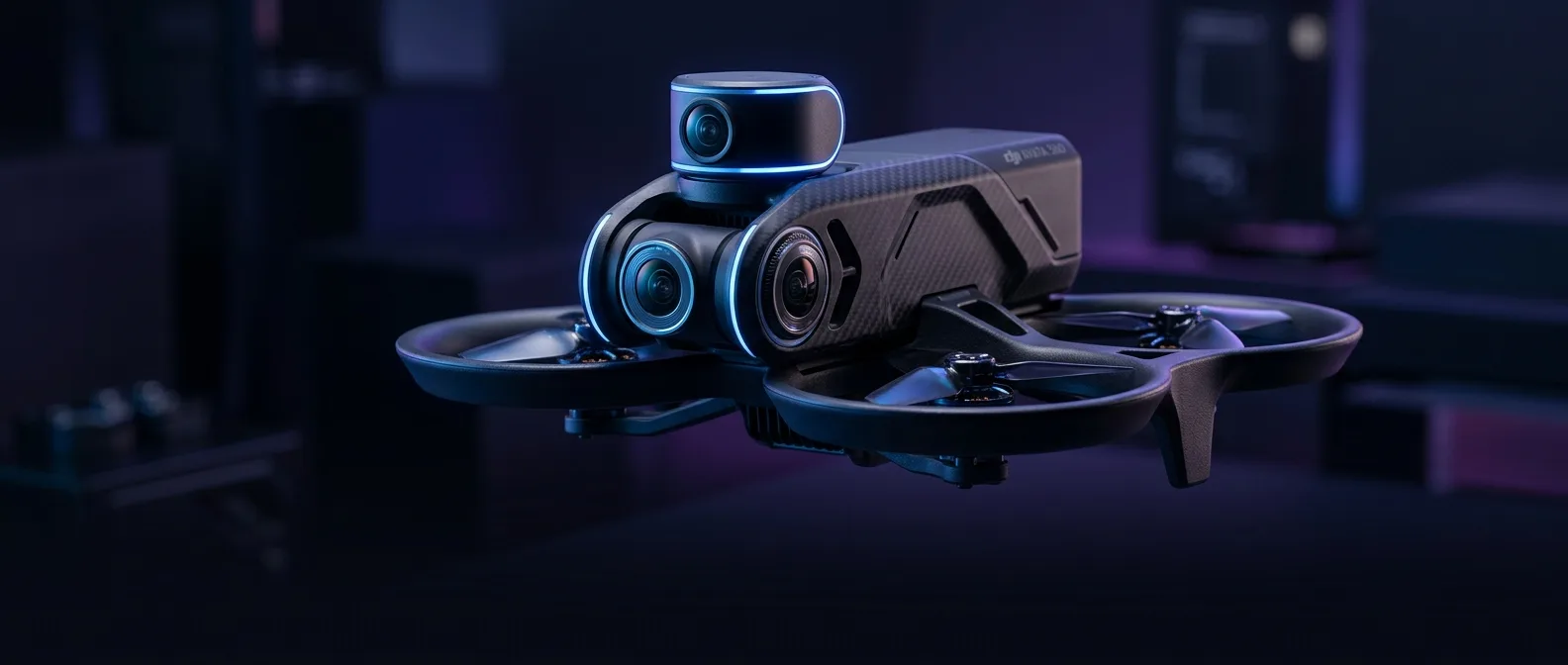
Day one. That's when DJI dropped firmware v01.00.0100 for the Avata 360, and it's not your typical bug-fix update. We're talking FPV Remote Controller 3 support, 18 m/s speeds in Sport mode, and head tracking that actually responds like your brain expects it to.
This isn't maintenance code. DJI held back features for launch day, and now we know why. The Avata 360 just became a different machine — one that combines motion-controlled flying with the precision stick control that FPV pilots need.
Timing matters in the drone wars. Every manufacturer is chasing the perfect FPV experience, and DJI just moved the goalposts with software alone. No new hardware required.
⚡ Controller Support and Speed Unleashed
The biggest change? Full DJI FPV Remote Controller 3 compatibility. Motion controls are impressive for newcomers, but when you need surgical precision — threading between trees at speed or nailing that perfect indoor shot — physical sticks win every time.
The speed bump to 18 meters per second in Sport mode isn't arbitrary. Action shots need velocity, and every extra m/s can mean the difference between keeping up with your subject and watching them disappear into the distance. Mountain bikers hit 25+ m/s on descents. Skiers go faster. Now the Avata 360 can actually follow.
Controllers for Every Flying Style
Controller 3 support opens doors for pilots who live and breathe stick control. Motion flying works well until you need to thread between obstacles or execute precise maneuvers. That's when muscle memory and tactile feedback become non-negotiable.
The ecosystem compatibility runs deep: DJI RC 2, DJI Goggles 3, and the updated DJI Fly app all sync seamlessly. This level of integration creates risk if one component fails, but when it works, all devices respond as a single system.
🧠 Smart Features and 360° Tracking Evolution
FocusTrack gets specialized detection for cycling and skiing. These sports challenge tracking algorithms with rapid direction changes and unpredictable movement patterns. Rapid direction changes, unpredictable terrain, and high speeds create the perfect storm for losing your subject.
"When you're bombing downhill at 50+ km/h, the drone needs to predict your next move, not just react to where you've been"
— Based on technical specifications
Head Tracking with Reduced Lag
The 360° head tracking gets a latency reduction and roll angle control. Sounds technical, but in practice it means your head movements translate to camera movements without that nauseating delay that breaks immersion. Roll control lets you tilt your head and have the drone respond naturally — like you're actually flying instead of watching a screen.
This matters more than you'd think. VR veterans know that even milliseconds of lag can trigger motion sickness. When you're wearing goggles and moving your head to control a camera hundreds of feet away, your brain needs that response to feel immediate and natural.
📹 Video Options and Creative Control
The 2.7K video options across multiple frame rates (24fps to 60fps) in Single Lens mode give creators more flexibility. Sometimes 2.7K with rock-solid stabilization beats shaky 4K footage. The math is simple: usable footage trumps maximum resolution every time.
New Recording Capabilities
- 2.7K Multi-Rate: 24fps to 60fps in Single Lens mode
- Panorama Stitching: Enhanced accuracy for 360° rendering
- 8K/30+ Playback: Reduced latency in Free View mode
- Dynamic UI: Tilt angle display follows flight direction
Panorama Stitching Gets Smarter
Panorama Stitching Calibration was overdue for a drone with "360" in its name. Seamless 360-degree images require precision processing, and every improvement in the stitching algorithm means less time fixing seams in post-production.
Expect fewer artifacts where the lenses meet and more uniform exposure across the entire image. Don't expect miracles — physics still applies — but the improvement is visible to anyone who's wrestled with 360° footage before.
🎮 UI Improvements That Actually Matter
The most important changes aren't always the flashy headline features. The tilt angle display in FocusTrack Spotlight Free mode now follows flight direction dynamically. Sounds minor until you're flying fast through complex terrain and need every bit of orientation help you can get.
For FPV pilots navigating tight spaces or high-speed environments, losing track of your orientation can mean the difference between a great shot and a crashed drone. Every visual cue helps when you're processing multiple inputs at once.
Performance Boost
8K/30+ playback with reduced latency in goggles
Better Tracking
Auto-detection for cycling and skiing subjects
Enhanced Control
Roll angle control in 360° head tracking
Reduced Latency for High-Res Viewing
The latency reduction for 8K/30+ playback in Free View mode tackles one of FPV's biggest problems. High-resolution viewing traditionally meant lag, which killed immersion and made the footage feel disconnected from the flight experience.
Watching 8K 360° footage through goggles with minimal lag changes how you experience captured content. It's no longer post-flight review — it's near-real-time immersion in what the drone recorded.
🔄 Ecosystem Integration and Compatibility
This firmware update touches the entire DJI ecosystem: RC 2, Goggles 3, FPV Remote Controller 3, and the DJI Fly app all get synchronized updates. This coordinated approach shows planning, not random feature additions.
The complexity here is real. Managing multiple devices that must sync perfectly for the entire experience to work requires robust software architecture. If one link in the chain breaks, the whole setup becomes problematic.
"The ecosystem approach has domino effect risk — if one component fails, everything fails"
— Observation from tech reviewer experience
O4 Transmission and Signal Stability
The underlying O4 transmission system supports the increased capability for stable long-range signals. This becomes critical during high-speed maneuvers — the last thing you need is signal dropouts at 18 m/s.
Real-time video transmission at these speeds, especially in 360° format, creates massive bandwidth demands. DJI must have made significant improvements to compression and data handling to make this work reliably.
💰 Pricing Context and Market Position
With prices starting around €469 for the basic drone and reaching €959 for complete bundles, the Avata 360 occupies interesting territory. Not budget-friendly, but not premium stratosphere either.
Comparing against competitors gets tricky because the 360°/FPV combination is relatively unique. Most 360 drones are bulkier and less agile, while FPV drones rarely offer immersive capture capabilities.
The €959 Motion Fly More Combo price seems reasonable when you consider it includes multiple batteries and controllers. For professional use, extended flight time isn't optional — it's essential.
🎯 Frequently Asked Questions
Do I need Controller 3 or are motion controls enough?
Depends on your flying style. For casual flying and immersive experiences, motion controls are perfect. For precision maneuvers, cinematic work, or tight spaces, Controller 3 gives you surgical accuracy. The good news is you have options.
How significant is the Sport mode speed increase?
The jump to 18 m/s might look small on paper, but in practice it means more possibilities for dynamic shots. Especially for action sports or chase sequences, every extra m/s counts for keeping up with your subject.
Is it worth upgrading from the Avata 2?
If 360° capture is on your priority list, absolutely. The head tracking, enhanced video options, and improved controllers make a real difference. If you're happy with traditional FPV, you can wait a bit longer.
🔮 The Future of FPV Market
This firmware update reveals DJI's FPV strategy: immersive experience for newcomers, traditional controls for professionals.
The question is whether competitors can follow. 360° FPV drones require massive R&D investment, and most companies don't have DJI's scale to develop complete ecosystems.
On the flip side, the system's complexity creates opportunities for smaller companies to focus on specific niches. A simpler, more specialized FPV drone might win pilots who want performance without ecosystem complexity.
Firmware updates like this prove that drone innovation is far from complete. Each new feature opens creative possibilities we hadn't imagined. 2026 might be the year FPV drones finally break out of the niche community and become mainstream creative tools.
Sources: